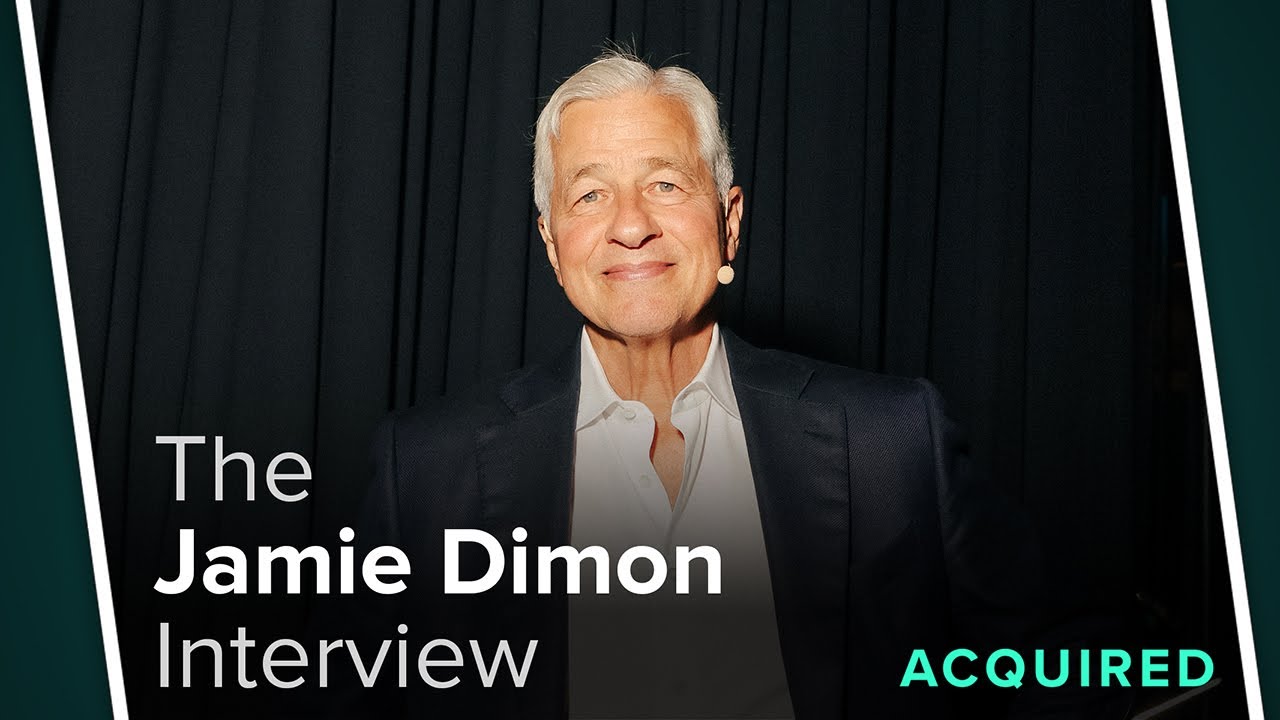
Jamie Dimon built JP Morgan Chase into the largest bank in the US (over $800 billion market cap, more than twice its nearest competitor) and the most valuable company east of the Mississippi, through a career defined by disciplined risk management, strategic acquisitions, and a relentless focus on long-term value over short-term profits.
He rose in the 1980s and 1990s as the protégé of Sandy Weill, helping build Citigroup through a series of mergers and acquisitions into a financial conglomerate.
In 1998, he was unexpectedly fired from Citigroup despite being the heir apparent, a moment he handled with remarkable composure.
After 18 months exploring options—including a serious conversation with Jeff Bezos about running Amazon—he took over as CEO of Bank One, a troubled Midwestern bank with a $30 billion market cap (compared to Citigroup’s $200 billion).
He invested half his net worth in Bank One stock on day one, signaling total commitment.
He found a dysfunctional organization: multiple incompatible systems from prior mergers, tribal board dynamics (21 directors, 11 of whom hated the other 10), and aggressive accounting that masked massive credit risk.
He overhauled the risk culture, marking down loans, building reserves, and reducing the balance sheet by $50 billion through loan sales and hedges before the next recession hit.
In 2004, Bank One merged with JP Morgan Chase in a “merger of equals” where Bank One shareholders received 42% of the combined company.
The deal was structured so Dimon would become CEO 18 months later unless 75% of the board voted to remove him—effectively guaranteeing his control.
He valued business logic over brand: the strategic fit between Bank One’s corporate banking and JP Morgan’s investment bank, consumer, and wealth management businesses drove the deal, not the prestige of the JP Morgan name.
As CEO from 2006 onward, Dimon’s philosophy of the “fortress balance sheet” set JP Morgan apart from competitors.
He maintained lower leverage (roughly one-third that of major investment banks), higher liquidity, and more conservative accounting.
He eliminated side deals and misaligned incentive structures that rewarded bankers for taking excessive risk.
He stress-tested against worst-ever historical scenarios, not just regulatory minimums—for example, modeling high yield credit spreads at 17% (the historical worst) rather than the 40% the firm had previously used.
This meant JP Morgan was slightly less profitable in boom years but survived crises that destroyed competitors.
During the 2008 financial crisis, Dimon made two pivotal acquisitions that cemented JP Morgan’s dominance.
Bear Stearns (March 2008): He bought the failing investment bank over a single weekend at $2 per share (later raised to $10) in a deal backed by Federal Reserve financing. The acquisition cost JP Morgan roughly $15–20 billion in total losses from write-downs, lawsuits, and government penalties on Bear’s bad mortgages. Dimon has said he wouldn’t do it again because the government later sued JP Morgan for conduct that predated the acquisition—but he acknowledges the reputational value was enormous.
Washington Mutual (September 2008): A week after Lehman Brothers collapsed, JP Morgan bought WaMu for approximately $1.9 billion, acquiring 2,300 branches in healthy states (California, Florida, Georgia, Nevada) and writing off the mortgage book. Unlike Bear, this was a clean acquisition. Dimon raised $11 billion in new equity the next day—capital he didn’t strictly need—to ensure the balance sheet remained strong, a move only possible because of the trust JP Morgan had built with shareholders.
In 2023, when Silicon Valley Bank and First Republic failed, JP Morgan acquired First Republic.
Both banks had taken excessive interest rate risk hidden by “held to maturity” accounting, and both experienced rapid deposit runs triggered by venture capital firms advising their portfolio companies to withdraw funds.
JP Morgan hedged all exposures within days, wrote down the bad assets, and integrated the systems within 9 months.
The acquisition brought valuable high-net worth client relationships and a concierge service model that JP Morgan is now scaling through its new “JP Morgan Financial Centers” on Madison Avenue—its first major branded consumer banking initiative.
Dimon attributes JP Morgan’s sustained outperformance to several factors.
Strategic coherence: Every business feeds the others (consumer, commercial, investment banking, wealth management, payments), unlike Citigroup under Weill which accumulated unrelated businesses like truck leasing and property casualty insurance.
Continuous investment: Always investing in people, branches, and technology, even at the expense of short-term margins.
Efficiency ratio: JP Morgan keeps roughly 15 cents more of every revenue dollar as profit than competitors, compounding over time into a massive reinvestment advantage.
Culture: Curious, smart people who “have heart and soul,” treat everyone well (from guards to receptionists), and play as a team rather than as jerks or chest-pounders.
Fortress balance sheet as strategy: Conservative accounting, stress testing against fat tails, avoiding leverage, and maintaining liquidity—not just as risk management but as a competitive weapon that allows JP Morgan to act when others are paralyzed.
Dimon remains the longest-serving CEO of any major Wall Street bank, driven by a sense of purpose rooted in his Greek immigrant family’s ethic: have a purpose, give it your all, treat everyone properly, and stand up to