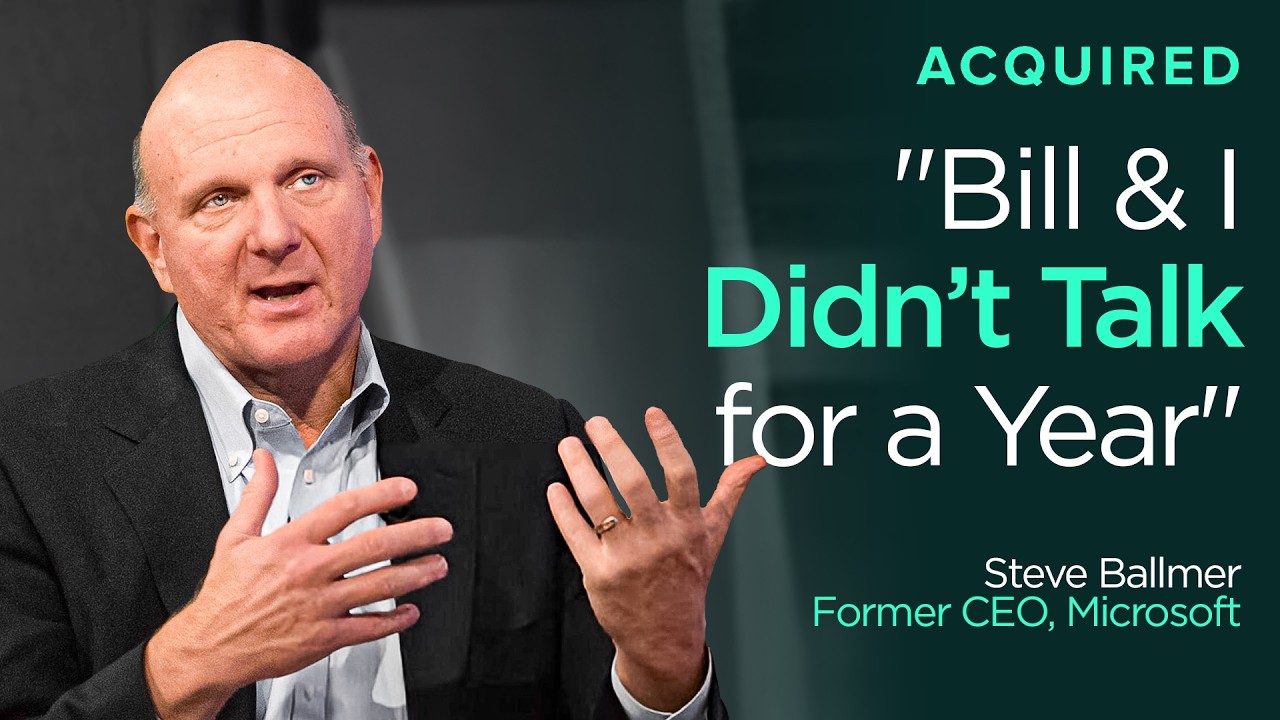
Steve Ballmer joined Microsoft in 1980 and over 34 years helped transform it from a consumer software company into an enterprise juggernaut—and then, after stepping down as CEO in 2014, made arguably the greatest investment decision of the last 20 years: holding nearly all his Microsoft stock, growing his net worth from $20 billion to $130 billion. This conversation, recorded at his philanthropy office in Bellevue, Washington, covers the inside story of Microsoft’s enterprise rise, the misses on mobile and search, the cultural and strategic lessons from his tenure, his complex relationship with Bill Gates, the founding of Azure, and his post-Microsoft life as owner of the LA Clippers and builder of the Intuit Dome.
Microsoft’s origin and the IBM PC deal
When Ballmer joined Microsoft in 1980, IBM was “the sun, the moon, and the stars” of computing—dominant in mainframes, software, and service, with an antitrust lawsuit that had been dragging on since 1969.
IBM approached Microsoft in 1980 wanting an operating system and language software for a new personal computer they wanted to build quickly using off-the-shelf components.
Microsoft didn’t have an operating system. They licensed a CP/M clone called QDOS from Seattle Computer Products for roughly $50,000, then licensed it to IBM non-exclusively for a flat fee—not per-unit royalties.
The non-exclusive, flat-fee structure is what allowed Microsoft to retain the right to sell MS-DOS to other PC manufacturers, which became the foundation of the company’s rise.
IBM thought their proprietary BIOS would protect them from being disintermediated, but companies like Compaq reverse-engineered compatible BIOSes, and the clone market exploded.
Ballmer and Bill Gates initially laughed at Intel’s Andy Grove when he predicted 100 million PCs per year—they classically under-forecast the market.
The OS/2 divorce and the birth of Windows
In the mid-1980s, IBM and Microsoft entered a convoluted joint development agreement to build OS/2 together, with IBM adding proprietary database and communications layers.
Microsoft was simultaneously developing Windows as its own project, essentially running a “Plan B” alongside the IBM partnership.
Ballmer’s job was “riding the bear”—staying close enough to IBM that they wouldn’t crush Microsoft, while quietly advancing Windows.
In May 1990, IBM abruptly ended the partnership and took OS/2 in-house. Ballmer learned about it from the Wall Street Journal while out running with his wife.
At that point, Windows was still a fledgling product constrained by the 640K memory barrier. Windows 3.1 (1991–92) was the first version that broke through.
The divorce forced Microsoft to confront IBM directly and build its own enterprise-grade infrastructure.
Building the enterprise business
Ballmer personally took on building Microsoft’s enterprise sales capability—this was not Bill Gates’s passion area. Gates was focused on apps and what Windows could deliver to applications.
Microsoft had no enterprise licensing model, no CIO relationships, and no back-end infrastructure. The first “enterprise” customer was the US Air Force, buying single copies of Windows at retail.
Dave Cutler, recruited from Digital Equipment Corporation, was the architect of Windows NT—the robust, secure, enterprise-grade operating system that became the foundation for Microsoft’s server business.
Ballmer’s key innovation was the enterprise agreement: instead of selling per-copy licenses or upgrade licenses (which meant revenue would decline over time), Microsoft offered a three-year per-machine subscription that included all upgrades.
This solved two problems: administrative complexity for customers and Microsoft’s revenue-decline problem.
It also introduced an “all you can eat” license where companies could use any Microsoft software, creating an insurance-like peace of mind for IT departments.
The “holy trinity” of Windows, Windows Server, Active Directory, Exchange, Office, and SQL Server came together in the late 1990s/early 2000s, with email as the “locomotive” that pulled the whole enterprise suite.
Microsoft and Accenture formed a joint venture called Avanade to help deploy this infrastructure, because Microsoft didn’t have enough implementation capacity.
”Developers, developers, developers”—what the clip doesn’t show
The famous 1999 speech came at a moment of deep competitive anxiety: IBM was still selling OS/2, Linux was emerging as a server threat, open-source office alternatives existed, Lotus Notes was competing, and the DOJ antitrust case was reaching its climax.
Ballmer’s core message: third-party developers were essential to reinforcing the Windows platform. He needed external developers to build on Windows Server, ActiveX controls, and the web platform.
Ballmer’s definition of a platform: anything that is extensible. By this definition, applications like Office are platforms too—partners plug in, write add-ons, use file formats.
He believes Microsoft got stuck in a “platform company” mindset and forgot that platforms need great first-party apps. Office was the best first-party app on Windows, and that’s how the platform got good.
He was frustrated in the late 2000s that people inside Microsoft would say “we can’t do that, we’re a platform company”—he wanted them to think “app and platform.”
The Windows Everywhere overconfidence and the mobile miss
In the 2000s, Microsoft became too confident in extending Windows to every form factor—phones, cars, TV (Media Center)—rather than recognizing when a new paradigm required a fundamentally different approach.
Windows Mobile failed because Microsoft tried to keep the Windows UI and API on a device where it didn’t fit, started on the wrong processors (Intel), and couldn’t match the iPhone or Android user experience.
Ballmer identifies two models that actually worked in mobile: Apple’s integrated hardware/software approach and Google’s Android model (free OS monetized through search advertising). Microsoft was in neither.
There was a window around Christmas 2008–09 when Verizon, frustrated with AT&T’s iPhone exclusivity, was looking for an alternative. Microsoft didn’t have the right product at the right time, and Verizon went Android.
Ballmer had explored buying HTC years before the Nokia deal, but concluded a Taiwanese acquisition would be too difficult to integrate.
He believes Microsoft needed to treat mobile as a separate “trick” (business) rather than as an extension of the Windows trick. The company lacked the right capabilities and business model.
The search miss
Google started in 1998; Microsoft didn’t seriously enter search until 2003—a five-year gap. Ballmer acknowledges they had no birthright in search and no one with relevant experience.
Microsoft spread itself too thin across a portal strategy, vertical sites (Expedia, Sidewalk, CarPoint), and search simultaneously, rather than focusing resources.
Even after launching Bing, the strategy was too tied to Windows integration (Windows Live Search, etc.) rather than being treated as a standalone product.
By around 2005, Google was generating more revenue per PC user than Microsoft was, thanks to search advertising—a staggering difference in monetization models.
Azure’s founding
Azure’s origins trace back to the “Energizer” project in the mid-1990s, where Microsoft ran IT infrastructure for a customer—a precursor to cloud computing.
Around 2005–06, as AWS was launching, Ballmer personally recruited Dave Cutler and Amitab Sevastava (from Microsoft Research) to build a cloud platform.
Azure was started as a separate incubation under Ray Ozzie, not within the existing Server and Tools business, to protect it from being constrained by the existing Windows-first mindset.
Ballmer explicitly chose to build platform-as-a-service (not just infrastructure-as-a-service) because it leveraged Microsoft’s developer platform strengths.
This was a deliberate bet that Windows Server developers would remain a strong, relevant community—which was partially true but underestimated the shift to web and Linux on the backend.
Azure had eight years of development before Ballmer left in 2014. The major growth came under Satya Nadella, but the foundational work happened during Ballmer’s tenure.
Ballmer’s “trick” accounting and why multi-trick ponies are rare
Ballmer’s framework: most companies are “one-trick ponies” (Google: search ads; TSMC: foundries; Nvidia: GPUs + gaming). These can be $50–100B+ market cap companies.
“Two-trick ponies” are rare and historically significant in business history.
Microsoft is a two-trick company: the desktop business (Windows + Office) and the server/enterprise business. Gaming is a “half trick.”
Amazon: AWS and the store. Apple: Mac and mobile (services are a monetization layer on the mobile trick, not a separate locomotive).
Ballmer desperately wanted a third trick. The two closest opportunities were mobile and search—both of which Microsoft missed.
He considers these the two biggest misses: mobile was a client-side device Microsoft should have understood, and search was a productivity tool adjacent to Office.
He acknowledges that Microsoft’s voraciousness—wanting to do everything—led to doing too many things without sufficient focus.
Non-product wins and mistakes as CEO
Biggest win: Establishing Microsoft with IT departments and building the enterprise sales, marketing, and licensing framework. “Nobody developed that software model but us.”
Stock option accounting change: Early in his tenure, Microsoft had to start expensing stock options, which dramatically reduced reported profits. Ballmer led the industry transition from stock options to restricted stock units (RSUs) to maintain employee motivation.
Antitrust as cultural issue: The DOJ case wasn’t just a legal problem—it was a cultural crisis. At an executive retreat, a senior sales leader said “my personal integrity feels like it’s under assault.” Ballmer had to completely restructure the retreat to address it.
The court initially ordered Microsoft to split into two companies (one for operating systems, one for applications), though this was never implemented.
Why the stock was flat for a decade despite tripling revenue:
Ballmer and Gates deliberately warned investors not to overprice the stock, lowering expectations.
Neither attended quarterly analyst calls (Buffett-style), which Ballmer now sees as a mistake—it showed disrespect to investors.
Ballmer was viewed as a “spender” who prioritized investment over short-term returns, and he had no credibility with investors on capital discipline.
Wall Street worried about the future of the Windows franchise.
Ballmer believes he needed a new CEO to reset the narrative—you can’t rebrand yourself after 34 years at the company.
The Bill Gates relationship
Ballmer and Gates didn’t speak for roughly a year (2000–2001) after Ballmer became CEO. Neither knew how to navigate the new power dynamic—Gates didn’t know how to work for Ballmer, and Ballmer didn’t know how to be Gates’s boss.
Their wives pushed them back together over an awkward dinner, but they “never really got the right mojo” again.
They disagreed on hardware (Surface, phone), on Longhorn/Vista (which Ballmer calls “the emperor that had no clothes”), and on the Nokia acquisition.
Ballmer believes some of his best work came in his last six years, after Gates had transitioned out: Azure, Surface, Bing improvements, and hiring Satya Nadella.
The Satya Nadella hire
When Harry Shum (working on search under Nadella) told Ballmer that a Yahoo executive named Qi Lei was brilliant, Ballmer, Nadella, and Shum flew to California to meet him.
After the meeting, someone (probably Nadella) suggested: “We should hire Qi Lei—and I should work for him.” They flipped the entire reporting structure on the spot.
Ballmer saw this as the defining moment that proved Nadella would do the right thing for the company without ego getting in the way.
He later moved Nadella from search to Server and Tools to broaden his experience, putting him on the path to CEO.
Why Ballmer left
Mobile was eating at him. He believed Microsoft needed to make hardware to have a consumer future, and he pushed to buy Nokia.
The board said no, and Ballmer found the process disrespectful. He decided it was the right time to step aside.
He also recognized that cloud required new capabilities and a new generation of leadership to build the machinery (accounting systems, sales models, gross margin focus) for a lower-margin, higher-volume business.
The board later reversed course and approved the Nokia acquisition after Ballmer had already decided to leave. Ballmer isn’t sure why—he had explained that the Nokia partnership was already deep, and buying the company was the only way to get the marketing investment needed, since Nokia lacked the financial capacity.
The Microsoft hold
Ballmer is still the largest individual shareholder in Microsoft. His net worth grew from $20B to $130B entirely from holding Microsoft stock.
He seriously considered selling everything around 2015–16 for emotional detachment, but a former Microsoft finance employee on his team told him “you can’t sell—this is going to be worth a lot more.”
His reasoning for holding:
Loyalty to the company he built.
The dividend checks alone nearly fund his philanthropy (roughly $1B/year in giving).
Selling would mean paying capital gains taxes and having less to give to philanthropy unless Microsoft underperforms the index by the capital gains rate.
He’s emotionally detached enough that he’s fine either way—even if Microsoft went to zero, his family would be fine.
Charlie Munger once publicly asked him: “Why did you hold when your partners didn’t? I know you’re not that smart.” Ballmer replied: “No, Charlie, but I’m loyal.”
The LA Clippers and Intuit Dome
Ballmer bought the Clippers in 2014 for $2B, fully paid off (after initially borrowing, now repaid). The Intuit Dome, which he personally owns, has debt on it for estate planning reasons—it makes the building easier to sell because the buyer needs less cash.
Business model parallels to Microsoft: version upgrades (draft/free agency = major release, trade deadline = service pack), OEM business (broadcast revenue), software licenses (tickets), sponsorship (advertising). Even agile development maps to coaches adjusting game plans.
Key differences from business:
Extreme accountability: every 24 seconds you get a report card (shot clock), every 48 minutes the game is decided. You can’t say “I’ll make it up next quarter.”
Customers (fans) know everything the team knows—every statistic is public.
Teamwork is non-negotiable and real-time. Ballmer eliminated “teamwork” as a Microsoft value and replaced it with “open, respectful, and dedicated to making each other better.”
Reference checking is far more rigorous in basketball—scouts talk to coaches, teammates, parents, and watch practices. In business, most reference checks are superficial.
Career paths are constrained by the union and the fact that there are only 30 head coaching jobs—people have to leave to advance.
Intuit Dome thesis: the best place for the hardcore basketball fan. No hockey (which would compromise the court-side experience). The “Wall”—4,000 standing-room-only seats where you must stand and cheer, no visiting gear allowed, positioned behind the backboard to disrupt opposing free-throw shooters.
Visiting teams’ free throw percentage is lowest in the league against the Wall.
An acre of 4K scoreboard (Halo board), the largest indoor screen in the world.
Three times the average number of toilets, frictionless concessions (face recognition or phone tap, no checkout), and only five food items (which account for 85% of sales)—all designed to keep fans in their seats watching basketball.
Fewer suites and lower-priced season tickets ($1,000 for close-to-the-court seats) by design—Ballmer took a revenue hit to optimize for the basketball experience.
No public funding (California law prohibits it for arenas).
Ballmer designed the arena for himself as a fan, and it turns out Clippers fans are like him—die-hard, long-suffering, and passionate. The team hasn’t had a losing season in 14 years.
He sees the Clippers’ long-term goal in LA as a patient, hardcore grind to earn their fair share against the Lakers—not to be the “little brother.”