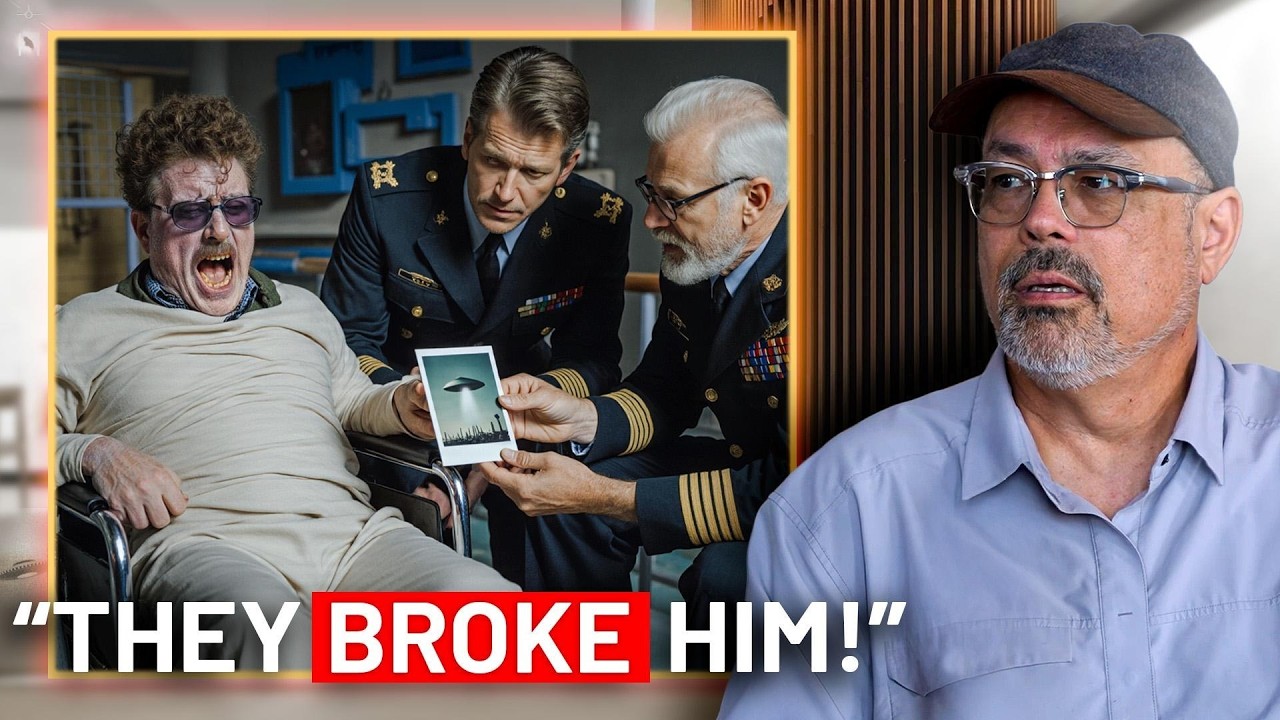
Greg Bishop, author of Project Beta and It Defies Language, discusses the Paul Bennewitz case—a landmark episode in UFO history where a civilian electronics expert was systematically manipulated by U.S. Air Force counterintelligence into believing he was intercepting alien communications, ultimately driving him to a mental breakdown. The case illustrates how UFOs function as a tool for intelligence operations, used to identify security leaks, discredit researchers, and inject disinformation into the UFO community.
The Paul Bennewitz Case
Paul Bennewitz was an electronics engineer living near Kirtland Air Force Base in Albuquerque, New Mexico, running a company called Thunder Scientific that built temperature and humidity instruments for military and scientific use.
In the late 1970s, he began observing unusual glowing orbs lifting off near the base, flying over mountains, and descending—sometimes seeing figures walking around them before takeoff.
He reported these sightings to the Air Force, which instead of dismissing him, engaged him—inviting him to share his footage and encouraging further monitoring.
This was not benign curiosity: the Air Force Office of Special Investigations (AFOSI), particularly agent Rick Doty, saw Bennewitz as both a potential security risk and an opportunity.
Bennewitz built custom equipment to intercept radio signals from the base, believing he was detecting alien transmissions—telemetry, he thought, or communications between extraterrestrials and the military.
His paranoia grew: he became convinced of an underground alien base at Archuleta Mesa on the Jicarilla Apache Reservation, that aliens needed Earth women to propagate their race, and that an invasion was imminent.
The Air Force actively encouraged this belief—flying him in a helicopter to Archuleta Mesa, placing props like jeeps and water tanks there to reinforce his focus away from Kirtland.
At one point, J. Allen Hynek—the famed UFO consultant to Project Blue Book—delivered a computer to Bennewitz, preloaded with fabricated signals that appeared to confirm alien contact. Hynek may not have known the full purpose, but he was still on the Air Force payroll.
Bennewitz’s mental health deteriorated: he stopped working, chain-smoked, lost sleep, and carried firearms. His family eventually had him committed to a mental health facility for about a month.
After release, he calmed somewhat but remained haunted. He later accused researcher John Lear of exploiting him and cut off contact.
The Role of Bill Moore
Bill Moore, a prominent UFO researcher and co-author of The Roswell Incident, was recruited by AFOSI through a retired CIA agent named Harry Rositzki (“Falcon”), a Soviet operations specialist.
Moore was tested first: he correctly identified two fake UFO documents (a letter from a “military witness” and the “Silver Sky memo”) as hoaxes, proving his investigative rigor.
In exchange for cooperation, Moore received classified-looking documents—including early versions of the MJ-12 papers—and was tasked with monitoring Bennewitz and passing along disinformation.
Moore gave Bennewitz the “Aquarius Document,” which referenced MJ-12 and analyzed some of Bennewitz’s own films as “unidentified”—lending false credibility to his claims.
Moore later admitted that nearly all the documents he was given were fabricated or misleading. He felt used and cheated, especially after realizing the operation was less about UFOs and more about counterintelligence.
Moore described the Bennewitz operation as “five minutes in one scene” of a 24-hour stage play—a tiny part of a much larger Cold War counterintelligence effort targeting Soviet and Chinese assets.
UFOs as an Intelligence Tool
UFOs are described as a “Swiss Army knife” for intelligence: emotionally compelling, unprovable, and ideal for testing loyalty, identifying leaks, and manipulating belief.
Because people are emotionally invested in UFOs, they can be led down false trails—making it easy to spot who talks, who believes, and who might be a foreign agent.
The Bennewitz case was not about hiding alien technology—it was about using the idea of aliens to control a civilian who was inadvertently monitoring sensitive military activity.
Prosaic military tech (e.g., drones, stealth prototypes) is sometimes used as a cover for UFO claims, but more often, UFO narratives are used to obscure real advanced projects.
Rick Doty, the AFOSI agent at the center of the operation, later appeared on shows like Ancient Aliens, promoting sensational claims—including that Lou Elizondo was part of Space Force disinformation—raising questions about whether he remains an active disinformation agent.
Broader Implications and Modern Parallels
The 2017 New York Times article revealing the Pentagon’s AATIP program (with Elizondo, Mellon, and others) may represent a new phase of the same strategy—using UFOs to redirect attention, crowdsource expertise, or test public reaction.
Unlike the Bennewitz era, today’s information environment allows rapid dissemination, but the core tactic remains: release ambiguous evidence, watch who engages, and use the resulting discourse for intelligence purposes.
Some researchers, like Chris Bledsoe (who claims ongoing contact with non-human entities), may be subject to similar dynamics—monitored not because they’re crazy, but because they’re seen as potentially useful or revealing.
Greg Bishop emphasizes that while some UFO phenomena are genuinely anomalous, the field is rife with disinformation, and researchers must remain skeptical without dismissing everything.
He defends figures like Bill Moore and J. Allen Hynek as complex actors—not villains, but participants in a system where truth is compartmentalized and motives are mixed.
On Disclosure and Belief
Bishop is skeptical of official “disclosure,” comparing it to asking a habitual liar to tell the truth just once.
He notes that even insiders often hold more conspiratorial views than outsiders—not because they’re deceptive, but because they’ve seen how decisions are made long before they become public.
The UFO phenomenon exists in a liminal space—neither fully real nor fully fake—and resists definitive proof, making it perpetually useful for those in power.
Bishop ends with a tribute to Whitley Strieber, whom he sees not as a literal truth-teller but as an artist conveying the emotional and psychological reality of the experiencer—a perspective that transcends the debunking debate.