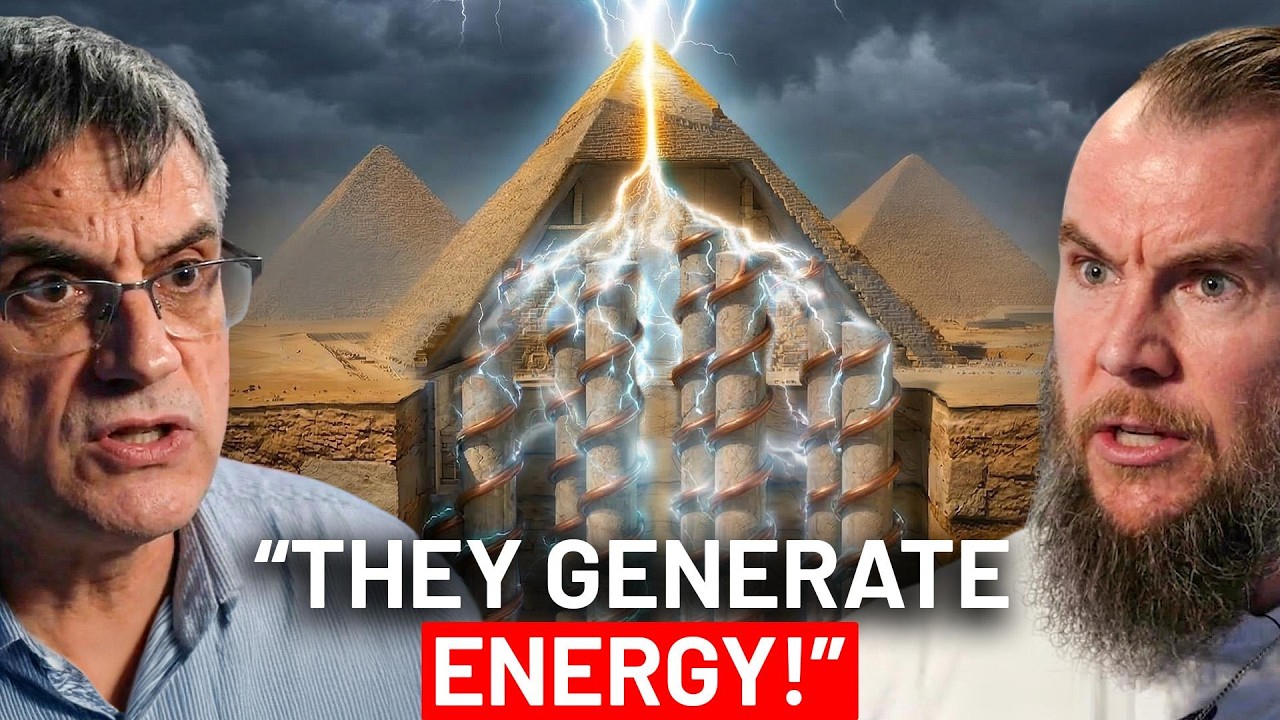
- A historic roundtable discussion brings together Italian radar scientist Filippo Biondi and independent researcher Jeffrey Drum to examine Biondi’s controversial claim that eight enormous cylindrical structures lie beneath the Giza Plateau, detected using a novel technique called synthetic aperture radar (SAR) Doppler tomography. The conversation rigorously stress-tests the data, explores competing scanning technologies, and investigates a radical hypothesis that the Egyptian pyramids were industrial-scale chemical manufacturing facilities built atop a landscape rich in hydrothermal mineral deposits, metal ores, and subterranean water systems.
The Biondi Protocol and How It Works
-
Filippo Biondi developed a new software method, called the Biondi protocol, that works in conjunction with existing synthetic aperture radar (SAR) satellites to detect micro-vibrations on the surface of structures, which he terms “phonons.”
- These micro-vibrations are caused by background seismic waves and propagate through matter, carrying information about what lies beneath the surface.
- The method uses radio frequency signals (around 10 GHz) as a carrier to transmit vibrational information from the subsurface through the structure to the satellite.
- The core innovation is that it does not rely on electromagnetic waves penetrating deep into the earth; instead, it reads surface vibrations that encode subsurface structural information.
- The software performs two steps: synthesis (retrieving vibrations from pixels along a chosen tomographic line) and analysis (inverting the data using fast Fourier transform to produce focused images).
-
A single scan takes 15 seconds of satellite integration time, producing one SAR image that is a sufficient statistic for tomographic analysis.
- The standard scan footprint is 5 km × 5 km with sub-metric resolution (approximately 1 m × 1 m).
- The satellite orbits the earth, and the same target can be revisited after 16 days (for the Cosmo-SkyMed system) to collect additional data from different angles.
- Multiple scans at different incidence angles can be combined to improve depth penetration and triangulate findings.
-
The technique was validated against known modern structures: the Gran Sasso physics laboratory in Italy (buried 1.4 km inside a mountain), the Gotthard Tunnel in Switzerland, the Carlin Tunnel, and the Mosul Dam.
- These proof-of-concept scans successfully detected internal chambers, tunnels, and even mechanical components like turbines.
- However, a critical caveat exists: modern facilities have active mechanical vibrations (ventilators, electricity, moving parts) that produce stronger, more readily readable signatures than ancient megalithic structures with no moving components.
Scanning the Great Pyramid: Hits and Misses
-
The first paper, published in 2020, scanned the Great Pyramid (Khufu) and claimed the pyramid “becomes transparent like a crystal” when observed in the micro-movement domain.
- The Queen’s Chamber consistently produces a strong vibrational signature and serves as a benchmark for scan accuracy.
- The King’s Chamber, constructed of granite (as opposed to the surrounding limestone), also produces a detectable signature in some tomographic slices, including what may be the granite relieving beams above it and the coffer (sarcophagus) inside.
- The Grand Gallery is not always visible in every tomographic slice because it is a large air-filled space that appears as a blue (low-vibration) signature, and detection depends on the precise alignment of the tomographic line.
- The subterranean chamber, carved into the bedrock below the pyramid, is not reliably detected, likely because the bedrock’s heterogeneous density creates background noise and aberrations that absorb or scatter the vibrational signal.
-
A newly discovered dead-end shaft on the northern face of the Great Pyramid (Tag 17) was detected by Biondi’s team in 2020 and later confirmed by physical exploration with a microscopic camera.
- The team also detected a corridor leading from beneath the chevrons toward the Grand Gallery (Tag 18), though multiple radar reflections create some ambiguity in the data.
-
A shaft and chamber system below the Queen’s Chamber was detected, corroborating anecdotal reports from original excavations in the late 1800s and early 1900s that were subsequently covered up and sealed with modern blocks.
- This finding is particularly significant because it validates the technology’s ability to detect structures that are no longer accessible or visible.
The Big Void: SAR vs. Muon Scanning
-
The Scan Pyramids project, using muon detection (cosmic ray absorption), identified a large void above the Grand Gallery, which they describe as a longitudinal structure running parallel to the Grand Gallery at the same incline.
- Muon detectors placed inside the Queen’s Chamber and on the northern face measure the absorption and diffraction of cosmic ray muons passing through the pyramid.
- The muon data is presented as a composite sum of all horizontal layers, making it difficult to discriminate vertical positions of features.
- Biondi argues the muon team may be misinterpreting their data, confusing the roof and floor of the Grand Gallery with a separate void.
-
Biondi’s SAR data shows the large void oriented east-to-west (transverse), connected to a square structure surrounding the King’s Chamber, which he interprets as a potential heat exchanger system.
- The SAR position differs from the muon position, and Biondi suggests the muon team’s photogrammetry may be conflating two parallel surfaces (the Grand Gallery’s roof and floor) into a single “void” signature.
- The Egyptian Ministry of Antiquities has approved an excavation into the void, potentially in 2026, which could resolve the discrepancy between the two scanning methods.
The Subterranean Structures: Eight Cylindrical Pillars
-
Biondi’s most controversial claim is the detection of eight enormous cylindrical tubular structures (four plus four) descending beneath the Giza Plateau, possibly extending hundreds of meters or more than a kilometer deep, connected to large cubic formations at their base.
- Each cylinder is approximately 20 m in diameter with about 5 m spacing between them.
- The structures appear beneath multiple pyramids and even beneath the Sphinx.
- Biondi is highly confident in these detections because of their enormous size, which produces strong vibrational signatures that are easier to distinguish from background noise than smaller features.
-
A significant anomaly exists in the data: the vibrational signature of these vertical structures tapers off or cuts off at approximately 550–600 m depth, rather than continuing to the full kilometer that was initially estimated.
- Biondi initially attributed this cutoff to the water table, but the actual water table at Giza is only about 50 m below the plateau surface (15 m above sea level), not 600 m down.
- The true cause of the signal attenuation at depth remains unexplained. Biondi stated he has a hypothesis but could not disclose it during the conversation.
- The tapering signature is consistent across all the vertical structures, suggesting a systematic cause rather than random noise.
-
The known chambers inside the Khafre (central) pyramid, including the Belzoni chamber, are not detected by the SAR scans.
- Biondi’s team published an explanation stating that the structures are embedded in limestone bedrock that absorbs the signal, and the vibrational energy is too attenuated to retrieve small, suspended chambers.
- This raises a logical objection: if the signal cannot penetrate 15 m of limestone to detect known chambers, how can it detect structures hundreds of meters deeper through the same material?
- Biondi responds that the enormous size of the deep structures (20 m diameter) makes them detectable even with attenuated energy, whereas small chambers like Belzoni’s are below the detection threshold.
- He also notes that structures “anchored” to the surface (like the vertical shafts along the causeway) produce stronger evanescent waves at the earth’s boundary, making them easier to detect than isolated chambers suspended within bedrock.
Proof of Concept and Processing Discrepancies
-
During the 2025 Malta conference, Biondi presented dramatically improved scans of the Gran Sasso laboratory using a newer, more computationally intensive processing technique.
- These images are far clearer, showing the laboratory’s internal structure with minimal noise, described as “transparent like a crystal.”
- The technique involves averaging pixel-by-pixel across multiple adjacent tomographic lines to mitigate vertical striped noise, requiring approximately two months of processing time on borrowed high-performance computers.
- This superior processing has not yet been applied to the pyramid scans because Biondi lacks the necessary computing hardware (an array of GPUs that would cost millions of dollars).
- Jeffrey Drum and host Jesse strongly urged that this improved methodology be applied to the pyramid data before publication, as the noisier original scans give unnecessary ammunition to skeptics.
-
Biondi’s team is establishing a foundation in Malta with a solar-powered facility where they plan to install a data center with GPU arrays, pending donor funding.
- The goal is to achieve real-time tomographic scanning capability, allowing operators to move through adjacent tomographic lines dynamically, similar to a medical CT scan.
Jeffrey Drum’s Hypothesis: Industrial Chemical Manufacturing
-
Drum proposes that the Egyptian pyramids were not tombs but industrial-scale chemical manufacturing facilities, where each pyramid produces a specific chemical in a sequential chain of reactions.
- The Great Pyramid’s function begins with hydrogen sulfide gas rising from a natural karst cave and tunnel system beneath the Giza Plateau as the initial reactant.
- Different chambers inside the pyramid serve as reaction vessels where chemicals interact (e.g., zinc and acid producing hydrogen) in controlled processes.
- The subterranean water system, including independent aquifers not connected to the Nile, provides both reactants and cooling.
-
Drum interprets the newly detected structures through this functional framework:
- The shaft system below the Queen’s Chamber is an extraction shaft for removing product solutions.
- The large void above the Grand Gallery is a heat exchanger for removing thermal energy from exothermic reactions occurring in the Grand Gallery.
- The square structure around the King’s Chamber is part of a thermal management or reaction containment system.
- The vertical bedrock shafts along the causeway are infrastructure for the underground industrial complex.
-
Drum argues the Giza Plateau was specifically chosen because of its unique geological resources:
- Hydrothermal mineral deposits permeate the limestone bedrock, containing iron ore, gold, silver, electrum, rare earth elements, platinum, and titanium.
- Fulgurites (fossilized lightning) found in the iron ore veins are evidence of high-voltage electrical current distribution through these mineral deposits, suggesting the site was selected for its electrical properties as well as its chemical ones.
- The Tethys Sea once covered the area, and ancient hydrothermal vent systems created the vertical mineral-rich structures that Biondi’s scans may be detecting.
Water Systems Beneath Giza
-
The Osiris Shaft, a three-level underground structure on the eastern causeway of the Khafre pyramid, taps into an independent aquifer that is not connected to the Nile River.
- The water level in the Osiris Shaft has remained constant since the construction of the High Aswan Dam, confirming the aquifer’s independence.
- The third level of the Osiris Shaft is designed to sit precisely at the water table surface, with a limestone island and container surrounded by water.
- Zahi Hawass’s team pumped the water out during excavation but found nothing inside the container; the water returned to its original level afterward.
-
The Egyptian government has installed pumping stations near the Khafre Valley Temple and Sphinx enclosure to remove subterranean water for archaeological preservation purposes.
- There are pockets of independent aquifers all over the Giza Plateau, as well as subterranean flowing water.
- Drum had water samples from the Osiris Shaft tested in conjunction with the Osirion 7 archaeological mission to determine the source and composition of the water.
Construction and Dating
-
Drum argues the pyramids were built by a civilization living in Egypt during the Saharan Humid Period (8,500 BC to 5,300 BC), predating the conventional dating of 2500 BC by thousands of years.
- This period featured sweeping monsoon rains, abundant water, and frequent thunderstorms, which connects to his hypothesis about atmospheric electricity and lightning being part of the pyramids’ power source.
- Water erosion on the Sphinx enclosure (documented by Robert Schoch) supports a much older date for at least some structures at Giza.
-
Drum believes the pyramids were infrastructure projects built by human beings at the end of the last ice age to rebuild humanity after a catastrophic event, not by extraterrestrials.
- However, he acknowledges that if the 20 m diameter, kilometer-deep cylindrical structures are confirmed as artificial, the engineering challenge would exceed even the pyramids themselves, pushing the limits of any known ancient human capability.
-
The Sphinx itself is a dynastic-era monument built on an existing bedrock outcrop and is not contemporary with the pyramids, according to Drum.
Open Questions and Path Forward
-
The conversation identified several critical action items:
- Apply the superior Gran Sasso processing technique to the pyramid substructure data, requiring millions of dollars in GPU computing resources.
- Conduct control sample scans of hills or areas with no known subsurface structures to establish baseline signatures.
- Perform additional SAR scans of the Khafre pyramid at multiple incidence angles to attempt detection of the known Belzoni chamber and resolve the signal attenuation issue.
- Pursue a formal collaboration between Biondi’s SAR team and the Scan Pyramids muon team to merge datasets and cross-validate findings.
- Submit a proposal to the Egyptian government to clean and explore the vertical bedrock shafts along the causeway using robots, which could provide direct physical access to the underground complex without drilling.
-
The 2026 excavation of the large void above the Grand Gallery could serve as a critical test: if the void matches Biondi’s SAR-predicted position and orientation rather than the muon-predicted one, it would significantly bolster confidence in the SAR method and, by extension, the deeper substructure claims.
-
Biondi holds an expired patent on the original technique and has filed a second patent in the United States for improvements, though he emphasizes that the software and processing know-how are more important than the patents themselves.
- He has conducted approximately 10 scanning projects (including commercial mining and metallurgical applications under NDA) and claims a high success rate in detecting subsurface features.