Flying Lotus (Steven Ellison) — legendary hip-hop producer, electronic musician, filmmaker, and founder of the Brainfeeder label — sits down for a wide-ranging conversation that weaves together UFOlogy, music production, altered consciousness, film, and the creative life. What emerges is a portrait of someone whose fascination with the unknown runs through everything he does, from his genre-defying beats to his surreal films to his deep dive into UFO culture.
UFO obsession and the state of the field
Flying Lotus has been deeply embedded in UFO Twitter for years, often one of the few visible cultural figures (alongside Father John Misty) openly engaging with UAP content.
He sees the UFO topic as fundamentally strange — stranger than fiction — and is drawn to it regardless of whether any specific claim is true.
He’s frustrated by the community’s echo-chamber dynamics and the inability of key figures to have honest, direct conversations with each other.
He wants to see people like Luis Elizondo and Christopher Mellon in a room together, or David Grush and Elon Musk, or skeptic Mick West alongside believers.
He notes that the anti-UFO side often seems more guarded and defensive, suggesting they may be protecting something.
He pushed back on the Skinny Bob video (a supposed alien autopsy footage), calling it obvious CGI, and was immediately attacked by the community as a possible government disinformation agent — an experience that illustrates how belief in this space functions almost religiously.
Key UFO stories and figures he’s drawn to
Bob Lazar — the “gateway drug” of UFO conspiracy; Flying Lotus would smoke DMT with him if given the chance.
Eric Hecker (Ratheon whistleblower) — claimed there was a neutrino emitter/detector at the South Pole and linked it to the Christchurch earthquake in New Zealand; Flying Lotus finds the story wild and compelling even if unverified.
Steven Greer — fascinating but hostile; Greer called Flying Lotus a “dilatant” multiple times during their encounter and was dismissive of his knowledge.
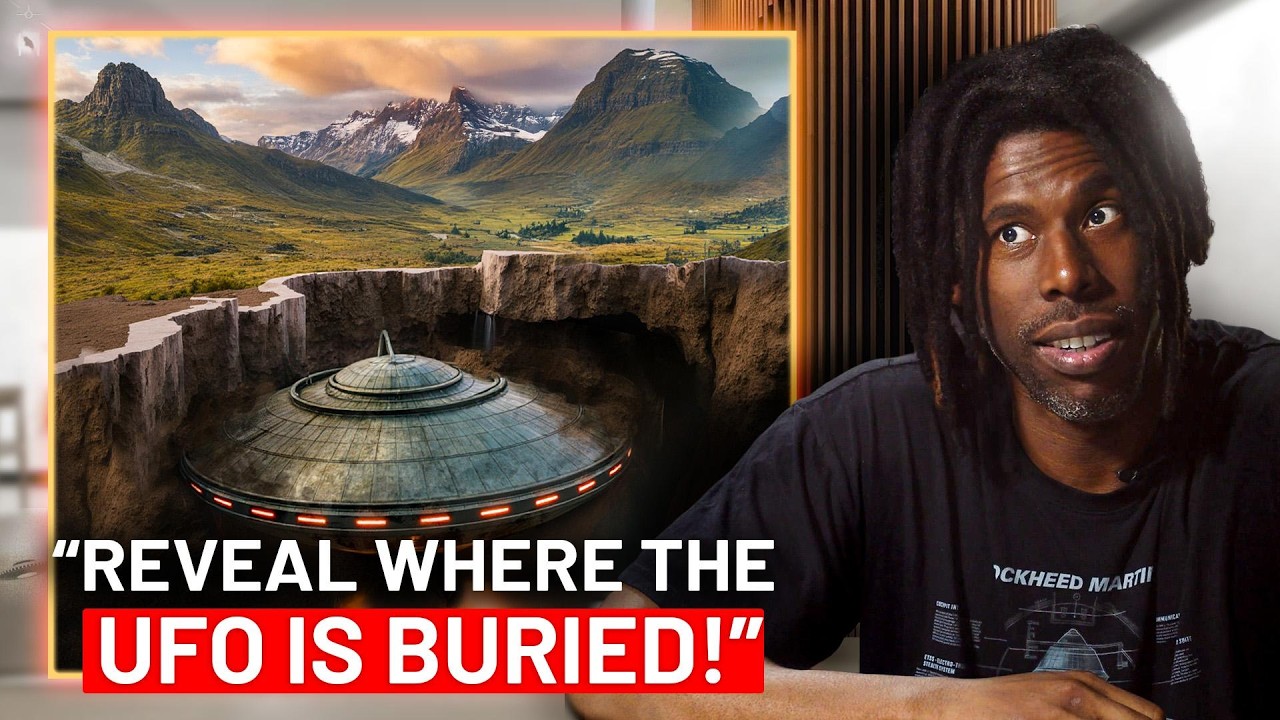
Ross Coulthart — journalist who reported on a buried UFO too large to move, allegedly in a sensitive location (possibly a current war zone). Coulthart implied revealing more would endanger military personnel on the ground who are unaware of what’s beneath them.
Flying Lotus is skeptical but intrigued, noting Coulthart’s sources have shifted stories over time (e.g., the Chinese drone narrative).
Jake Barber — the “Skywatcher” who claims to have mentally connected with a UFO using a spinning egg device. Flying Lotus finds the story compelling precisely because it involves a mental/psychic component, which most people dismiss.
He notes both Barber and Grush have a distinctive “googly-eyed” look in their Coulthart interviews, as if they’ve seen something disturbing.
Randy Anderson — a whistleblower who claims to have seen hieroglyphic-emitting technology at a deep underground base at Naval Surface Warfare Center Crane in Indiana in 2014. Anderson faced brutal credibility attacks after coming out, with people disputing his military background despite documentation.
Matthew Brown — a source who claims to have seen government documents linking Luis Elizondo to a program called Immaculate Constellation, and who recently tweeted about the White House possessing a proprietary AI that can predict future timelines.
Nazca beings and buried UFO claims
Flying Lotus attended the unveiling of the Nazca mummies (tridactyl beings from Peru) in Los Angeles, organized by Jaime Maussan.
He didn’t see the beings in person, only photos and X-rays, so he reserved judgment but found the event fascinating.
He acknowledges Maussan is considered a known fraud by many, but takes it all with a grain of salt.
Genetic analysis has reportedly found a mutation in the Nazca beings matching a human mutation involving digit differences, and one specimen appears to contain a tridactyl fetus.
Spielberg, time travel, and hidden UFO knowledge
Flying Lotus is a massive Steven Spielberg fan, particularly for the sense of wonder his films create in collaboration with composer John Williams.
He only saw E.T. for the first time as an adult and was emotionally destroyed by it.
He had never seen Close Encounters of the Third Kind until recently and was struck by how much insider UFO detail it contains.
He believes Spielberg has inside knowledge of UFO phenomena:
Close Encounters includes crates labeled TRW and Skunk Works — obscure defense R&D references that weren’t widely known at the time.
The film depicts electromagnetic radiation burns on witnesses, matching real cases studied by CIA-affiliated researchers like Kit Green and Gary Nolan.
The psychic connection between E.T. and the child mirrors Jake Barber’s claimed mental link with craft.
Back to the Future (which Spielberg executive produced) contains what Flying Lotus sees as hidden references to Thomas Townsend Brown, the anti-gravity inventor:
The character is Emmett Brown (E.M. Brown); Brown’s experiments were in Pasadena; the film is set in 1985 (the year Brown died) and goes back to 1957 (when Brown proved his experiment); the DeLorean is powered by Mr. Fusion, mirroring Brown’s desire to power his experiments with nuclear reactions.
Spielberg himself has hinted at the time-travel hypothesis: in an interview with Joe Rogan, he asked whether it’s more likely that beings come from a distant galaxy or that they’re “us” from hundreds of thousands of years in the future, trying to adjust timelines.
At a White House screening of E.T., Reagan reportedly told Spielberg: “There are a number of people in this room who know that everything on that screen is absolutely true” — and he said it without smiling.
DMT, consciousness, and the UFO connection
Joe Rogan introduced Flying Lotus to DMT back in the MySpace era; he eventually tried it in Australia after a stranger at a New Year’s party in Perth offered him a bag.
He’s only done DMT two or three times. It didn’t change his worldview permanently but served as validation that there is more to reality than what we normally perceive.
He did DMT shortly after his mother passed away and felt it helped him “connect to the other side” while still being present.
He no longer recommends DMT broadly because of the risk for people susceptible to schizophrenia or other mental health conditions.
He sees a possible connection between DMT experiences and UFO encounters — the idea that DMT might be like “night vision” for perceiving realities or entities that are always present but normally invisible.
He notes that Jake Barber seems to be alluding to something similar with his mental connection claims.
Music, pain, and the creative process
Flying Lotus sees his music as therapy and a way to process pain. His mother’s death deeply influenced his album Cosmogramma (which he sometimes calls “Cosmic Grandma”).
He’s grateful to have art as an outlet — a way to “go to church” and channel overwhelming emotions into something.
He comes from an extraordinary musical family:
Alice Coltrane (his great aunt) — a spiritual jazz master he describes as “Yoda-like,” tapped into something profound. He never saw her practice, and when he asked to play her Steinway as a child, she challenged him: “Are you going to play it?” — meaning don’t mess around.
Marilyn McLeod (his grandmother) — wrote “Love Hangover” (Diana Ross), “I Get High” (sampled by Styles P), and songs for Junior Walker. Her songwriting royalties supported the family for years.
He grew up surrounded by music-making cousins and family members experimenting with early technology.
He faced significant criticism early in his career for using computers to make beats instead of hardware samplers like the MPC — people said you couldn’t “swing” on a computer. This made him more determined to prove otherwise.
He was an intern at Stones Throw Records, where he witnessed J Dilla near the end of his life — delivering a check to his house, seeing him in a wheelchair with machines still running, still creating. The experience was devastating but also affirming of Dilla’s unstoppable creative force.
Madlib was a massive inspiration — his sheer volume of output (hundreds of beat CDs) made Flying Lotus feel lazy but also lit a fire under him.
MF Doom remains his favorite rapper. He has stories of Doom’s villain persona being completely real — canceling a London gig at the last minute, asking “Can I trust you?” upon first meeting.
Thundercat credits Flying Lotus with encouraging him to sing over his bass tracks. Flying Lotus takes enormous pride in Thundercat’s growth from respected session musician to widely known artist.
He founded Brainfeeder Records as a passion project, not a primary income source, which gives him freedom to take risks on artists like Taylor McFerrin and Thundercat without commercial pressure.
He recommends an underground drum and bass producer named Thing who puts out music weekly and blends classic drum and bass with UK garage.
Film and David Lynch
Flying Lotus is a serious filmmaker whose work (Kuso, Ash, VHS) is surreal, disturbing, and visually ambitious.
His biggest filmmaking inspiration is David Lynch:
Favorite Lynch film: Eraserhead.
He admires Lynch’s total commitment to the art life — waking up, smoking, creating — and the permission it gave him to live that way.
He appreciates that Lynch prioritizes feeling over narrative clarity and doesn’t feel obligated to satisfy audience expectations for closure.
He attended a transcendental meditation event at Lynch’s house and was struck by how “tapped in” Lynch seemed.
He believes his film Ash resonates with current cultural themes — AI, pandemic, parasitic takeover — and wishes he’d known more about UFO lore when making it, as it would have informed the approach.
He’s planning to make a UFO/alien film and feels more qualified now after years of deep research.
The UFO topic as cultural mirror
Flying Lotus sees the UFO phenomenon as a mirror for broader questions about consciousness, reality, and human development.
He wonders if early human beings were “closer to the source” and could access the kinds of realities people encounter on DMT.
He’s open to multiple explanations coexisting: future humans, extradrestrials, interdimensional beings, secret human technology.
He’s noticed a racial disparity in UFO abduction accounts — very few documented Black abductees — and finds this curious and underexplored.
He’s critical of how the UFO community treats whistleblowers, picking apart their backgrounds and credibility in ways that discourage anyone else from coming forward.
He’s cautiously optimistic that disclosure is progressing, noting that congressional hearings and mainstream media coverage (like the Wall Street Journal) are creating pressure that’s hard to reverse — even if specific claims turn out to be false or exaggerated.
Gratitude and the creative life
Flying Lotus keeps “be grateful” written on his refrigerator and genuinely feels he has the best job in the world.
He’s aware of the tension between the innocent joy of creation and the pressures of catalog, legacy, management, legal issues, and public expectation.
He tries to hold onto the playful, inspired part of himself — the part that made beats as a child — and believes audiences can hear the difference between work made with joy and work made under pressure.
He and Jesse (the host) bond over both having encyclopedic memories in their respective domains — UFO lore and music samples — and promise to exchange samples and playlists.