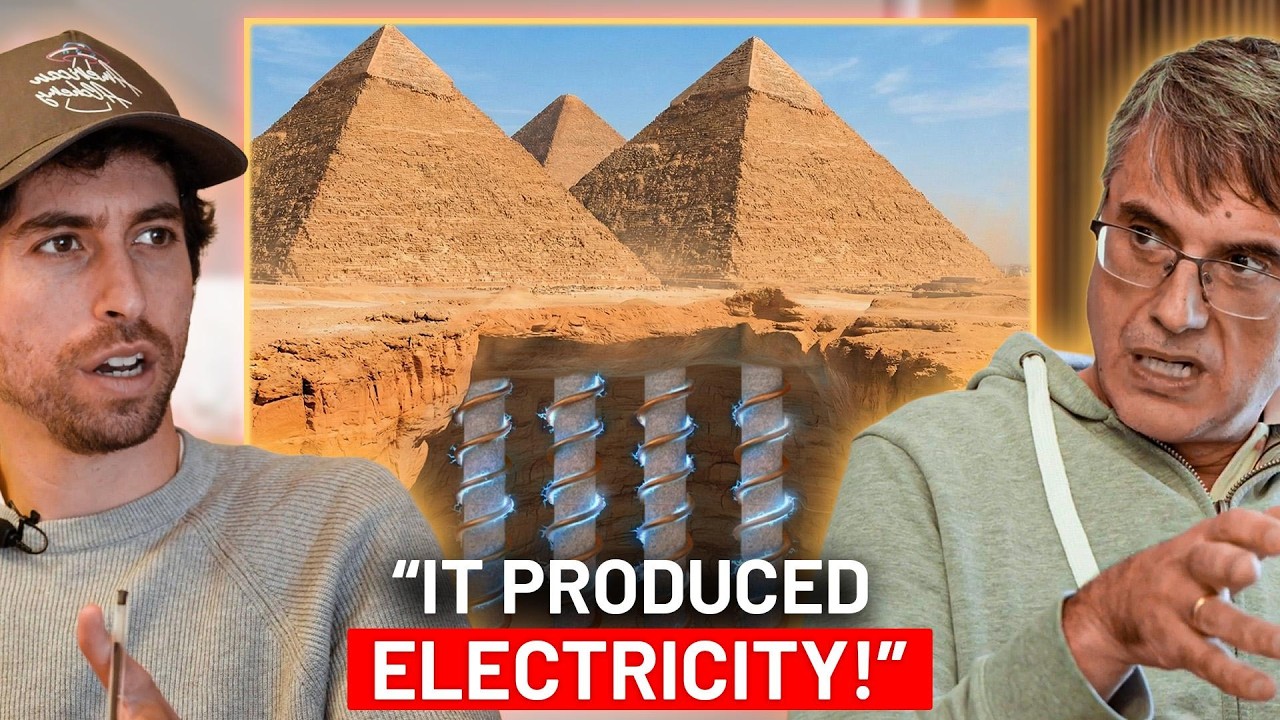
Filippo Biondi, an Italian radar engineer, used a novel technique called synthetic aperture radar Doppler tomography to scan beneath the Giza plateau and claims to have discovered massive man-made structures under the Pyramid of Khafre (the “Coffer” or “Cafra” pyramid), including eight hollow cylindrical pillars extending over 1 kilometer deep, connected to large chambers at the bottom, with spiral formations wrapping around central cores. The findings are controversial, with Egypt’s former minister of antiquities Zahi Hawass dismissing them as “fake news,” while supporters argue the methodology is sound and the implications are extraordinary.
The Discovery Under the Khafre Pyramid
Biondi’s team detected eight hollow cylindrical structures (described as “4+4” pillars, not 4×4) beneath the Khafre pyramid, descending over 1,000 meters (1 kilometer) below the surface.
At the bottom of these pillars are estimated chambers approximately 80 meters wide and 80 meters tall.
The structures appear to be tubes or shafts connecting the base of the pyramid to these deep chambers.
Each tube has a spiral nature — something wraps around a central core as it descends — which Biondi says is definitively man-made because nothing in nature produces such perfect coiling.
The spiral formations went viral online as images resembling an “energy grid” with coils around pillars, though Biondi cautions that the exact material (copper, cable, stairs, etc.) cannot yet be determined from the data alone.
The Technology: Synthetic Aperture Radar Doppler Tomography
Standard radar limitation: Electromagnetic waves interact only superficially with earth — classical physics (Maxwell’s equations) says penetration is only a few centimeters. Critics seized on this to claim the findings are impossible.
Biondi’s innovation: He developed a technique that combines photons (light/electromagnetic quanta) with phonons (vibration quanta) at the boundary between free space and matter. By detecting the surface vibrations of the earth — which carry information from deep underground — and combining this with radar data, he performs tomographic inversion to image subsurface structures at great depth.
The satellite moves at ~7 km/s, creating a large Doppler bandwidth that allows detection of frequency modulation caused by earth vibrations (from seismic activity, cities, natural phenomena).
This frequency modulation is proportional to vibration, and the vibrational data at the surface boundary contains information about structures deep below.
The technique achieves submetric resolution (pixel size roughly 0.25 meters).
Data sources: Four separate satellite systems were used — ICEYE (European), Capella Space (American), Umbra Space (American), and Cosmo-SkyMed (Italian, affiliated with the Italian Space Agency). All four returned consistent raw tomography data.
Not AI-generated: Biondi emphasizes the imaging uses his own inversion software (standard tomographic inversion, called “podo inversion” in the scientific community), not artificial intelligence. The viral images are reconstructions from validated software, not AI hallucinations.
Validation and Track Record
Biondi’s technique is not new to this project — it has been used in other contexts where accuracy matters:
Volcano monitoring: Mapping magma chambers under Mount Vesuvius in Naples, which has been accumulating energy since 1948 and poses a serious eruption risk.
Mining and resource exploration: The technique can be used for locating rare earth materials, gold, and crude oil.
Defense applications: Biondi does classified work for the Italian military (he was reluctant to even confirm this).
Validation experiments: Biondi’s team has conducted 3–4 validation tests where they scanned known structures and confirmed 100% accuracy:
They scanned the Gran Sasso National Laboratory (located inside a mountain, ~200 km from Pergola, Italy) and the tomography matched the known structure perfectly.
They scanned the Osiris Shaft at Giza (a known structure going down ~37 meters) and the readings matched 100%.
No double-blind test yet: Biondi acknowledges this would strengthen the case but has not yet been done. He welcomes the suggestion.
Peer review status: A scientific paper on the findings is currently under peer review at a journal. Biondi is cautious about predicting the outcome, noting that academia can be orthodox and that the media attention around this paper is far greater than for their earlier work on the Khufu pyramid.
The Role of Water
Biondi identifies water as the “principal actor” in the Giza structures:
Water flowing through pipes or spirals generates precise vibrational information.
He notes that the human body is ~80% water by mass, but ~99% water by number of molecules (moles) — meaning water dominates our molecular composition.
He connects this to the work of two Italian physicists, Juliano Preparata and Giorgio De Judicis (both now deceased), who collaborated with Fleischmann and Pons (the cold fusion researchers) and studied how to persuade hydrogen atoms to fuse.
Preparata and De Judicis proposed that palladium acts as a “third person” catalyst that persuades two hydrogen atoms to naturally fuse into helium, releasing energy — the basis of cold fusion.
Biondi speculates that water flowing through the spiral structures could interact with piezoelectric material (which generates electricity under mechanical stress) to produce energy.
There is a known water table beneath the Giza plateau. Water was found in the Osiris Shaft at approximately -33 to -37 meters, though Biondi cautions it may not be uniformly present everywhere.
Theories About the Pyramids’ Purpose
Christopher Dunn’s “Giza Power Plant” hypothesis: Biondi endorses the work of engineer Christopher Dunn, who proposed in his 1998 book The Giza Power Plant that the Great Pyramid was a solid-state electron generator — an energy power plant using microwave waveguides and possibly hydrogen generation.
Biondi speculates the pyramids may have been energy facilities related to electricity or electron generation, with water flowing through piezoelectric spirals to generate power.
He cannot confirm whether the pyramids were nuclear fusion machines but finds the connection to cold fusion research intriguing.
Orion’s Belt alignment: The pyramids map to Orion’s belt, which across many cultures (including Mesoamerican and North American traditions) is associated with the path of souls after death — ascension through the heavens. Biondi is open to this but emphasizes the need for physical exploration.
“Tip of the iceberg”: Biondi and his collaborator Armando Mai describe the pyramids as merely the visible portion of a vast underground system. The real structure and purpose lies beneath.
Other findings on the plateau:
Similar (but smaller) structures were found under the Pyramid of Menkaure (2+2 pillars instead of 4+4) and under the Sphinx (one pillar going down).
A network of interconnected tunnels was detected beneath the plateau, suggesting the entire Giza complex is a unified system.
Independent researcher Trevor Gracie (cited by Biondi) has identified a “corridor of rooms” from the surface connecting to this tunnel network, and believes the known shafts between the Khafre pyramid and the Sphinx are service entrances to the underground facilities.
Biondi also references Ben van Kirkwick’s claims about a massive labyrinth beneath the Hawara region, documented by Herodotus and Pliny the Elder.
The Coffer (Khafre) Research Project: Next Steps
Biondi’s team is completing all scanning of the Giza plateau and is preparing a project proposal to submit to Egyptian authorities for in-situ exploration.
They are not asking to enter the pyramids themselves (which would be politically complicated) but rather to access existing shafts on the Giza plateau surface between the Khafre pyramid and the Sphinx.
These shafts are currently blocked by debris and rubbish. The plan is to:
Perform seismic reflectivity measurements (independent method) to map the water level and cross-validate with Doppler tomography.
Clean the shafts and physically explore them, as they are believed to connect to the underground tunnel network.
Potentially collaborate with the ScanPyramids project (which uses muon detectors to map voids inside pyramids) by placing muon detectors inside the tunnels accessed through these shafts, combining both techniques for a more complete picture.
Political challenges: Egyptian authorities have historically been resistant to findings that challenge conventional narratives about the pyramids. Biondi notes that Zahi Hawass has a pattern of suppressing discoveries. However, Biondi is optimistic that the economic incentive (tourism, national pride) could motivate cooperation.
Timeline: If a focused, well-structured proposal is submitted by the end of 2025, Biondi believes authorization for exploration could come in 2026.
Broader Context and Open-Mindedness
Biondi draws a parallel to Guglielmo Marconi, who was ridiculed by academia for attempting transatlantic radio transmission because Maxwell’s theory said electromagnetic waves travel only in straight lines (line of sight). Marconi succeeded because he unknowingly exploited the ionosphere as a reflective layer — a “third way” no one had theorized. Marconi won the Nobel Prize despite having no formal scientific education.
Biondi uses this to argue that heretical thinking — being “free of mind” (the Latin root of “heretic”) — drives scientific progress. Every generation believes it knows everything, and every generation is proven wrong.
He is open to more exotic interpretations, including scalar physics and extended electromagnetism (beyond transverse Hertzian waves), though he has not personally studied these fields.
Biondi’s collaborator Armando Mai has esoteric theories involving the number 137 (the fine-structure constant in quantum physics, the ratio of the speed of light to the electron’s orbital speed in hydrogen), which he connects to the proportions of the Khafre pyramid. Biondi encourages Mai’s work as interesting and worth exploring.
Biondi also mentions that Luis Alvarez (a key Manhattan Project physicist depicted in the Oppenheimer film) x-rayed the pyramids in the 1950s using muon detection, showing that high-level scientific and government interest in the pyramids’ internal structure has a long history.