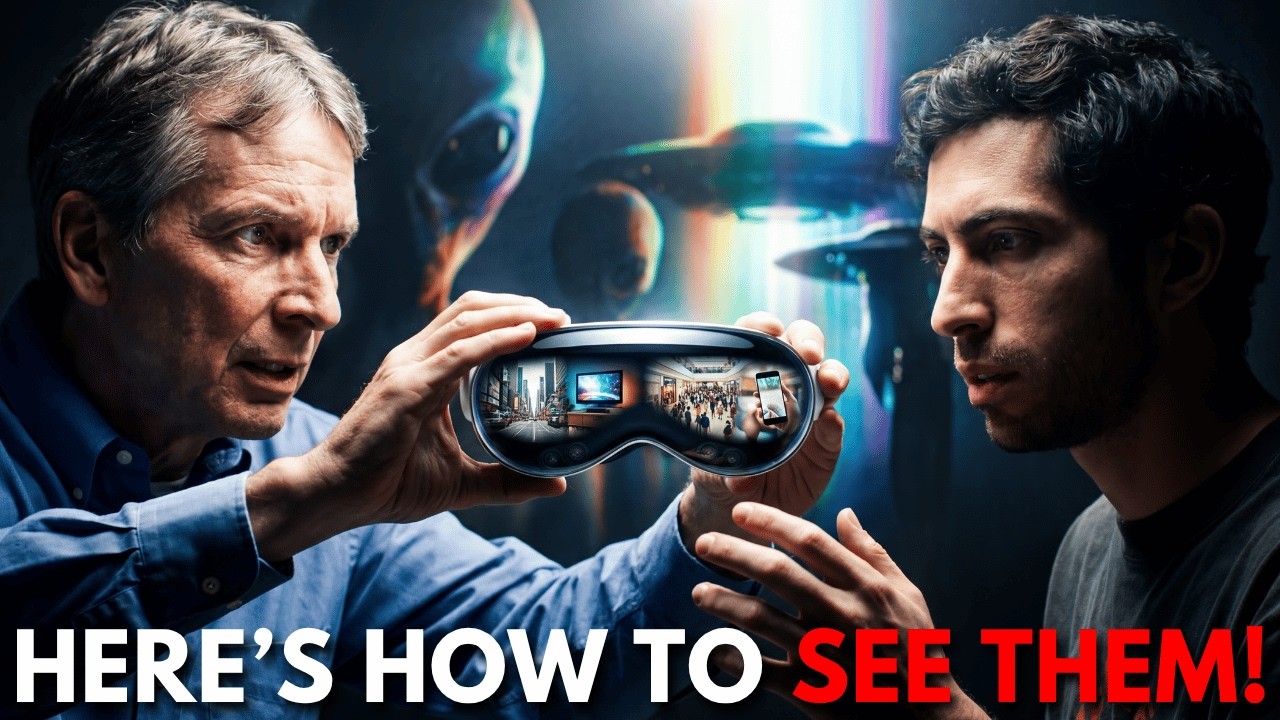
Donald Hoffman argues that evolution has not shaped us to see reality as it is — the probability that any sensory system has evolved to perceive any true feature of objective reality is precisely zero. Instead, evolution gives us a simplified “desktop interface” that hides the complexity of reality and only shows us what we need to survive and reproduce. This has radical implications: our perceptions are not windows onto truth, they are adaptive icons, and the universe may be teeming with intelligences and phenomena our headset is simply not built to detect.
Fitness Beats Perception
The standard intuition is that evolution should shape organisms to see the truth — if you see a train, you should really see a train, not an illusion. But Hoffman and his collaborators used evolutionary game theory to prove a theorem: the probability that natural selection shapes any sensory system to see any true structure of the world is exactly zero.
The proof hinges on fitness payoff functions. For evolution to tune an organism to some structure in the world (a metric, a topology, etc.), the payoff function would need to be a homomorphism of that structure — it would have to “know about” it. When you consider all possible payoff functions, the fraction that satisfy this condition is zero.
Something can happen infinitely often and still have probability zero — like picking a specific point on a square. It’s not impossible, but it’s probability zero.
A concrete example is color vision. When you see “red,” you are not seeing wavelengths of photons. You are seeing an icon your brain constructed. Inside the computer that is your brain, there is nothing red — just voltages toggling in patterns. The color is eye candy, like a blue folder on a desktop that doesn’t correspond to anything blue or rectangular inside the machine.
Another example: you don’t need to know the absolute temperature of something, only whether it’s too hot, too cold, or just right for your survival. Evolution compresses reality into the minimum parameters needed for adaptive action.
The jewel beetle illustrates this starkly. Male beetles in Australia evolved to identify females by a simple hack: dimpled, glossy, brown. When beer bottles with those exact properties appeared in the outback, males forsook real females and crawled all over the bottles, unable to distinguish the icon from the reality it was supposed to represent.
The Desktop Interface Analogy
Hoffman compares our sensory experience to a computer desktop. The icons (colors, shapes, objects) are not reality — they are a user interface designed to let you interact with reality without needing to toggle voltages or understand the underlying code.
In the computer case, the interface was designed by engineers. In our case, evolution built the interface. But the key difference is that there are infinite genetic and phenotypic variations, so each person’s “desktop” is slightly different.
Some women are tetrachromats with four color receptors instead of three, meaning they see colors no man could ever imagine. Some people have synesthesia, blending senses in unusual ways. Each person’s headset is idiosyncratic.
Hoffman extends this further than even Steven Pinker, who made a similar argument. Hoffman says even everyday physical objects — this cup, this chair — are just icons. There is nothing in objective reality that directly corresponds to a cup. The relationship between the cup-icon and reality is as abstract as the relationship between a blue folder on your screen and the bits inside your computer.
Hacking the Interface
Once you understand how the headset works, you can hack it. Hoffman has consulted for clothing and advertising companies, using knowledge of how the visual system interprets shading gradients and stitching patterns to make jeans create more attractive body shapes — changing the perceived 3D shape of the wearer’s body through subtle visual cues.
Attention can also be hacked. We have subcortical circuitry evolved to detect animate objects, especially eyes. Hoffman helped companies design packaging with patterns that tap into this circuitry, grabbing visual attention without the viewer knowing why. CBS’s logo is literally a big eye.
The dystopian implication is that AI combined with this knowledge could generate supernormal stimuli — images optimized to maximally exploit our evolved perceptual biases — far beyond what traditional advertising could achieve.
The Hard Problem and the Failure of Physicalism
Hoffman argues that science has a foundational problem: it cannot explain observation itself. Science is built on systematic observation, yet there is no accepted theory of what an observation is, why observations should give us legitimate data about the world, or how the act of observing relates to physical processes.
In quantum mechanics, this is the measurement problem. The Schrödinger equation governs systems when you’re not looking; collapse happens when you look. This has been unsolved for a century. No physical system governed by the Schrödinger equation can collapse the wave function — so where does observation come from?
Decoherence doesn’t solve the problem — it gets rid of interference but doesn’t give you a single outcome.
The Penrose-Hameroff orchestrated collapse theory (microtubules in the brain causing quantum collapse) still doesn’t explain how collapse produces a specific conscious experience like the taste of chocolate.
Hoffman’s challenge to colleagues who say consciousness is an illusion: give me the precise mathematical model of the illusion of the taste of mint. No one can. There is zero on the table.
The Many Worlds interpretation fails because it severs the connection between observed frequencies and the theory. If every possible sequence of outcomes occurs in some branch, there is no reason to believe the frequencies you observe in your lab confirm the Schrödinger equation.
Quantum Bayesianism (QBism) makes wave functions purely subjective degrees of belief, which solves some paradoxes but fails to tether the wave function to objective data.
Recursive Trace Logic
Hoffman proposes starting not with physics but with observation as fundamental. The simplest model of an observer: an entity with a finite set of possible experiences (states) that change over time. This is a Markov chain — a matrix of transition probabilities.
Add a counter that increments with each experience update: this gives you “enhanced Markov chains.”
The key discovery: if you have a big Markov chain and restrict yourself to observing only a subset of its states, there is a precise mathematical formula for what you will see — called the trace. The relationship of being a trace defines a logic on the set of all Markov chains. This is the trace logic.
It is a partial order, locally Boolean but globally non-Boolean. It is the “pre-established harmony” that Leibniz envisioned connecting all monads.
Each Markov chain is an observer window (a monad). The trace logic ties all possible observer windows together.
Agency is built recursively. A “policy” is a Markov chain on top of the trace logic — a way of crawling around on observer windows. Meta-policies crawl around on policies. This recursion goes on indefinitely.
From this simple foundation, Hoffman’s team is deriving major results:
Time dilation and length contraction emerge naturally. A sub-trace observer’s counter ticks slower than the full matrix’s counter — this is time dilation. Distances contract because the sub-trace observer diffuses through fewer states.
Quantum wave functions appear as the asymptotic behavior of enhanced Markov chains. The harmonic functions of these chains have exactly the same mathematical form as wave functions for free particles in quantum mechanics.
The trace logic is a hidden variables theory, but different from Bohm’s pilot wave theory because it is not tied to spacetime.
Hoffman has nine conjectures his team is working to prove: that special relativity, general relativity, the Born rule, the Big Bang, Heisenberg uncertainty, and non-locality all emerge from the trace logic. If proven, this would be a game-changer.
Disembodied Consciousness and Alien Intelligence
The trace logic predicts that embodiment is the exception, not the rule. The set of all possible observer windows that require embodiment has measure zero — probability zero. Most consciousness is disembodied.
Our spacetime headset is one of the more trivial, restrictive possible headsets. We are near the bottom of the consciousness food chain, not the top.
An ant’s reality is as rich and complex to the ant as ours is to us. But the ant knows almost nothing about the intellectual life of a human. Similarly, we may be surrounded by intelligences of staggering complexity that our headset simply cannot render — they appear to us as trivial natural phenomena, or nothing at all.
There are an infinite number of alien intelligences, not in just one direction but in infinite directions. No matter how big your matrix is, there is always a bigger one. There is no top.
UAP phenomena are consistent with the trace logic. A craft that appears here and instantly accelerates to Mach 40 could be moving leisurely in a higher-dimensional headset whose clock runs at a different rate than ours. A being with a bigger matrix can play with a sub-trace observer — they have access to exit states and corridors that the sub-trace observer cannot see.
UFOs appearing at nuclear sites, particle accelerators, and in consciousness-altering experiences (DMT, near-death experiences) could represent entities monitoring the “exit points” of our spacetime headset — the boundaries where we poke at the edges of our interface.
The Hologram and Context Windows
Hoffman’s view aligns with the holographic principle: all the 3D information we perceive is encoded on a 2D surface. We are like characters in a video game — when you look away, the red Ferrari you were looking at literally ceases to exist for you. There is no Ferrari in some underlying computer; there are only bits. Similarly, the table in front of you does not exist when you’re not perceiving it.
Neurons don’t exist when they’re not perceived. The brain you would see in a scan is an icon rendered by your headset.
The only objective reality is awareness itself — the one consciousness looking through infinite windows. You are that awareness, currently operating through a Jesse avatar or a Don Hoffman avatar. The mathematical structure of the trace logic shows how separate monads are connected by a pre-established harmony, pointing to a fundamental unity of consciousness.
Science, Spirituality, and God
Hoffman’s personal arc: raised by a fundamentalist Protestant minister, he embraced the rigor of science, then discovered that the physicalist framework was too restrictive to explain observation or consciousness. The recursive trace logic has brought him back to something resembling the spiritual insight he grew up with — but now with mathematical guardrails.
He proposes a synthesis: take the mathematical rigor and empirical discipline of science, and take the essential insight of spiritual traditions — that there is a fundamental unity of consciousness, and love your neighbor as yourself because your neighbor is yourself.
When asked if he believes in God, Hoffman offers an ostensive definition rather than a verbal one: ask yourself “what will my next thought be?” and wait. In the gap before the thought arises — that awareness without content — is what he means by God. It cannot be described, only pointed to.
The bliss reported in deep meditation may reflect the fundamental nature of reality: that beneath all the headsets, there is only one awareness, and there is no danger. The emotions and fears are real inside the headset, but you were never actually at risk.
AI and the Future
Current large language models compute correlations and are “dumber than cucumbers” — they don’t know anything. But the recursive trace logic suggests a fundamentally different AI architecture based on the logic of zero surprise rather than correlation.
The trace logic is computationally universal (like Markov chains themselves). It also induces a new logic on algorithms and may contribute to computational complexity theory.
There is a homomorphism from the trace logic on Markov chains to the Lebesgue logic on probability measures — observation and belief mesh perfectly.
Hoffman believes that if his team proves the nine conjectures, it will be the end of the spacetime framework as fundamental physics and open the door to technologies and understandings that go beyond our current headset — including a rigorous scientific framework for studying spiritual phenomena that have been dismissed as unscientific since the Enlightenment.