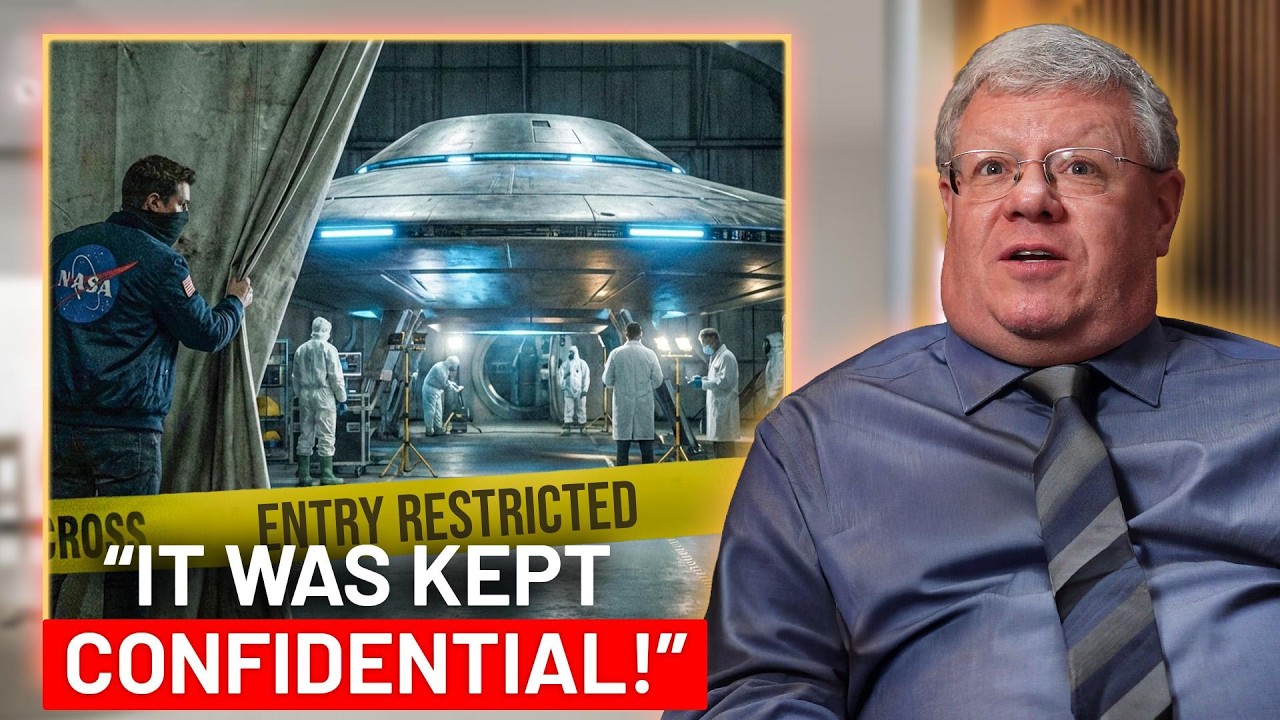
Kevin Knuth, a physicist at the University of Albany and former NASA researcher, is one of the few credentialed scientists studying UFOs (UAP) with rigorous, hard-headed methods. He discusses how he entered the field, the nuclear-UFO connection, the physics of how these craft might fly, underwater bases, NASA’s suppression of astronaut testimony, and the scientific community’s failure to engage with the evidence.
His interest began in childhood during the 1977 wave of UFO-themed media, but he only started serious research around 2015 after discovering that a graduate school professor’s offhand joke about UFOs shutting down nuclear missiles at Malmstrom Air Force Base was actually real, documented by Air Force veterans at a 2010 press conference.
He argues the nuclear-UFO link is the most compelling gateway for rigorous scientists because it represents a repeatable, global pattern: UFOs have been documented monitoring nuclear weapons sites in the US, Soviet Union, France, England, and Japan, often before the sites were fully operational or had nuclear material present.
The Nuclear-UFO Connection
UFOs have been repeatedly observed at nuclear weapons sites worldwide, suggesting deliberate surveillance of humanity’s most destructive technology.
Robert Hastings documented cases at Malmstrom AFB where UFOs reportedly shut down nuclear missiles in 1966–67; Knuth’s own wife’s uncle, an Air Force veteran stationed there in the early 1970s, confirmed it “happened all the time.”
The Scientific Coalition for UAP Studies (SCU) found statistically significant clustering of UFO sightings at nuclear sites compared to nearby military bases and population centers, including during construction phases before nuclear material arrived.
A 1945 pilot named Bud Clem reported UFOs over the Hanford plutonium production site before it was fully operational.
Possible explanations include: intelligence gathering, concern about humanity’s energy breakthroughs, or a protective impulse to prevent nuclear self-destruction.
How UFOs Might Fly
The observed performance characteristics of UFOs defy known physics and engineering, pointing to manipulation of inertia, gravity, or spacetime itself.
The Tic Tac from the Nimitz incident (2004) was estimated to accelerate at ~5,000 Gs; by comparison, F-35 wings rip off at 13 Gs and missile frames fail above 60 Gs.
The power required for that Tic Tac maneuver was approximately 1,100 gigawatts—more than the total US nuclear power output—in a craft the size of an F-18. Even 1% inefficiency would produce 11 gigawatts of waste heat, enough to melt any known material.
Knuth considers warp drive and general relativity-based explanations as the most plausible framework, since the craft show no sonic booms, fireballs, or atmospheric interaction.
Underwater UFOs (USOs) present the same paradox: an 800-foot cylindrical object was tracked closing 2 km in 25 seconds beneath a New Zealand frigate, displacing water that should have produced massive waves, yet sonar confirmed its presence while it appeared to interact minimally with the surrounding water.
UFO Materials and Reverse Engineering
Analysis of purported UFO crash debris is underway using advanced techniques that could provide a smoking gun.
Knuth’s colleague Matthew Szydagis has developed a non-destructive neutron activation technique to identify isotope ratios in materials, which could reveal non-terrestrial origins if the ratios don’t match anything found naturally on Earth or in meteorites.
This complements Gary Nolan’s mass spectrometry work at Stanford on materials including magnesium-bismuth nanolayers, which are also of interest in anti-gravity research (the Biefeld-Brown effect) and modern spintronics.
Knuth believes the US likely has a reverse engineering program based on accounts from credible insiders, though he notes that those insiders admit they don’t understand how the technology works—comparable to giving an iPhone to a caveman.
Water Worlds and Underwater Bases
Knuth argues that water worlds are the most logical base locations for non-human intelligence, both for environmental stability and concealment.
Water provides a stable temperature range (0–100°C), protection from radiation and meteorites, and electromagnetic stealth—EM waves don’t travel far in water, making detection extremely difficult.
Water’s unique properties (solid form less than liquid, dissolved minerals, energy storage potential via hydrogen-oxygen separation) make it a practical resource hub.
Historical USO reports go back to the 1800s, including Columbus-era accounts of balls of light emerging from the sea, hovering near ships, and departing into clouds.
Knuth participated in a 2021 university-supported data collection mission to Catalina Island (documented in A Tear in the Sky), where some anomalous observations were later explained (a bright light was the ISS, a flare camera malfunctioned), but he personally witnessed an infrared object drop into the sea that was never explained.
NASA’s Suppression of Astronaut Testimony
Multiple astronauts and cosmonauts have reported UFO encounters in space, but these accounts have been systematically excluded from official NASA reviews.
Cosmonaut Akinashev photographed a craft with windows that pulled alongside his spacecraft, matched its orbit, and departed; the Soviet government confiscated the photographs, and he made drawings from memory.
Apollo 12 astronaut Alan Bean reported a red flashing light that followed Skylab; the photographs are publicly available.
Gemini 11 astronauts experienced an object that flew over their craft and drained an entire battery stack (Stack C); the transcripts show six minutes of missing audio after the event.
The Soviet Phobos mission spacecraft was disabled after photographing what appeared to be a fin-shaped object—the last image it ever transmitted.
Story Musgrave, a shuttle pilot, described seeing “snakes” writhing in space.
Knuth found a famous lithograph in the Simkinson NASA archive labeled “strange object as seen by Gemini 11 astronauts” but determined it was likely an artist’s mock-up created after the fact, not a real photograph, based on timing discrepancies and the absence of the UFO in the original background photograph.
The Scientific Community’s Failure
Knuth is sharply critical of mainstream scientists who dismiss UFOs without engaging with the evidence, calling it a failure of scientific responsibility.
He notes that the stigma has real consequences: he and colleagues have faced backlash, and friends working on anti-gravity have received threats.
He criticizes prominent science communicators like Neil deGrasse Tyson for repeating debunked arguments (e.g., “why don’t cell phones capture UFOs?”) without addressing the actual data, such as the nuclear correlation or radar-confirmed cases.
He praises Stanton Friedman’s admonition: scientists should do their homework before opening their mouths on the topic.
The French GEIPAN program and the 1999 Cometa report are held up as models of transparency; the Cometa report concluded UFOs could be alien spacecraft, that a solar system base was plausible, and that the US was likely covering up information.
JAL 1628: The Most Compelling Case
Knuth considers the 1986 Japan Airlines Flight 1628 incident the single most convincing UFO case, despite its extraordinary nature.
Captain Kenju Terauchi reported a walnut-shaped object the size of an aircraft carrier following his 747 cargo flight across Alaska for 45 minutes, with smaller rectangular craft shining light into the cockpit that the crew could feel as heat.
Military height-finding radar confirmed the object’s presence. Daniel Kumby’s analysis of the radar data showed accelerations exceeding 9,000 Gs (one instance at ~11,000 Gs) and top speeds of 250,000 mph—fast enough to reach the Moon in 54 minutes.
FAA accident chief John Callahan retained a copy of the radar data after Reagan’s scientific team and the CIA collected the originals; he later made it public.
Callahan reported that Reagan’s scientific team said, “We’ve never had 45 minutes of radar data from one of these things before,” implying they had shorter recordings from other incidents.
Terauchi was fired and had his license revoked for going public, then later reinstated.
3I/ATLAS and Institutional Gaslighting
Knuth is critical of NASA’s handling of the interstellar object 3I/ATLAS, viewing the agency’s dismissive press conference as gaslighting.
3I/ATLAS has anomalous properties: only 4% water vapor (far less than any known comet), nickel without iron (which is geochemically unusual since they typically occur together), and an anti-tail.
Knuth argues that claiming it’s “just a comet” and walking away is scientifically irresponsible, since it’s an interstellar object offering direct information about conditions around another star system.
He is skeptical of Avi Loeb’s confident claims that it’s an alien spacecraft but believes the scientific community’s refusal to seriously study it is driven by stigma rather than evidence.
Personal and Historical Connections
Knuth’s family has a remarkable connection to the UFO and nuclear history through his father’s cousin, Donald Hornig.
Hornig was scientific advisor to Presidents Eisenhower, Kennedy, and Johnson, designed the electronic triggers for the plutonium bomb during the Manhattan Project, and babysat the Trinity test device in a thunderstorm the night before detonation.
Knuth found a government document listing Hornig as present at the 1965 Kecksburg, Pennsylvania UFO crash, lending authenticity to the document.
Knuth also notes that Wernher von Braun’s mentor, Hermann Oberth (father of German rocketry), gave a 1954 lecture stating that UFOs were real, came from another solar system, and had aided the rocket program.
Ongoing Research at University of Albany
Knuth and colleagues Matthew Szydagis and Professor Cecilia Levy run Project X at the University of Albany, one of the few academic programs systematically studying UAP.
The project received a generous donation from businessman Tony Gorman, creating an endowment that funds the work in perpetuity.
Knuth advocates for multi-sensor detection approaches, with infrared (flare) cameras as his preferred single modality because they provide both visual records and temperature data through black body radiation analysis.