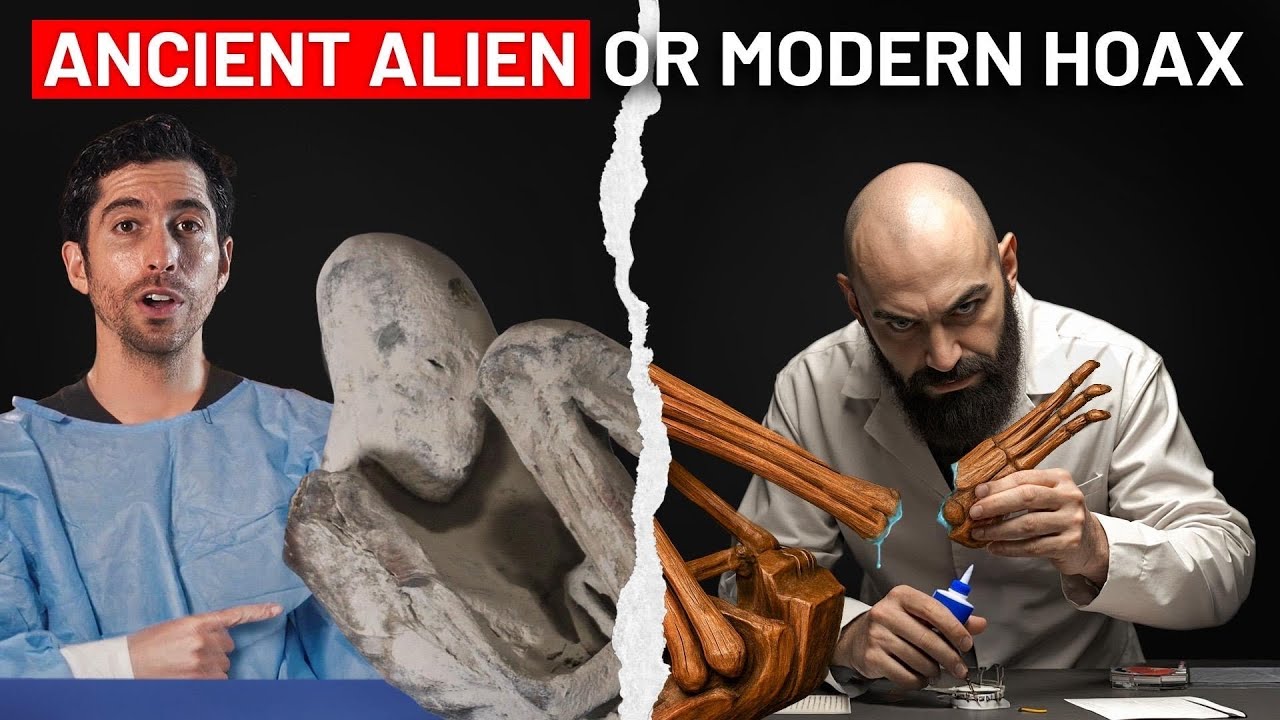
Jesse Michaels travels to Peru to investigate the controversial Nazca mummies — tridactyl (three-fingered, three-toed) mummified bodies discovered in 2015 by a local gravedigger named Leandro in a cave in the Nazca region of southern Peru. The central question is whether these beings are real biological organisms — possibly a new hominid species, ancient human-animal hybrids, or something else entirely — or an elaborate hoax. Multiple forensic experts from Peru, Mexico, and the United States have examined the bodies and concluded they are likely once-living organisms, not fabricated artifacts, though significant controversy remains around provenance, genetics, and government interference.
The Nazca region and its archaeological backdrop
The Nazca region of southern Peru, named after the Nazca culture (100–800 CE), is already one of the most archaeologically mysterious places on Earth.
The Nazca practiced ritual cranial deformation (skull elongation), created polychrome pottery with mythological motifs, and produced massive desert geoglyphs known as the Nazca Lines — some spanning up to 30 meters and only fully comprehensible from 150–500 meters in the air.
Erich von Däniken famously argued the lines were tributes to ancient alien astronauts; regardless of that claim, the engineering question of why humans would create ground-level art meant to be seen only from the sky remains genuinely puzzling.
A petroglyph at a prominent Nazca archaeological site depicts what appears to be a tridactyl being, and similar three-fingered figures appear in woven fabrics and cave art from the region.
The region also has frequent UFO sightings, adding to its reputation as an anomalous hotspot.
Discovery of the bodies
In 2015, Leandro, a local gravedigger who also conducts shamanic tours, stumbled upon a cave containing over 200 body parts — isolated heads, limbs, and many fully intact bodies.
All specimens were covered in diatomaceous earth, a natural desiccant that dried and preserved them; many still have fully intact organs, meaning they are not technically “mummies” in the traditional sense.
Carbon dating places the bodies between 700 and 1,800 years old, mostly overlapping with the Nazca period.
Three dominant body types have been identified:
S-types: Small winged creatures (not the focus of the episode).
J-types (reptilians): Skinny, 2–3 feet tall, with geometric/boxy bodies and faces resembling the aliens from Close Encounters of the Third Kind; some contain eggs inside their bellies (25–30 specimens).
M-types (hominids): 4–5 feet tall, human-looking beings with organs, tendons, cartilage, and bones fully intact. These are considered the most significant.
Forensic and medical evidence
Multiple credentialed forensic experts have examined the bodies in person and concluded they appear to be real, anatomically self-consistent organisms:
John McDow, president of the American Forensics Association and recipient of the Grand Wall Award (the highest U.S. forensic honor), stated there is data suggesting these bodies can be interpreted as once-living organisms.
Jim Caruso, chief medical examiner for Denver, a forensic pathologist and former Navy medical officer with over 300 autopsies and dozens of peer-reviewed papers, participated in the examination.
Dr. David Ruiz, president of the Peruvian Society of Legal Medicine (the Peruvian equivalent of McDow’s position), went further — confidently stating these are non-human but very real beings and that tridactyl entities have been visiting Earth for thousands of years. He explicitly avoided the word “extraterrestrial,” preferring “hominid” or “humanoid species.”
Dr. José Zalce, chief of the medical division for the Mexican Navy, also concluded the bodies are real organisms and speculated they may be so genetically dissimilar from humans as to potentially be extraterrestrial.
CT scans and DICOM medical imaging data (publicly available at tridactyls.org) show anatomically consistent internal structures:
Capillaries nourishing eggs inside J-type bodies.
No evidence of deliberate mutilation of fingers or toes — the tridactyl structure appears natural.
No stress fractures typical of artificial head-binding rituals on the elongated skulls.
The skull of “Maria” (an M-type) shows no lines of artificial deformation, and the skull is proportionally large, suggesting the beings were born that way.
The hoax narrative and how it originated
The widespread perception that the Nazca mummies are a hoax stems from a specific conflation that Jesse argues is mistaken:
A journalist named Manuel Cáceres made wooden figurines resembling the Nazca mummies to sell to tourists as trinkets. These were confiscated at Lima airport in 2023.
In early 2024, Reuters and other legacy media reported that archaeologist Flavio Estrada of the Peruvian Ministry of Culture declared: “They’re not extraterrestrials, they’re dolls made from animal bones joined with modern synthetic glue.”
This conflation — between handmade tourist trinkets and the actual anatomically consistent bodies — became the sole basis for the Western media consensus that the entire case is fake.
Jesse argues this is a fundamental error: the wooden figurines are obviously fake craft, but they have no connection to the actual bodies found in the cave.
Genetic findings and anomalies
Genetic testing on the bodies has produced complex, contradictory, and sometimes confusing results:
Elena Hardy, a bioinformatics expert, found a mutation in the GLI3 gene (part of the Sonic Hedgehog pathway) in the NCBI database genetic data from the mummies. This mutation is associated in the literature with polydactyly and digit development disorders — a rare mutation not widely known in the genetics community and certainly not something a Peruvian gravedigger would know to fabricate.
For Maria (an M-type), DNA analysis showed approximately 70% known DNA and 30% completely unknown DNA. The known portion contained sequences matching chimpanzee, bonobo, and a South Asian human primate — a combination never seen together in nature.
Dr. David Ranell hypothesizes Maria is a natural hybrid, possibly between an early wild human from Asia (~2,500 years ago) and an African organism, with the tridactyl features representing an evolutionary adaptation for arboreal (tree-dwelling) life, similar to sloths. He also claims a parasite found only in Africa was detected in one of the beings.
However, Steve Meera reported that two different finger bones from Maria tested in Sri Lanka came back as one male and one female — a result that, if true, would undermine the claim that Maria is a single anatomically consistent organism.
A proteomics expert (who requested anonymity) found that an isolated J-type head tested positive for alpaca proteins throughout the bone, raising questions about whether at least some J-types are fabricated from animal parts.
Jesse speculates the contradictory genetic results may be due to human contamination, a common problem with ancient DNA.
Montserrat’s fetus
One of the most striking findings involves an M-type being named Montserrat:
CT scans revealed what appears to be a fetus inside Montserrat’s body, and the fetus also appears to be tridactyl (three-fingered hands and feet).
If confirmed, this would imply genetic match and phenotypic inheritance between mother and offspring — extremely difficult to fake and strong evidence of a real biological organism.
Montserrat’s prominent belly and hand position suggest she was holding her belly when she died, and the amniotic fluid was lost post-mortem.
Rare metal implants
Many M-type bodies contain metal implants made of osmium and cadmium — extremely rare earth metals:
Osmium is ~1,500 times rarer than gold and ~2,500 times rarer than silver; only about 100 kg to 1 ton is extracted globally per year.
These metals were only officially discovered by Western science in the 19th century, yet they appear in implants in bodies carbon-dated to over 1,000 years old.
The implants show osseointegration — organic tissue fused to the metal — indicating the beings were alive when the implants were placed.
Osmium and cadmium have also been found on meteorites from space.
Alan Earas, a population geneticist, theorized the implants could function as a bioelectric brain-machine interface, modulating gene expression at a phenotypic level — meaning the beings might be minimally genetically altered but significantly modified through bioelectric technology.
Jaime Maussan and the Mexican connection
Jaime Maussan, a Mexican journalist and UFO researcher, has been the most public advocate for the Nazca mummies and is widely labeled a hoaxer by critics.
Jesse visited Maussan at his home outside Mexico City and found him to be independently wealthy, generous with data, genuinely believing in the extraterrestrial origin of the beings, and open to scientific scrutiny — not cynical or territorial.
Maussan is now suing the Peruvian government for $300 million for defamation over their claims that he is pushing a hoax.
Maussan also showed Jesse a metallic sphere recovered in Bugotá, Colombia, made of an aluminum alloy three times harder than aerospace-grade aluminum, which he claims exhibits electromagnetic anomalies (Jesse is more skeptical of this object).
Maussan invited any credible scientist to come to Mexico City to examine the evidence.
Government interference and legal battles
The Peruvian government and Ministry of Culture have actively opposed investigation of the Nazca mummies:
They raided a press conference, with federal police and prosecutors taking over the microphone while researcher Joyce Mantia was about to speak.
They have repeatedly tried to confiscate the bodies from the University of Ica, where researchers like Dr. Roger Zuniga are studying them — on seven occasions arriving with police and prosecutors.
The government has accused respected scientists involved in the research of being grave robbers manipulating human remains.
Until September 2024, the Peruvian government maintained a hardline denial; since then, they have begun tacitly endorsing research at the University of Ica that may indicate the bodies are real.
Dr. José Zalce was jailed for five days by the Mexican Navy for his involvement with the mummies and told to stop investigating.
Jesse views Flavio Estrada and the Peruvian Ministry of Culture as bad faith actors.
Provenance problems and black market concerns
The case has serious provenance issues that Jesse acknowledges honestly:
The bodies were found by Leandro, a gravedigger with links to local organizations, who charges ~$3,000 for tours to a cave that multiple sources say is too small to have held 200 bodies and is likely not the real discovery site.
Anonymous sources (some fearing retribution from local cartels) say the actual source is a large subterranean tunnel system.
The involvement of criminal networks means there are strong financial incentives to create and sell knockoff bodies on the black market — Jesse has heard prices in the seven figures.
This means even if the original bodies are real, a thriving market for fakes likely exists, which complicates any investigation.
Jesse emphasizes this provenance problem should give everyone humility about making bold claims in either direction.
The Russian snow alien connection
In 2011, in the Irkutsk region of Siberia (home to Russian nuclear missile assets), a mass UFO sighting occurred with multiple witnesses, including a pensioner and local children.
One month later, two young men (ages 18 and 19) found a body in nearby woods that looks remarkably like the Nazca J-type beings and the aliens from Close Encounters of the Third Kind.
The video has 12 million YouTube views. The two men were detained by police and allegedly confessed to hoaxing it with breadcrumbs, plasticine, and chicken skin — a claim Jesse finds suspiciously similar to the Manuel Cáceres tourist trinket narrative.
Jesse is personally skeptical this video is real (the age of the filmmakers makes a prank plausible), but notes the striking morphological similarities to the Peruvian case and the preceding UFO sighting.
Ronald Reagan reportedly watched Close Encounters of the Third Kind in the White House and told Steven Spielberg: “There are a number of people in this room who know that everything on that screen is absolutely true” — and he said it without smiling.
U.S. government and congressional involvement
Representative Eric Burlison of Missouri attended a hearing in Mexico City about the Nazca mummies.
According to Burlison, UFO whistleblower David Grusch told him that some of the Nazca mummies (not all — Grusch acknowledged some are faked) resemble beings Grusch had seen described in classified briefings during his Pentagon role.
This would mean a U.S. government whistleblower with security clearances has indirectly corroborated the physiological plausibility of at least some of these bodies.
There are also credible UFO crash retrieval cases in Peru, including whistleblower Jonathan Wagont, who described retrieving a craft embedded in a rocky cliff face in the Peruvian jungle with what appeared to be a four-fingered arm hanging from an open hatch.
Speculations on what the beings might be
If the beings are real, several origin theories have been proposed:
Subterranean species: A global underground-dwelling species, analogous to the Hopi “Ant People” legend — wise, industrious beings who live underground and are traditionally depicted in cave art with three fingers and three toes. The Nazca region’s vast, sparsely populated terrain and rumored tunnel systems could support this.
Hybridization: M-types could be hybrids between J-type reptilian beings and humans, retaining the tridactyl features but appearing mostly human. The local Nazca-language name for the region reportedly translates to “laboratory where cloning and hybridization were done.”
Reverse imitation: The contrarian take — J-types are real and M-types are humans who were surgically modified to look like the reptilian beings.
Gray aliens: The beings match descriptions of “tall grays” and “little grays” from abduction cases. Whitley Strieber (author of Communion) is deeply interested in this case and connected Jesse with several researchers. The osmium/cadmium implants might allow electromagnetic manipulation, explaining why different people perceive the beings differently.
New terrestrial species: Perhaps the least dramatic explanation — a previously unknown branch of hominid. Given that 5–10 new hominid species have been discovered in just the last decade (out of 21–30 total known), this is not far-fetched. However, no known hominid has three fingers or three toes, though some mammals (like sloths) do as an arboreal adaptation.
Coexistence with humans: Specimens range from 700 to 1,800 years old, suggesting these beings may have coexisted with human ancestors in South America for over 1,000 years.
Jesse’s personal assessment
Jesse’s honest evaluation, “gun to my head”:
M-types (hominids): Probably real organisms. The forensic consensus, anatomical consistency, Montserrat’s fetus, and lack of evidence for mutilation all point this way. The contradictory genetics (male/female finger bones) is likely due to contamination.
J-types (reptilians): More likely to be fake or reconstructions — the alpaca proteins on the isolated head are concerning, and the stylized faces trigger Jesse’s skepticism. However, the DICOM scans showing internal structures, eggs inside bodies, and the resemblance to other global cases give him pause.
Flavio Estrada and the Peruvian Ministry of Culture: Bad faith actors. Jesse does not trust them at all.
The main remaining “smoking gun” test: definitively proving Montserrat’s fetus is also tridactyl, which would essentially require accusing gravedigger Leandro of cloning capabilities beyond elite American researchers.
Next steps: Colossal Biosciences and the path forward
Jesse has contacted Ben Lamb at Colossal Biosciences (advised by Harvard’s George Church, and the company that recently de-extincted the dire wolf) to run advanced ancient DNA analysis on the Nazca mummies.
This requires permission from the Peruvian government — which Jesse sees as a “forcing function” revealing whether the government is pro-science or acting as a gatekeeper.
If government permission is denied, Jesse will personally fund flights and expenses for any genetics, paleoarchaeology, or proteomics expert to travel to the University of Ica and study the bodies firsthand.
Jesse emphasizes the key test: DNA from multiple parts of a single body (toe, finger, tooth, etc.) must all match for it to be confirmed as one organism.
The broader point: disclosure is not waiting for a government announcement — the evidence is already available for anyone willing to evaluate it. The stigma around the case (“alien mummies”) causes half the population to believe everything and the other half to believe nothing, with very few credentialed, open-minded investigators in the middle.