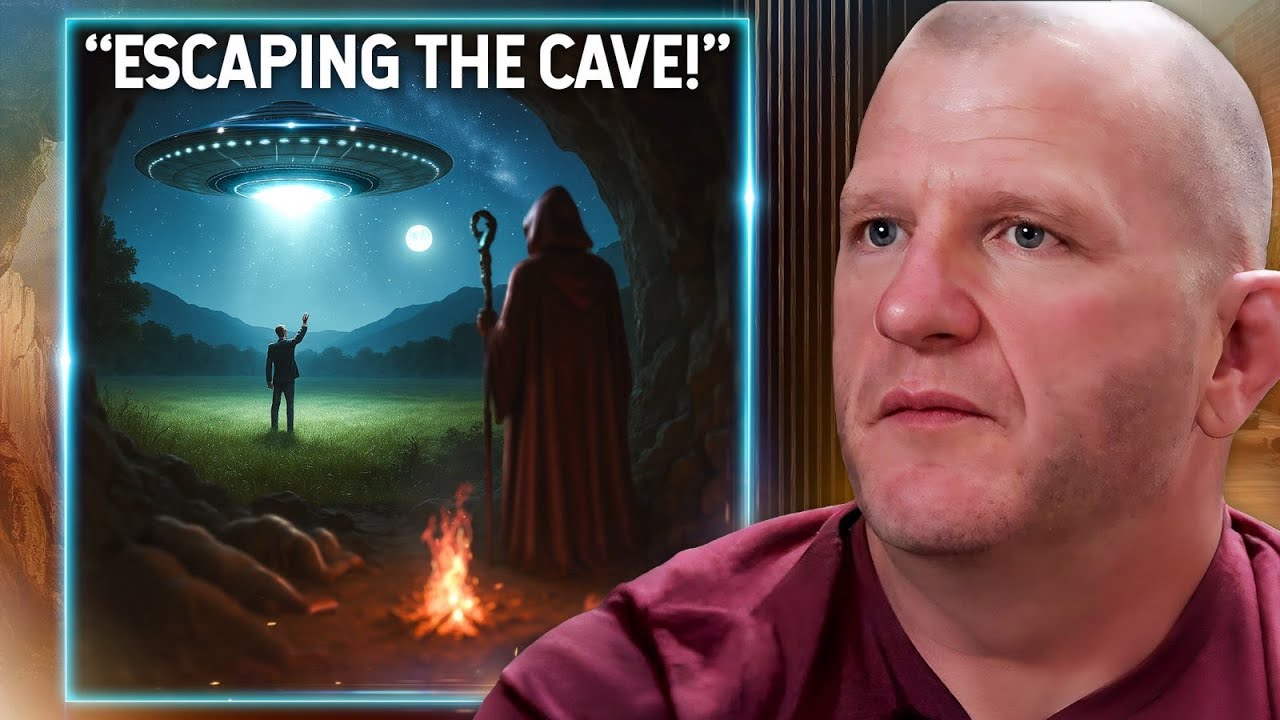
Philosopher Jim Madden argues that the UFO mystery is best understood through Plato’s Allegory of the Cave: humanity is trapped inside epistemological filters, and UFOs may represent something from outside that system trying to get our attention—or to remind us of truths we’ve forgotten.
Plato’s Republic and the Cave
Who Plato was: Student of Socrates, aristocratic Athenian, accomplished wrestler (his nickname means “broad”), writing in the aftermath of the Peloponnesian War during intense political strife. Socrates himself was executed in that climate.
The Republic’s setting: A dialogue set outside Athens at a religious festival, featuring Socrates and Plato’s half-brothers Glaucon and Adeimantus. The characters were all dead by the time Plato wrote it, and had died on opposite sides of political conflicts—making the dialogue a depiction of the last moment of civil unity before everything fell apart.
The real subject is death, not politics: The dialogue opens with an old man claiming the just have nothing to fear in death, then leaving when asked to explain what justice is. The book ends with the Myth of Er, a story about the afterlife. The question of justice is always in service of the deeper question: what happens when we die?
The Allegory of the Cave: Prisoners are chained facing a wall, watching shadows cast by puppets behind them, lit by a fire. One prisoner is freed, sees the fire, then claws his way out of the cave toward the sun—the source of all light and what Plato calls “the Good.” He can only glimpse it. Returning to the cave, he stumbles like a fool and is rejected—a clear reference to Socrates’ fate.
The founding problem: A just city requires a philosopher king, but philosophers can only be produced by a just city. This circularity means the ideal state is practically impossible—Plato is not proposing a political program but doing something else entirely.
The philosopher should not return: Socrates says the philosopher would owe his education to the ideal city and should return, but Plato has already established the ideal city won’t exist. The implication is that in any real political situation, the philosopher’s return is futile.
The Myth of Er: A virtuous soldier dies, tours the afterlife, and is reincarnated. Unlike everyone else, he remembers where he’s been. This connects to Plato’s doctrine that all knowledge is recollection—our relationship to ultimate truth is more like remembering than discovering.
How This Connects to UFOs
The cave as cognitive filtering: Human cognition works by sorting for relevance, which means ignoring far more than it processes. We are constantly “carving a cave out” of a richer reality. The problem is teasing apart what is real from what is our own cognitive contribution—once you admit there is an irreducible human contribution to perception, this becomes arguably the hardest problem in philosophy.
UFOs as something from outside the cave: If we are in a cave, there must be something outside doing the pulling. UFOs may represent a pressure or knocking from beyond our epistemic filters—something trying to remind us, in Plato’s language, of what we’ve forgotten.
The light as inflection point: In Plato, the sun can save or destroy. Technology today has the same dual character: information technology simultaneously outsources our agency (parasitizing us) and makes enlightenment more accessible than ever. The future may be a Schrödinger’s cat of possibilities—utopian enlightenment or nuclear holocaust.
The cave as a test: If the cave is a kind of low-level epistemic VR headset, contemplation of virtue and living well may be the criteria for “leveling up”—the Guardians in Plato’s Republic undergo tests, and the cave itself may be one.
The Limits of Perception and Science
We are biologically limited sensors: Humans perceive only 400–700 nanometers of the electromagnetic spectrum and a limited decibel range. Saying we are measurement sensors inside a larger reality is not controversial.
The observer-observed problem: Since Kant, Western philosophy has grappled with the inability to separate the knower from the known. In hard sciences, the same issue appears—teasing out the observer from the observed may be fundamentally impossible.
The weak anthropic principle: Physics appears tuned to our perceptive limitations (e.g., Planck’s constant). This could mean either countless iterations produced a habitable universe, or physics itself comports to our cognitive apparatus—an unanswerable but important question.
Science as umbrella-hacking: Following Eric Weinstein’s concept of the “umwelt,” science progressively expands our perceptual scope, but it is always tethered to the evolutionary origin point of human cognition. Any scientific revolution must still be translated into modes of cognition developed for Paleolithic ancestors.
Convergence on a Platonic worldview: Modern thinkers like Rupert Sheldrake (morphic fields), Michael Levin (bioelectric information fields), and Roger Penrose (orchestrated objective reduction in microtubules) are converging on ideas that resemble ancient Platonic and Aristotelian frameworks—consciousness may be a universal feature, not an accident of biology.
Technology, AI, and Human Obsolescence
Heidegger’s “The Question Concerning Technology”: The essence of technology is not devices but an attitude of extraction—asking nature “what can we get from it?” rather than “how can we work with it?” Heidegger traces this to a shift in Western philosophy and warns it leads to an “oblivion of being”—forgetting what existence really is.
Technology as amputation: Following McLuhan, every media extension is an amputation. Pre-information technology augmented humans; post-information technology outsources and parasitizes us. Humans are compressed into economically productive units.
Prometheus and self-destruction: In Sophocles’ Prometheus Bound, the god who gave humanity technology (including smithing) is himself chained by technology. He predicts that in the 13th generation, a human (Hercules) will overthrow Zeus—a prophecy of assertive humanism born from technological bondage. Humans may be on rails to self-destruction as technological animals.
AI as self-fulfilling prophecy: The more we think in terms of mechanical intelligence, the easier we make ourselves to mimic by machines. The 1960s film Fail-Safe already depicted humans becoming irrelevant to technological processes before AI was even a concept. Philosopher Gunther Anders warned we are “letting Prometheus loose” in our technologies, and those technologies will come back to run us.
UFOs as envoys of a managing intelligence: If our world is being managed by some AI-like or non-human intelligence (the Jacques Vallée control system hypothesis), UFOs may not be aliens themselves but von Neumann replicators—envoys sent to manage humanity, appearing when nuclear weapons are about to fire or when a human reaches a certain state of consciousness.
Religion, Myth, and the Inarticulable
Aristotle on religion: At the end of his natural theology, Aristotle says ancient ancestors were not wrong to posit divinity in nature, but this got co-opted into stories told for legal and political purposes. Religion can either be politically instrumentalized or serve as intuitive revelation that guides inquiry ahead of what can be proven.
The inarticulable: Following Lovecraft and Plato, there is always a factor that cannot be put into words. Prophets speak in riddles and parables not because of security clearance but because the truth is inherently inarticulable—the “symbol rate” of language is too slow. The message reaches those with “ears to hear.”
The dual role of religion: Religion can send people down the wrong path (dogma, mystification) or point toward the sacred. The recovery from materialism could slip into healthy re-enchantment or unhealthy irrationalism—the pendulum could swing too far.
The Eleusinian mysteries and Plato: Plato likely participated in the Eleusinian mysteries, which involved drinking the kykeon (possibly containing ergot-derived LSD). These experiences may have informed his philosophy—a “cheat code to the goal line” that one then spends a lifetime trying to think one’s way back to. There are no shortcuts; even psychedelics are non-specific amplifiers of good and bad.
Disclosure, Government, and Epistemic Trust
The Humean problem of testimony: Weighing whistleblower testimony (e.g., David Grush, Ryan Graves) against the prior probability of the claims involves comparing two very low probabilities—that the testimony is true versus that the person is deceived or part of a conspiracy. This is David Hume’s old argument about miracles.
Conspiracy theories are unavoidable: Either UFOs have been covered up for 75 years (unlikely conspiracy) or there is a current campaign to make people believe (also unlikely conspiracy). Either way, a low-probability conspiracy theory is required.
Credentialism and the placebo effect: Studies show placebos work even when people are told they are placebos, as long as the authority figure has the right credentials and packaging. People’s belief systems are managed by credentialism, not first principles. This makes the disclosure process epistemically fraught.
Disclosure will be jagged: Even if a major disclosure event occurs, a significant percentage of the population will remain skeptical. Evolution and the Big Bang have been taught for generations, yet many Americans do not believe them. Disclosure through power structures may not hit people “epistemically in the right way.”
The deeper question is not disclosure but metaphysics: Rather than waiting for governments to tell us what to do, the real work is developing philosophical, metaphysical, and cognitive models that make sense of where we would expect the unexpected to happen—and then digesting that personally, in friendships, and in classrooms.
Protocols for Ascending the Cave
The basic Greek protocols: Plato and Aristotle’s recommendations are straightforward: do not let irrational passion run your life, know yourself, value truth over other things, live moderately. These are the “protocols”—there is nothing fancier.
Psychedelics are not shortcuts: Psychedelics are non-specific amplifiers. Using them to escape issues rather than work through them is a form of escapism. Life is like surfing (earned, wave by wave); psychedelics are like snowboarding (you start at the top and must make it all the way down, risking injury).
Increasing the signal-to-noise ratio: Living a contemplative life—being more concerned with what is true than with what is comfortable—removes static and allows one to hear things otherwise obscured. Seeing low-level experiences as simulacra of higher things helps.
The Scylla and Charybdis of meaning: Overinvesting in synchronicities leads to narcissism (reality conforms to your beliefs); impugning all meaning leads to paranoia. The art is navigating between them.
Truth-seeking is the one thing that cannot be commodified: Genuine trans-political truth-seeking—motivated by truth rather than self-gain or dominion—is the least commodified and least rewarded activity in the world. It requires maintaining openness to being “utterly debased by the truth” and a willingness to publicly change one’s mind.
Final Reflections
Plato would mistrust the whole UFO/AI phenomenon: He would see it as another instance of cave politics—charismatic pointers at truth being used as political footballs. The Republic is ultimately a manual for political skepticism.
The unconscious pre-leverages everything: Every search for truth is mediated by personal psychology. The “dirty little secret” of ufology is that everyone who is drawn to it has autobiographical reasons. Admitting this does not mean abandoning the inquiry but being aware of cognitive weak spots and not being exploited.
Nietzsche’s first line in On the Genealogy of Morals: “We knowers are least well known to ourselves”—a direct challenge to Socrates’ “know thyself.” The examined life requires looking into one’s own irrational biases and unconscious needs.
The monolith as symbol: In 2001: A Space Odyssey, the monolith inspires technological advancement. A hermetic reading suggests the monolith is actually the screen itself—media shapes our understanding of what we see. Following Jacques Vallée, if enough people believe in space aliens, they may appear as a kind of egregore—a consensus reality collapsing function.