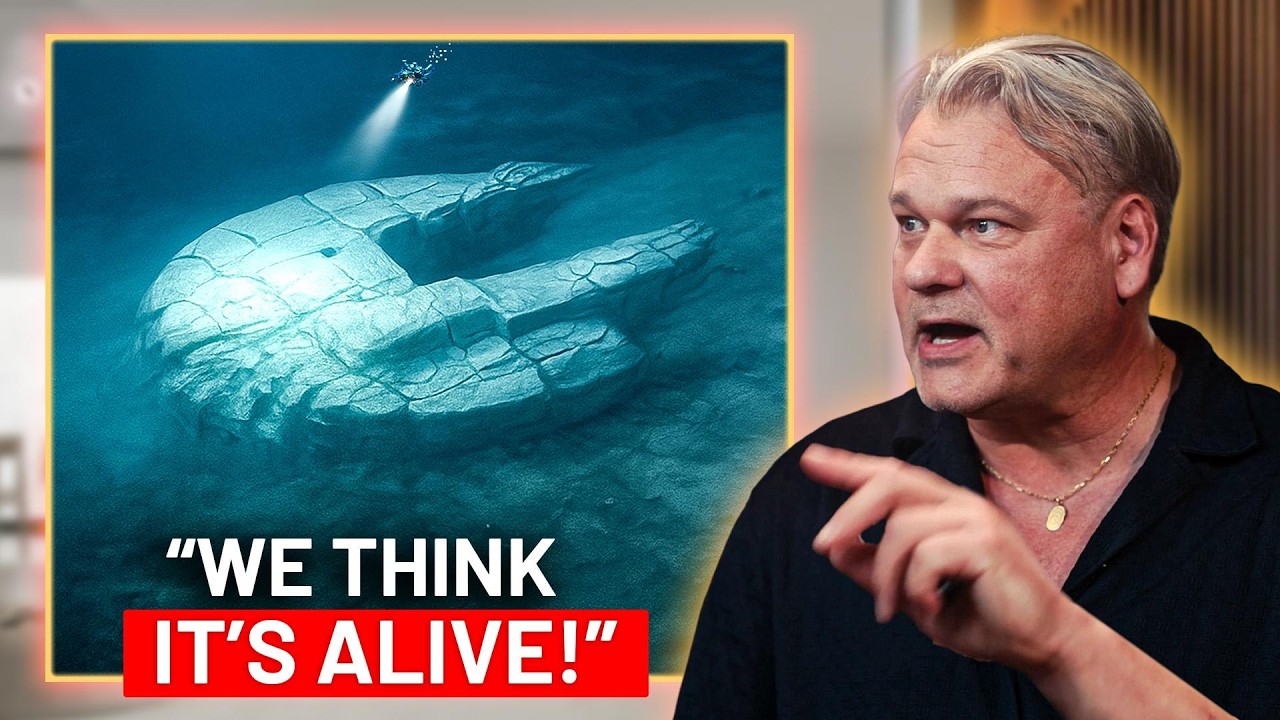
Dennis Asberg, a Swedish treasure hunter and founder of Ocean X, discovered a massive anomalous object on the floor of the Baltic Sea in June 2011, roughly 60 km out between Finland and Sweden, at a depth of 90 meters. The object, now known as the Baltic Sea anomaly, is approximately 60 meters in diameter (about 3,000 square meters), circular in shape, and features corridors with flat walls, 90-degree angles, and holes — characteristics that look artificial. It has become one of the most debated underwater discoveries in recent history, with theories ranging from a crashed UFO to an ancient man-made structure to a natural geological formation. Dennis has spent over 15 years trying to get serious scientific attention on the object, facing skepticism, institutional resistance, and even threats to his family.
Discovery and Initial Investigation
Dennis and his colleague Peter Lindberg were out searching for a shipwreck carrying champagne when their boat began leaking and nearly sank. After repairs, they decided to scan a new area with side scan sonar. Late at night, around 1–2 AM, they detected a massive circular object on the seafloor — 60 meters across — with Peter initially joking, “Dennis, here is a UFO.”
The sonar image showed a round structure with corridors, right angles, and holes — features that did not match any known wreck, mine, or natural formation they had ever encountered.
They consulted colleagues in the US, Australia, and Europe, none of whom had ever seen anything like it.
After a week of getting no answers, Dennis went public through the Swedish newspaper Expressen, which triggered a media firestorm — first in Sweden, then Scandinavia, then internationally. His phone rang day and night with journalists all asking the same question: what is it?
Physical Characteristics of the Object
The object is roughly circular when viewed from above, about 60 meters in diameter, with a circumference of approximately 180 meters. Its surface is rough and jagged rather than smooth, with visible corridors, flat walls, and 90-degree angles that suggest artificial construction.
There is a large hole approximately 2 meters in diameter with a frame around it, as well as smaller holes. One smaller hole (about 20 cm) was observed by diver Stefan Hogeborn to have sediment flowing in and out rhythmically, which Dennis describes as “breathing” — almost like a biological organism.
When Stefan brushed away sediment from the surface, the material underneath was dark gray to nearly black. He described the object as extremely hard — too hard to take a sample from — and noted the water temperature near it was almost freezing (near 0°C), compared to the usual 4–5°C at that depth.
Loose stones found on top of the object were tested in Israel and found to contain minerals including basalt (volcanic rock), which is unusual for the Baltic Sea since there are no volcanoes in the region. Scientists suggested the basalt may have been carried there by glacial meltwater at the end of the last ice age.
A small triangular piece (15–20 cm) with a perfectly round hole in it was also found on the object, appearing almost laser-cut.
Electromagnetic and Environmental Anomalies
Every expedition to the site has been plagued by equipment malfunctions that intensify the closer the team gets to the object. These anomalies include:
GPS failure: The team’s GPS systems lose connection entirely when passing over the object. This happened again in June 2025 with Stockholm University’s research ship using their own independent equipment, ruling out faulty gear.
Radar anomalies: The radar shows phantom objects (e.g., something appearing 150 meters away when nothing is visible). The radar also shows objects that shouldn’t be there.
ROV and camera failure: Remote-operated vehicles stop working near the object. Cameras and lights fail during dives.
Compass interference: Compasses behave erratically in the vicinity.
Lightning strikes: Lightning has been observed hitting the water directly above the object, as if it acts as a conductor. Dennis has filmed this.
Thunder localized to the spot: Thunder and weather phenomena occur specifically over the object and nowhere else nearby.
A Finnish colleague who was initially skeptical (“it’s just a stone”) brought his own ROV equipment to the site in 2019. Upon seeing the object, he immediately said, “This must be man-made. This is constructed. It looks like a power line — something putting out high voltage energy.”
Evidence It Is Not a Natural Geological Formation
Sub-bottom profiling (a radar-like technique that sees beneath the seafloor) has shown that the object is separated from the seabed — it is not attached to the ocean floor and is not part of an underwater mountain or rock formation. This is one of the most significant findings from the most recent expedition.
Dennis emphasizes: “The data says it’s not a geological formation. It’s an object.”
Scientists and experienced underwater professionals who have examined the data all say they have never seen anything like it.
It cannot be a volcano (no volcanic activity in the Baltic Sea), a meteor (no crater — the object is standing up), or a simple rock (the angles, corridors, holes, and separation from the seabed rule this out).
Military and Government Interest
During multiple expeditions, Dennis and his crew have been surrounded by NATO naval ships — French, German, American, and British — as well as a Swedish coast guard corvette. Dennis filmed six to seven large military ships encircling them in the middle of the Baltic Sea.
When the Swedish corvette blocked their search pattern, the crew radioed to say they had divers in the water and asked the ship to move. It did, but remained in the area.
Dennis was summoned to the Swedish military headquarters in Stockholm (and separately contacted by the Swedish equivalent of the FBI, SÄPO) — but in the case of the military meeting, it was explicitly about the Baltic Sea anomaly. When he confronted a military official — “You have been filming us, I have filmed you, so I know you have been there” — the official said nothing.
The object sits in the Finnish international economic zone, not Swedish waters, making the presence of Swedish military ships there unusual.
During the most recent June 2025 expedition, no military ships appeared — which Dennis found notable, speculating it may be because the ship used was owned by the Swedish government (Stockholm University’s vessel), meaning authorities would receive the data regardless.
Dennis’s Personal UFO Experience (1996)
Before discovering the Baltic Sea anomaly, Dennis had a life-changing UFO sighting in the summer of 1996. He was living near a Swedish military installation outside Stockholm. At around 3:30 AM — unusual for him, as he normally slept deeply — he woke up for no apparent reason and looked out his bedroom window.
He saw a large, round, brownish-yellow object hovering over the military installation, roughly 0.5 to 1.5 km away. It reflected sunlight and moved slowly before disappearing in about 1.5 seconds. He estimated it was 600–700 meters in diameter.
He tried to get his wife to see it, but by the time she got up, it was gone. He spent the rest of the morning trying to explain what he saw to his two young sons.
He investigated whether anyone else had seen it — checking local papers, military sites, and talking to friends in the military — but found nothing. He contacted UFO Sweden but received no response.
This experience completely transformed his worldview. Before 1996, he had no interest in UFOs — he had only seen Star Wars and ET. Afterward, he became convinced that humanity is not alone and that something is here.
He later discovered the military installation near his home was involved in plutonium enrichment — a pattern consistent with UFO sightings over nuclear sites worldwide (e.g., Hanford and Savannah River Site in the US).
The Path Forward: Scientific Investigation
For 15 years, Dennis struggled to get scientists and institutions seriously interested, largely because of the “UFO stigma” associated with the object. Many expressed interest but refused to get involved publicly.
About two years ago, he met Beatrice Viorica, a researcher who became the key collaborator who “opened the doors” to the scientific community. She connected Dennis with credible scientists who are now actively involved in the investigation.
The team’s next steps include:
Core drilling — both from the object itself (if possible, as it is extremely hard) and from the surrounding sediment and the track leading to the object, to analyze layers and determine how long it has been there.
Geiger counter measurements to test for radioactive activity.
More detailed sonar and 3D mapping using multibeam sonar from Stockholm University’s research vessel.
Using a smaller ROV equipped with sonar to explore the large 2-meter hole in the object, since visibility is near zero at that depth.
The team plans to document everything on film, potentially partnering with a production crew to create a full record of the investigation.
Dennis’s ultimate goal is simple: the truth. Whether it’s a rock, a volcano, a crashed UFO, or an ancient structure, he wants to know. He is committed to being open with all findings regardless of the conclusion.
Broader Context: Underwater UFOs and Transmedium Objects
Dennis notes that since going public in 2011, he has received countless emails and letters from people worldwide — including former navy officers — reporting sightings of cigar-shaped objects crashing into water.
The Baltic Sea has a long history of “ghost rocket” anomalies in the 1940s — objects seen plunging into lakes and the sea but never found on land.
There are parallels with other underwater UFO accounts, including a reported encounter at Lake Baikal in 1982 where Soviet divers allegedly met tall humanoid beings and were “petrified,” and a similar account from Hawaii involving an organic, breathing object on the ocean floor.
US whistleblower Matthew Brown has referenced government documents describing transmedium objects — UFOs that travel between air and water — and the concept that some of these objects may be “built to spec” for specific purposes.
Dennis speculates that the Baltic Sea anomaly could be a purpose-built object — perhaps an ancient energy source or a disposed-of craft — that was designed for a specific function.
Threats and Personal Cost
Dennis and his family have faced serious threats over the years, including emails threatening him and his children, with specific references to which kindergarten and school his kids attended. He still has these emails.
Some people have told him he is “opening a gateway to hell.”
His family initially struggled with the public attention and danger, asking him why he was putting them in this situation. They have ultimately supported him because they understand how important this is to him.
Despite the threats, the skepticism, and 15 years of struggle, Dennis remains undeterred. He believes the very intensity of the threats implies that whoever is sending them believes the object is real.
Dennis’s Vision
Dennis dreams of one day having the object — or a piece of it — in a museum, where children can see it and be inspired by the possibility that the universe holds things beyond our current understanding. He compares it to how the pyramid inspired him as a kid growing up near one.
He believes the phenomenon reveals itself to those who approach it with openness, curiosity, and love for humanity — and that it “rejects” those who don’t have that orientation.
He sees a deep connection between his 1996 UFO sighting and his 2011 discovery, suggesting that the experience may have been what prepared him — or even guided him — to find and persist with the Baltic Sea anomaly. He woke up at 3:30 AM that morning for no explainable reason, and he believes it was part of a larger plan for him to witness what he saw.