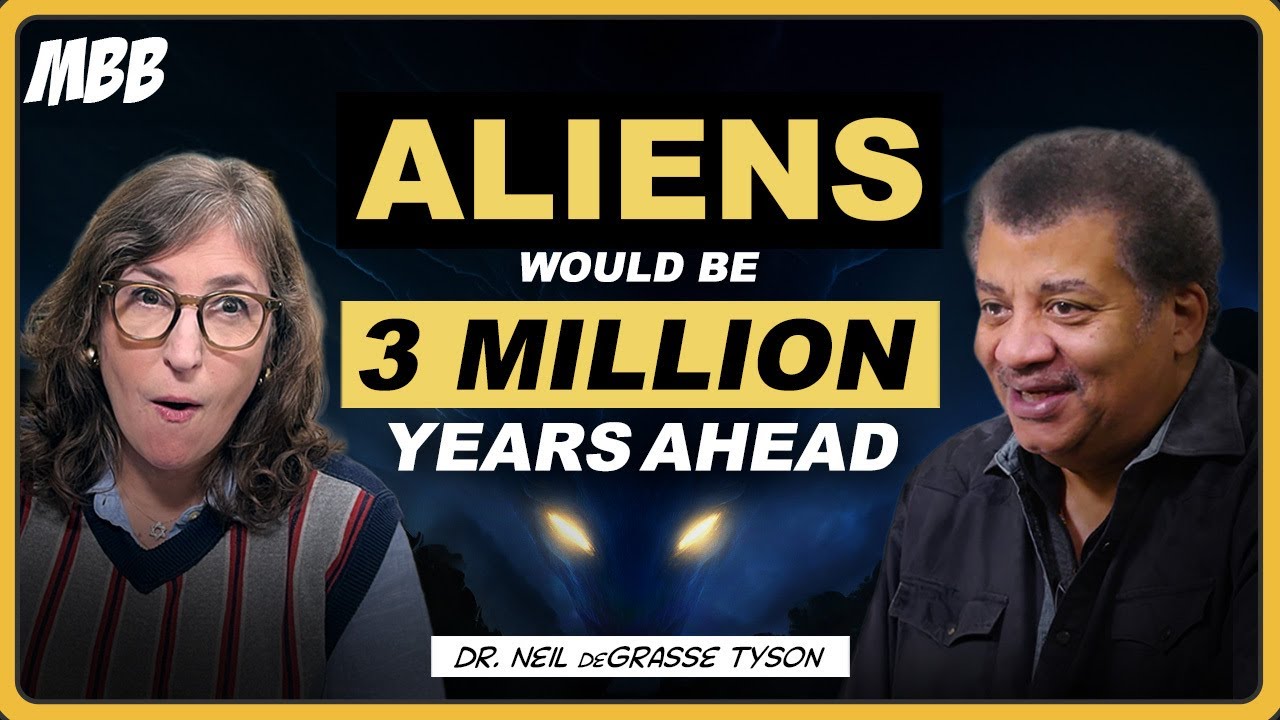
Astrophysicist Neil deGrasse Tyson joins the podcast to explore the biggest unanswered questions in science and spirituality — from dark matter and simulation theory to near-death experiences, the multiverse, and whether we’re smart enough to ever truly understand the universe. He argues that science, unlike religion, does not invoke the divine to explain the unknown, and that the frontier of mystery is not shrinking but expanding: as knowledge grows, so does the perimeter of ignorance. He is candid about what science does not yet know, open to the plausibility of simulation theory and alien superintelligence, and skeptical of claims that consciousness-expanding practices reveal objective external reality rather than internal brain states.
Science vs. Religion and the “God of the Gaps”
Before science, all unexplained phenomena — storms, disease, lightning — were attributed to gods or divine forces. Science has steadily replaced these explanations with testable, evidence-based accounts.
Tyson’s widely quoted line — “God is an ever-receding pocket of scientific ignorance” — is often stripped of its conditional framing. He clarifies: he is not declaring what God is, but observing that if God is defined as whatever science has not yet explained, then God necessarily shrinks as knowledge grows.
He distinguishes science from religion on a fundamental point: science never invokes divinity as an explanation, whereas every religious tradition does. This is what makes science categorically different from other attempts to understand the world.
He has made a deliberate effort to read religious texts (Torah, Hindu tracts, Mormon accounts, Jehovah’s Witness pamphlets) so he can engage with people of faith with sensitivity rather than dismissiveness.
On the misuse of the word “theory”: a scientific theory (evolution, relativity, quantum theory) is not a guess — it is a rigorously tested framework that organizes observable phenomena and makes verified predictions. The word reflects humility, not uncertainty.
Has Science Dismissed the Mystical Too Aggressively?
Tyson’s view: science cannot “go too far” because its purpose is to replace fear of the unknown with understanding. He cites Carl Sagan’s A Demon Haunted World — science as a candle in the dark.
He acknowledges that medicine has sometimes been dogmatic (e.g., doctors refusing to wash hands, the long separation of mind and body in medical thinking), but argues these were failures of insufficient testing, not failures of science itself. The scientific method ultimately corrected them.
He pushes back on romanticizing pre-modern life: cavemen who “ate organic” and “had clean water” still had a life expectancy of ~30. The doubling of human lifespan since the 1840s is attributable to germ theory, sanitation, and medical science — not diet or lifestyle trends.
On whether science can understand subjective experiences like love: Tyson argues it is entirely plausible that neuroscience could identify the brain centers involved in affection and even artificially stimulate them. He sees no principled boundary that science cannot cross, even if the experiment has not yet been done.
He notes that physics and cosmology are “easier” than neuroscience and medicine because the human body and mind are extraordinarily difficult to experiment on — much of what we know about the brain comes from studying injuries, not controlled experiments.
Simulation Theory
Tyson finds simulation theory difficult to argue against. His reasoning:
Computing power is growing exponentially. We already create simulated worlds (e.g., video games) with increasing sophistication.
In a future with quantum computing, a simulated being could have so many decision nodes that its experience of “free will” becomes indistinguishable from actual free will.
If simulated civilizations can themselves create simulations, the result is a fractal cascade of universes. The probability that any randomly selected universe is the “original” real one is vanishingly small.
His softening argument: we currently lack the computing power to create such a simulation, so we are either the first real universe or a simulated one that has not yet reached that capability — making it a 50/50 proposition rather than a near-certainty.
He connects this to the idea that we could be someone else’s simulation — an aquarium or terrarium constructed for amusement by a vastly more intelligent species.
Are Nonhuman Intelligences Watching Us?
Tyson is fully open to the existence of superintelligent alien life. What keeps him up at night is not whether aliens exist, but whether humans are neurologically capable of ever understanding the universe.
His argument from comparative genetics: humans share ~98.5% of their DNA with chimpanzees. That ~1.5% difference is what separates stacking boxes to reach a banana from building the James Webb telescope. A species just 1.5% beyond us on that same vector would find our greatest intellectual achievements trivial — the way our toddlers outperform the smartest chimp.
He speculates that such a species could regard us the way we regard pets — or even less. If aliens found us and wanted to make us their pets, “that’s the best we might be able to hope for.”
He is skeptical of claims that aliens are visiting Earth (UFO sightings, abductions), but fully entertains the possibility that vastly more advanced beings exist and may be observing us without interference — consistent with the zoo hypothesis.
He notes that any civilization significantly more advanced than us would likely have merged with or become AI, having used technology to augment or replace biological components.
Multiverse Theory
Tyson distinguishes between different types of multiverse:
Bubble universes within shared spacetime: Our universe is one expanding bubble among many, all governed by the same laws of physics. These bubbles are expanding faster than they can overlap, so contact between them is unlikely.
Quantum multiverse: Every quantum event spawns a new universe with slightly different physical properties (electron charge, antimatter behavior, amount of matter). These universes would be radically different from ours and unlikely to support recognizable life.
He traces the historical pattern of ego-demotion in science: Copernicus showed Earth is not the center; Giordano Bruno (burned at the stake in 1600) proposed that stars are suns with their own planets and possibly life. Bruno’s last reported words: “Your god is too small.”
Tyson argues that resistance to the multiverse is just the latest chapter in humanity’s long reluctance to accept that we are not special or central.
Near-Death Experiences and Consciousness
Tyson is skeptical of near-death experiences (NDEs) as evidence of an afterlife or external reality. He proposes a simple test: place a written message on a high shelf above the operating table that could only be seen from an out-of-body vantage point. No NDE account has ever passed this test.
He recounts a story of a criminal who, after being shot and resuscitated, claimed his dead brother appeared in “heaven” and pushed him back to life. Tyson notes the “heaven” description matches the operating room — bright lights above, chest compressions — and the brain constructed a narrative from sensory input.
On meditation, psychedelics, and mystical states: Tyson does not deny that people have profound experiences, but argues these are internally generated brain states, not windows into objective external reality. He challenges: if meditative trances revealed new testable laws of physics, he would take them seriously. So far, they have not.
He acknowledges that meditative states are reproducible and share common features across cultures, which tells us something interesting about the shared biology and evolutionary origin of the human mind — but not about the nature of external reality.
On psychedelics specifically: he is deeply skeptical, arguing the brain is already prone to error (optical illusions demonstrate this) and adding chemicals does not bring one closer to objective truth.
Time, Timelines, and the Akashic Records
Tyson is drawn to the idea of accessing the full timeline of one’s life — as depicted in Kurt Vonnegut’s Slaughterhouse-Five, where aliens give a human the ability to move freely along his own timeline. He notes that we are “prisoners of the present,” forever between an inaccessible past and an unknowable future.
On the Akashic Records (a concept from various mystical traditions holding that all events and thoughts are recorded in a collective consciousness): Tyson is unconvinced. He argues that if telepathy or mind-reading were real, it would have shown up in exquisitely sensitive experiments like LIGO (which can detect vibrations from someone walking half a mile away). It has not.
He emphasizes that all human perception is a constructed representation — the brain receives sensory data, interprets it, and produces a model of reality that may differ from person to person. This is precisely why science was invented: to disentangle subjective experience from objective truth.
What Science Does Not Yet Know
Tyson’s five biggest open questions:
Dark matter: We can measure its gravitational effects but do not know what it is.
Dark energy: We can measure it but do not know what it is. Together, dark matter and dark energy constitute ~95% of what drives the universe — meaning everything we know (chemistry, biology, physics) operates in ~4-5% of reality.
The origin of life: We do not know how nature went from organic molecules (which form easily) to self-replicating life. We cannot reproduce this in the lab.
What preceded the Big Bang: Unknown, and Tyson is comfortable saying so.
Are humans smart enough to figure out the universe? He worries we may only be clever enough to build incrementally on prior discoveries without ever grasping the full picture — the way a chimp cannot learn long division no matter how hard it tries.
Closing Thoughts
Tyson embraces the unknown as a source of excitement, not discomfort. He quotes Rilke: “Learn to love the questions themselves.”
His closing message: of all human inventions, science is uniquely capable of securing our health, wealth, and future. Rejecting or denying science is the path back to the caves.
He is comfortable with uncertainty about what came before the Big Bang, what consciousness ultimately is, and whether we are alone — because the questions themselves are what drive discovery forward.