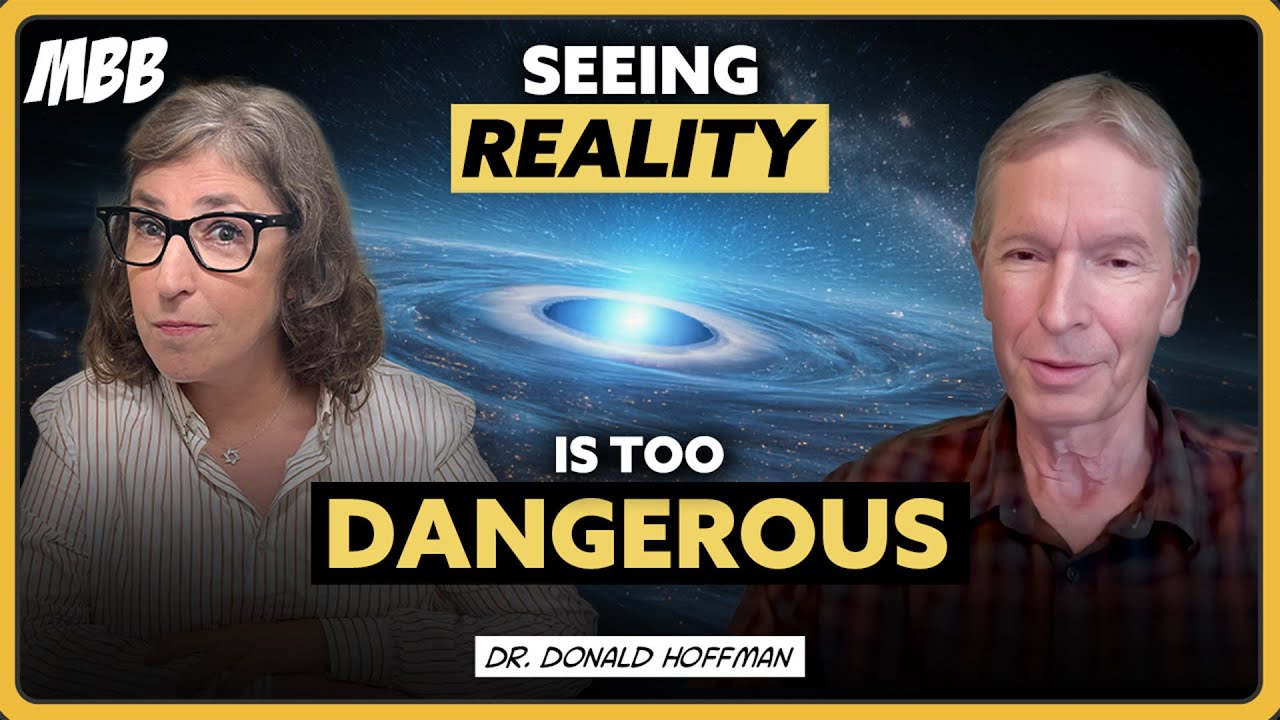
Dr. Donald Hoffman, a cognitive science professor emeritus from MIT, argues that spacetime is not fundamental reality but a kind of “VR headset” that consciousness uses to filter and construct our experience. His latest book, The Case Against Reality, lays out a case—grounded in evolutionary game theory, neuroscience, and high-energy physics—that the world we perceive is an interface hiding a deeper, non-physical reality, and that consciousness, not matter, is the true foundation of everything.
Why spacetime is not fundamental
High-energy theoretical physicists have concluded that spacetime breaks down at the Planck scale (around 10⁻³³ cm and 10⁻⁴³ seconds), meaning it cannot be the final layer of reality.
Physicists are now exploring “positive geometries”—static, higher-dimensional shapes outside spacetime whose volumes and surfaces encode the probabilities of particle interactions inside spacetime.
Quantum theory also lacks a theory of the observer: it treats measurement and observation as central but has no account of what an observer actually is.
Hoffman’s core claim: spacetime is a headset, and what lies beyond it is a deeper reality that is not physical in the traditional sense.
Evolution hides the truth from our eyes
Using evolutionary game theory, Hoffman and colleagues proved that the “fitness payoff functions” driving natural selection place no structural constraints on what our senses evolve to represent.
This means there is zero probability that our sensory systems evolved to show us objective truth about reality—only “satisficing” hacks good enough for survival.
A concrete example: male jewel beetles in Australia attempt to mate with dimpled, glossy brown beer bottles (“stubbies”) because those cues trigger their mating behavior—showing that evolution favors cheap shortcuts, not accurate perception.
Even humans with large brains are not exempt: our perceptual systems are shaped by the same payoff-driven logic, not by a drive toward truth.
Consciousness as the foundation: the “conscious agents” theory
Hoffman proposes a mathematical model of consciousness using Markov chains: each conscious agent is described by a matrix where each entry gives the probability of transitioning from one experience to another.
Starting only from these probabilistic transitions between experiences (no physics, no spacetime assumed), he and collaborators discovered a new mathematical structure they call “trace logic.”
Trace logic describes how smaller conscious agents can be combined into larger ones, forming an infinite hierarchy with no top—an infinite number of infinities of possible conscious agents.
This structure resonates with spiritual concepts of God as infinite, and with the Hebrew name for God meaning “without end.”
How spacetime emerges from consciousness
The theory shows that a specific class of Markov chains (called “n-cycles”) naturally produces the time dilation and length contraction described by Einstein’s special relativity.
The mechanism works like this: a larger Markov chain (e.g., red/yellow/green) induces a dynamics on a smaller subset (e.g., red/green only), and the smaller subset’s “clock” runs slower—exactly matching relativistic time dilation.
Length contraction emerges from “commute times” between states in the Markov chain, which correspond to Euclidean distances.
The conjecture is that in the limit of infinitely many experiences, these discrete structures yield the smooth Minkowski spacetime of special relativity, and more complex matrices could yield the curved spacetime of general relativity.
The long-term behavior of these systems also reproduces the wave functions of quantum mechanics.
Why this matters: science and spirituality converging
For centuries, science and spirituality have been split: science has mathematical rigor but assumes spacetime is fundamental; spirituality claims consciousness is fundamental but lacks mathematical tools.
Hoffman argues both sides now need each other: physicists have positive geometries but no dynamics or interpretation; spiritual traditions have insights but no testable, mathematically precise theories.
His framework aims to give a mathematically rigorous account of consciousness outside spacetime that can make the same predictions as general relativity and quantum theory—and eventually new predictions that can be tested.
Practical and existential implications
If spacetime is a headset and we learn to program it, technologies could emerge that look like magic today: teleportation across galaxies, time travel, limb regeneration, language download, and unlimited energy—because we would be operating outside the rules of the headset.
But the same power could be used destructively: “playing God” inside the headset could make reality nightmarish for others.
On a personal level, the theory implies that death is simply removing the headset—you are infinite consciousness temporarily experiencing a finite avatar, and when that avatar ends, the underlying consciousness continues.
Hoffman acknowledges that even after 40 years of working on this, he still feels emotionally attached to his avatar and fears death—underscoring how deeply we are “chained” to our bodies and identities.
The theory suggests that “your neighbor is yourself” viewed through a different headset, which, if taken seriously, could motivate less ego-driven, more compassionate behavior—though Hoffman is cautious about expecting rapid cultural change.
What this means for everyday life
Just as we learned that dogs hear frequencies we cannot, and that optical illusions reveal the limits of perception, Hoffman’s work suggests our entire experience of spacetime is a narrow-band filter on a vastly larger reality.
The invitation is to hold your current certainties lightly: what feels like undeniable reality is a construction, and what lies beyond it may be accessible through mathematics, meditation, and perhaps new technologies.
Near-death experiences, where people report ego dissolution and a sense of unity with all consciousness, are consistent with the headset model—but Hoffman insists on remaining a “hard-nosed scientist” who demands theory and repeatable experiments before drawing conclusions.