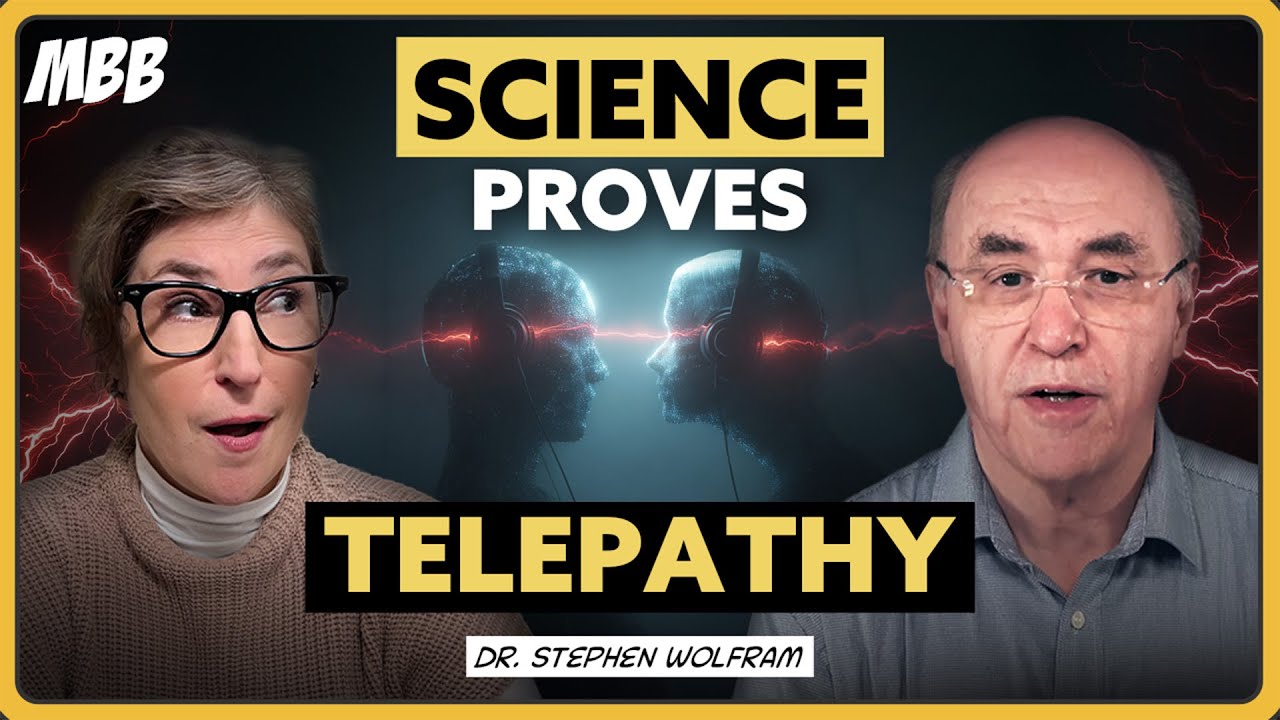
- Theoretical physicist and computational pioneer Stephen Wolfram discusses the foundations of physics, biology, consciousness, and alien intelligence through the lens of his life’s work on computation and complexity. He argues that the universe operates according to simple underlying rules that produce irreducible complexity, and that this framework reshapes how we understand everything from quantum mechanics to free will to the limits of medicine.
The Computational Universe and the Nature of Space
-
Wolfram’s central discovery, dating to the 1980s, is computational irreducibility: even when you know the exact rules governing a system, you often cannot predict what it will do without running every step. This breaks the traditional scientific assumption that knowing the rules lets you jump ahead to the outcome.
- This means many systems in nature are fundamentally unpredictable in practice, even if their rules are simple.
- It is the same phenomenon that makes machine learning work: neural networks can learn coarse tasks (distinguishing cats from dogs) but not highly precise ones (computing thousands of digits of pi), because coarse tasks are “reachable” through small adjustments in a rich computational space.
-
What the universe is made of: Wolfram proposes that space itself is not continuous but made of discrete “atoms of space” — points connected in a vast relational network. Everything in the universe is just the connectivity of this network.
- Time progresses as simple computational rules are repeatedly applied to this network, transforming its structure step by step.
- On large scales, this model reproduces known physics: the structure of spacetime, gravity, and relativity emerge from the underlying discrete network, much as the continuous flow of water emerges from discrete molecules.
- The scale of these atoms of space may be around 10⁻¹⁰⁰ meters — far smaller than anything currently measurable — meaning we may not be in the right century to experimentally confirm their existence.
-
The Ruliad: Wolfram’s concept for the entangled limit of all possible computational rules being applied simultaneously. Rather than the universe following one specific rule, all possible rules are running at once.
- What we perceive as “our universe” is our particular position or sampling within this vast space of all possible rules.
- Different minds, alien or otherwise, would exist at different positions in the Ruliad and perceive entirely different laws of physics — the universe might appear one-dimensional or infinite-dimensional to them.
Quantum Mechanics, Time, and Perception
-
Quantum mechanics as many threads of time: In Wolfram’s model, quantum mechanics arises because there are many possible ways to apply the rules at each step, producing many branching “threads of time” or histories for the universe.
- Each sequence of rule applications gives a different detailed history; quantum probabilities reflect our sampling across these branches.
- The mystery of why we perceive definite outcomes is explained by our minds doing the same kind of branching-and-merging as the universe — we perceive one aggregated thread.
-
Time is not fundamentally linear: There is no single thread of time in the universe. We aggregate many threads into what we experience as a single flowing timeline.
- Wolfram introduces the concept of “subtime” — what happens at the level of individual updates of the universe — versus time as we perceive it, which depends on detectable changes in state.
- If the universe returned to an identical state, with your mind also identical, it would be as if no time had passed, since there would be no detectable change.
-
Perception is scale-dependent: Our belief in a three-dimensional space that can be captured “at an instant” is a consequence of our particular scale and processing speed.
- Light crosses a room in microseconds; our brains take milliseconds to process it, so we perceive the room as a single spatial snapshot.
- A brain that processed a million times faster would not have this notion of simultaneous spatial states — the concept of “space at a moment” would not be natural to it.
- The fact that humans agree on an objective reality is a consequence of our biological similarity; a dog, relying primarily on smell, would have a somewhat different “physics.”
Consciousness, Free Will, and the Soul
-
Free will as computational irreducibility: Wolfram argues that free will is not mysterious — it is the ubiquitous consequence of computational irreducibility. Even though a brain is “programmed” by its biology, no external observer can predict what it will do without running the same computational steps.
- The old science-fiction idea that a programmed robot has no free will assumes you can predict the program’s output. Computational irreducibility says you generally cannot.
- Free will is therefore not special to humans but is a feature of many complex computational systems in nature.
-
Consciousness as a specialized process: Wolfram sees consciousness as more specific and less universal than free will. Its essential feature is taking in vast amounts of sensory data and compressing it down to a single thread of experience — a decision about what to do next.
- This “concentrating down” is what distinguishes conscious systems from, say, the weather, where every piece does its own thing without being unified into one thread.
- AI systems that classify images (cat vs. dog) are doing something structurally similar: taking many possible inputs and reducing them to one output.
- Consciousness is not “the top of the pile” in the universe — it is a subcase of what can happen, significant to us but not to the weather.
-
The soul as an abstract computational entity: Wolfram reinterprets the ancient concept of the soul as the abstract computational process that a mind performs, independent of the physical details of how neurons happen to work.
- He sees this as an example of old theological or philosophical ideas that were expressed in primitive terms but were reaching toward something real that science can now describe more precisely.
- He is cautious about dismissing traditional knowledge systems simply because they don’t align with mathematical science, while acknowledging that formal connections have not yet been made.
Biological Evolution and the Limits of Medicine
-
Why evolution works: Wolfram’s recent work addresses why biological evolution doesn’t get stuck. The answer lies in the combination of two facts:
- Simple programs can produce enormously complex behavior, so small mutations (small changes to the program) can produce large, unpredictable changes in the organism.
- The criteria for evolutionary fitness are coarse — organisms don’t need to compute pi to a thousand digits; they just need to survive and reproduce in a rough, forgiving way.
- This means the space of possible programs contains reachable paths to successful organisms, even though most details of how biology works are essentially accidental — “it happened to fit that way.”
-
Why medicine is fundamentally hard: The core problem of medicine is perturbing a system that has been shaped by billions of years of evolution to return it to its original state. This is computationally very difficult.
- Reductionist approaches fail because evolved systems are not modular — you can’t take out one piece and understand it in isolation, and poking one part to fix it often doesn’t work because everything connects to everything.
- Wolfram suggests that regeneration (rebuilding systems from scratch, as each new generation essentially does) is more promising than trying to repair a perturbed system.
- This framework explains why Western medicine struggles with complex, systemic conditions like perimenopause, autoimmune disease, and mental health — these are not problems with simple reductionist solutions.
-
Living matter as orchestrated molecular processes: Wolfram has recently begun developing a framework for understanding what he calls the “bulk orchestration” of molecular processes in living systems — the purposeful-seeming cooperative behavior of molecules inside cells that goes beyond simple chemistry.
Aliens, Communication, and Interconcept Space
-
Alien intelligences are everywhere: In the Ruliad, there are many systems doing mind-like computation. The weather, fluid dynamics, and many other physical processes are computationally as sophisticated as brains.
- The question is not whether aliens exist but whether any alien mind is close enough to ours in “rule space” (the space of possible rules) that communication is possible.
- The distance in rule space between minds is vastly greater than the physical distance between stars, making alignment extremely difficult.
-
AI as a test case for alien minds: Modern neural networks are alien minds that we can experiment with. Training aligns them with human-like tasks, but modifying their internals even slightly produces outputs that are incomprehensible to us — the cat image dissolves into bizarre colors and patterns.
- This demonstrates “interconcept space”: the vast domain of things that can be produced by minds but that humans have no words or concepts to describe. Human language covers only tiny islands in a much larger space of possible outputs.
-
The challenge of communicating with aliens: For communication to be possible, there must be a shared language or formalism that allows internal thoughts to be externalized and understood by another mind.
- Human language is surprisingly simple in structure (as revealed by large language models), which may limit its usefulness as a bridge to alien cognition.
- If we had brains 1,000 times larger, we might invent abstract concepts completely inaccessible to us now — suggesting there are levels of understanding our biology simply cannot reach.
-
The Arrival film: Wolfram served as a science consultant on the film Arrival, which explores what it would take to communicate with an alien species. The film’s central insight — that understanding alien communication requires stepping outside your own perceptual and cognitive framework — aligns with Wolfram’s view that serious engagement with anything outside your given reality (aliens, quantum mechanics, consciousness) requires expanding the paradigms you use to describe the world.
Telepathy, Psi, and the Externalization Problem
-
Internal experience vs. externalization: Every mind has internal experiences, but the critical question is whether those experiences can be externalized in a way others can understand. Without a shared language or formalism, internal feelings remain private and cannot enter the collective knowledge base.
- Wolfram draws an analogy to mathematics before formal notation existed: people may have had geometric intuitions but no way to communicate them precisely.
- He is skeptical of telepathy claims not because he rules them out absolutely but because the mechanism is unclear and the evidence is difficult to formalize.
-
Computers and electromagnetic “telepathy”: Computers emit and are affected by electromagnetic radiation, but the signals are chaotic and carry no structured information. Real communication between computers requires packaging data into agreed-upon formats — essentially, language.
- By analogy, even if brains emit some kind of signal, meaningful communication would require a shared encoding system, not just raw signal detection.
-
A history of declaring things impossible: Wolfram emphasizes that science has a terrible track record of declaring things impossible that later turned out to be possible. Faster-than-light travel, unscrambling eggs, and sensing magnetic fields were all once dismissed.
- He argues that many “impossibility” claims are really statements about the limits of current perception and technology, not fundamental limits of nature.
Language, Scale, and the Construction of Knowledge
-
Language shapes thought: Wolfram, who designed the computational language behind Mathematica and Wolfram Alpha, argues that the formalisms we use to describe the world directly affect what we can think about it.
- The invention of mathematical notation 500 years ago enabled algebra and calculus; similarly, computational notation enables new kinds of science.
- Human languages may limit or enable certain concepts — the number of words a culture has (e.g., for snow or love) reflects and constrains the distinctions its speakers can easily make.
-
Scale and significance: Humans are tiny relative to the universe (~1 meter vs. ~10²⁶ meters across) but enormous relative to the atoms of space (~10⁻¹⁰⁰ meters). We are mid-scale objects in a vast hierarchy.
- Everything we experience — tables, ants, algae, our own bodies — is made of the same underlying stuff: the connectivity of the spatial network, ultimately derived from simple computational rules.
- The fact that all matter is made of identical copies of a small number of elements (carbon atoms are all identical) is already surprising; the deeper realization is that all these elements are themselves the same underlying structure of space.