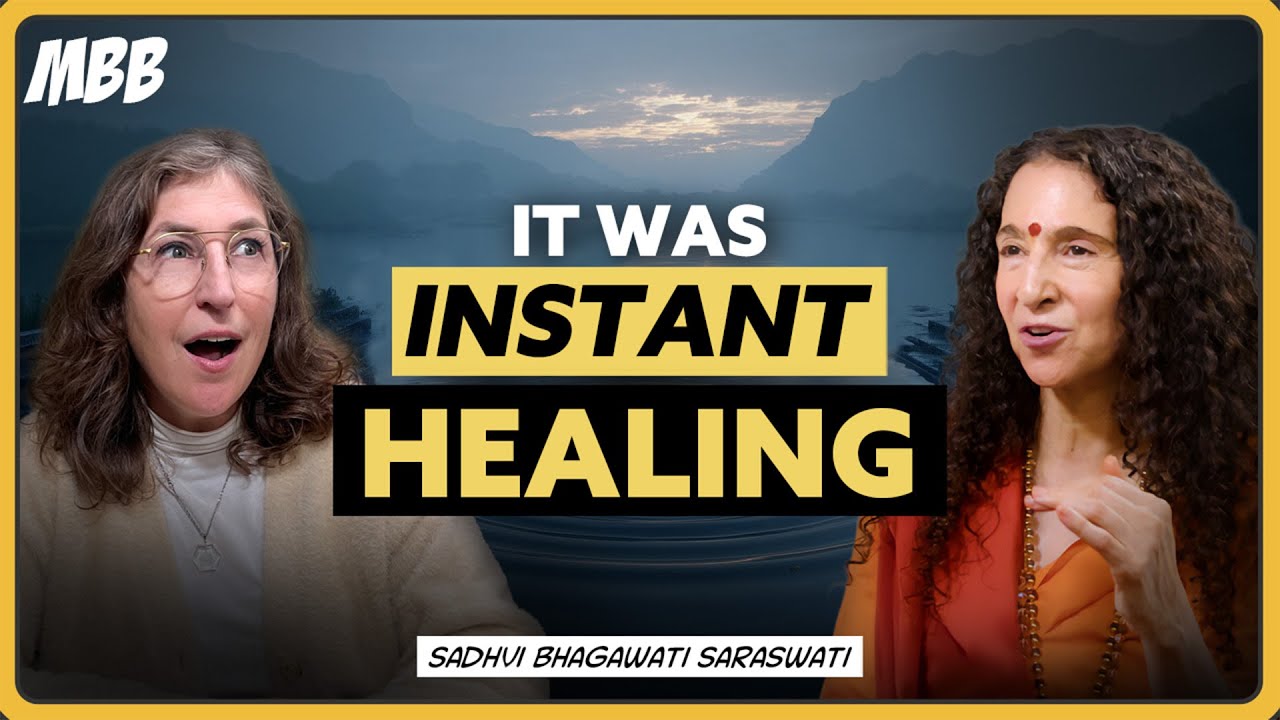
Sadhvi Bhagawati Saraswati is an American-born Stanford graduate with a PhD in psychology who, at age 25 in 1996, had a sudden and permanent spiritual awakening on the banks of the Ganges River in Rishikesh, India, that instantaneously healed her of bulimia, depression, anxiety, and deep trauma from childhood sexual abuse and abandonment. She has lived as a monk in the Himalayas for 30 years, is the international director of Parmarth Niketan, and is a global spiritual leader who speaks at the United Nations and has the Dalai Lama’s support. Her memoir Hollywood to the Himalayas tells her story, and her latest book Come Home to Yourself offers practical spiritual guidance drawn from daily question-and-answer sessions with seekers from around the world.
The Awakening on the Ganges
In September 1996, Sadhvi (then a non-believing scientist reluctantly following her husband to India) stood on the banks of the Ganges River in Rishikesh and experienced what she describes as a direct encounter with the divine.
Her visual field split: the background remained the physical scene, but the foreground became a merging and melting of light, energy, and presence, as though all separate things were revealed to be one unified divinity.
When she turned that vision inward, she realized she was not separate from this divine presence. The insight struck her to the ground in tears: she was not broken, tainted, or worthless. She was whole and inseparable from divinity.
The experience was not drug-like: it had no half-life. When her husband challenged her to leave Rishikesh to test whether the experience was location-dependent or chemically induced, the state persisted unchanged. It was external and internal simultaneously, with no distinction between the two.
She was rendered nearly nonverbal for days, able only to say, “Oh my God, it’s so beautiful.”
What Changed Instantaneously
Abandonment wounds vanished. Sadhvi had suffered severe abandonment trauma from childhood, which manifested as codependent clinging in relationships. When her husband said he was going to the mountains and she could come or not, she felt calm for the first time. She did not need him to fill what she calls the “God-shaped hole.” That hole had been filled with God.
Bulimia disappeared overnight. She had been severely bulimic, hospitalized multiple times, vomiting up to 20 times a day. After the awakening, she sat cross-legged on the floor in the ashram eating whatever was served from metal buckets with no anxiety, no compulsion to purge. The attachment between food and emotional response was simply gone.
The inner critic went silent. The voice that had driven her to overachieve, to white-knuckle every aspect of her life, fell quiet. She felt secure, not afraid, not less than.
She spent months deliberately trying to re-trigger herself, looking for the old neurosis, testing whether seeing certain foods or situations would bring it back. The memories remained, but the emotional charge and compulsive behavioral response were uncoupled, similar to what EMDR therapy aims to achieve.
The Science-Spirituality Interface
Sadhvi emphasizes that she was trained as a scientist and that her experience fundamentally defies the materialist framework she was educated in. Yet she sees growing overlap with quantum science.
Western psychology and psychiatry had helped her understand her patterns cognitively and emotionally, but they could only help her manage her life. Spirituality offered actual freedom.
She uses the analogy of the rope and snake: in dim light you see a snake and are terrified; when the light comes on, you see it is a rope. The object has not changed, but your relationship to it is permanently transformed. That is what awakening did to her self-identification.
She also uses the “exit sign” analogy: if you are driving and someone asks “who are you?” and you say “I am exit 51,” that is essentially what we do when we identify as our body, history, or roles. Those are locations, not identity.
The Guru and the Voice
After the initial awakening, Sadhvi heard a voice say “You must stay here” while walking through Parmarth Niketan. She ignored it twice, remembering a vow she had taken on the airplane to India to keep her heart open. The third time, she followed the voice to the office and asked to stay.
She met Swami G (the president of Parmarth Niketan, later her guru), expecting a man in a suit and instead encountering a saffron-robed spiritual master surrounded by people. She felt an oceanic, pervasive love, not a personal romantic love but an unconditional presence available to everyone.
When she tried to leave the ashram to join her husband, her feet literally would not move in the direction of the gate. She tested every direction scientifically: she could move backward away from the gate but not forward toward it, and not backward in the opposite direction. The only direction she could walk was back toward Swami G’s room. She surrendered and said, “I think I’m supposed to stay now.”
Dharma and Universal Intelligence
Sadhvi frames what happened through the concept of dharma—a divine or universal intelligence that guides beings toward their purpose, the same intelligence through which a caterpillar knows how to build a cocoon and a seed knows when to sprout.
Universal dharma is the same for everyone: to realize experientially the truth of who you are beyond body, story, and identity.
Individual dharma varies: hers was to walk a path of monastic renunciation and, through her own healing, become someone who could help others heal.
She does not see this as a controlling God but as a cosmic intelligence operating through nature. You can call it God, divine force, or universal intelligence.
Letting Go and Forgiveness
Sadhvi is clear that spiritual awakening is not spiritual bypassing. She had done years of therapy before India and had cognitively understood her trauma. Understanding alone did not free her.
Her guru sent her into the Ganges River after a sacred ceremony to offer all her anger and pain to the river and to forgive her biological father, who had sexually abused her as a child.
She held water from the river in her hands, offered it back, and continued until she could see her father’s face and say “I forgive you”—seeing him not as a monster but as a haunted man on his own karmic journey.
The letting go is not denial or belittlement of what happened. It is the recognition that the being who was abused does not share a single cell with who she is now (all cells regenerate within 7-8 years), and on a deeper level, the soul itself was never touched.
She distinguishes between the physical-level truth (the body has completely regenerated) and the soul-level truth (there is a self that is unchanging through all the decades of life, and that self is not defined by any experience).
Celibacy and Energy
Sadhvi took vows of celibacy, which she never anticipated. She describes the divine as having “sucked out” her attachment to everything that would no longer be part of her life—including sex, bagels, and avocados.
Sexual desire disappeared after the awakening and did not return for years. When it briefly resurfaced after a Bollywood actor expressed attraction to her, she went to her guru, who gave her yogic practices to transmute the energy upward through the chakras rather than suppressing or indulging it.
She emphasizes that celibacy is not required for enlightenment. Most sages in the Vedic tradition were householders. Krishna and Rama were married. Celibacy was her specific dharma, not a universal requirement.
The Guru-Disciple Relationship
Sadhvi addresses the cult and guru-abuse concerns directly. She acknowledges that charisma does not equal goodness and that many spiritual leaders have abused power.
She distinguishes between imperfect vessels and false teachings: perfect teachings can come through imperfect humans, just as the existence of abusive doctors does not invalidate medicine.
A real guru, she says, shines light on you, not on themselves. Swami G showed her that she was not broken, not damaged, but divine. That was the light of her, not his charisma.
She admits she fell in love with him and expected the relationship to become physical, as that was her trauma-informed template for worthiness. His complete disinterest in her body and his consistent redirection toward soul forced her to rebuild her sense of value entirely.
The devotion she feels is devotion to truth and to a path, not to a person. She describes it as being clay on a potter’s wheel: there are ego slaps and the fire of transformation, but the guru constantly reminds you it is not about them.
Is Awakening Available to Everyone?
Sadhvi believes spiritual awakening is available to everyone in this lifetime, but the universe is infinitely patient across many lifetimes.
Standing between most people and awakening is not what they lack but what they are holding on to: anger, grudges, unfulfilled expectations, identification with body, story, relationships, career, bank account.
The requirement is a willingness to let go and a trust fall into the unknown: “I don’t know who I would be without this story, but holding on to it is causing me suffering.”
Sacred places (like the Ganges) carry concentrated energy from millennia of sages meditating there, which can help align a person’s energy and give courage to see beyond habitual patterns. But awakening can happen anywhere.
She uses the suntan analogy: you are more likely to get a suntan at the top of a mountain, but the sun shines everywhere.
Integrating Spiritual Practice into Ordinary Life
Sadhvi’s book Come Home to Yourself is drawn from actual questions she answers every evening in satsung (gathering in the presence of truth) at Parmarth Niketan, covering grief, relationships, negativity, purpose, and the nature of the soul.
These teachings are meant for householders—people with jobs, marriages, and children—not just monastics. The Bhagavad Gita itself was spoken on a battlefield to a father and husband.
Community helps enormously because the energy is focused and the discipline is shared, but it is not strictly necessary. Online communities, local meditation groups, and cross-traditional gatherings are increasingly available even in small towns.
She recommends “micro-practices” throughout the day: every time you drink something, eat something, turn on the car ignition, or hit send on an email, take 30 seconds to drop in and re-remember. This works best when anchored to a longer daily meditation practice that “wires the home,” after which flipping the switch becomes nearly instantaneous.
She references research suggesting that if just 10% of people become conscious, it would create a tipping point for the entire world.