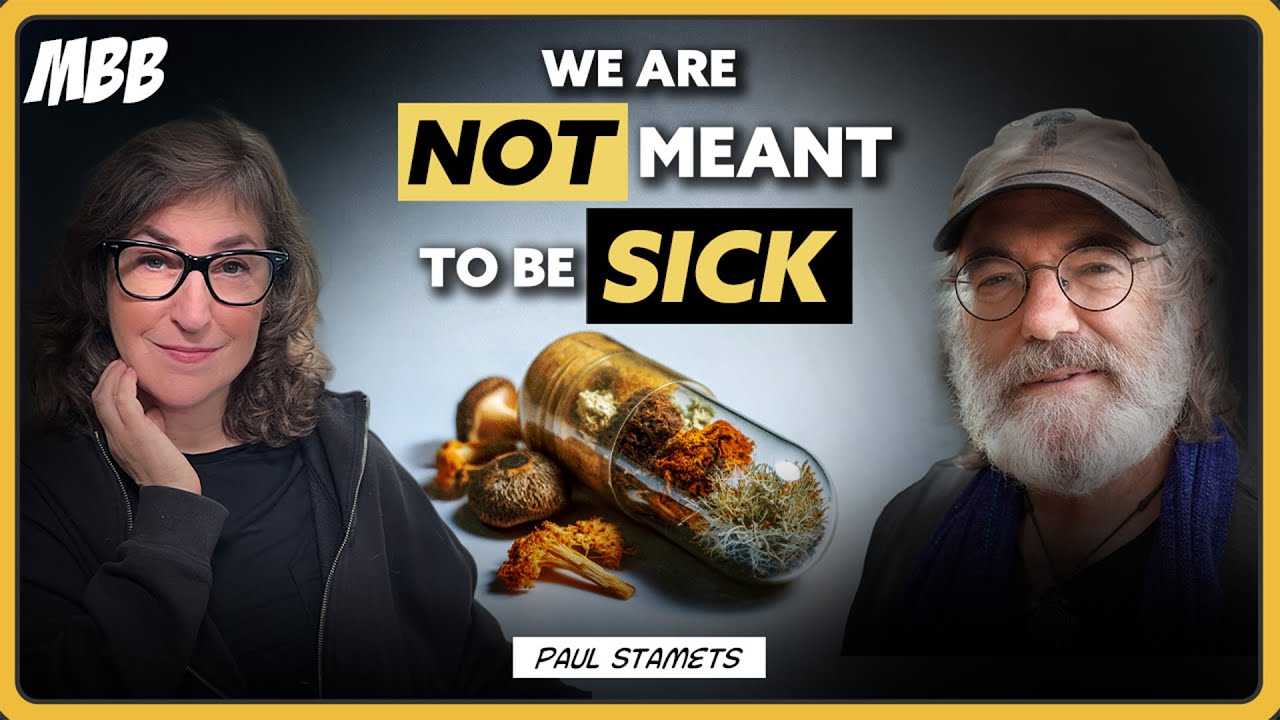
Paul Stamets, a world-renowned mycologist, shares his personal journey and scientific insights on how fungi—particularly psilocybin mushrooms—can transform human consciousness, heal trauma, restore ecosystems, and even guide the ethical development of artificial intelligence. His story weaves together neuroscience, spirituality, ecology, and innovation, arguing that fungi are foundational to life on Earth and hold solutions to many of humanity’s most pressing crises.
Paul’s Personal Transformation Through Psilocybin
Stamets grew up with a severe stutter that isolated him socially; he found solace in nature, especially with snapping turtles.
As a young man, he took a heroic dose of psilocybin mushrooms during a thunderstorm while perched in a tall tree—an experience he describes as terrifying yet profoundly beautiful, filled with fractal visions and a sense of unity with the universe.
During this experience, he had an epiphany: “I am a good person,” which freed him from the fear of judgment. The next day, he spoke fluently to a woman he admired—and never stuttered again (except under extreme stress).
This event catalyzed his lifelong mission: understanding fungi not just as organisms, but as portals to expanded consciousness and healing.
Fungi 101: The Hidden Network Beneath Our Feet
Mushrooms are the fruiting bodies of fungi—less than 1% of their life cycle. The real organism is mycelium, a vast underground network of thread-like cells.
Mycelium acts as nature’s digestive and nervous system: it breaks down nutrients externally, communicates via chemical signals, and forms symbiotic relationships with plants.
There are four main types of fungal lifestyles:
Saprophytic: decompose dead matter (e.g., oyster mushrooms)
Parasitic: infect living hosts (e.g., honey mushrooms)
Mycorrhizal: form mutualistic partnerships with plant roots (critical for forest health)
Endophytic: live inside plants without causing disease, often producing beneficial compounds
Fungi predate animals by ~650 million years—we are evolutionary descendants of fungi, which explains why antifungal drugs tend to be toxic to humans.
An estimated 1.5–20 million fungal species exist; only ~14,000 produce mushrooms, and just ~220 of those contain psilocybin.
Psilocybin as Medicine: Rewiring the Brain
Psilocybin converts to psilocin in the body, acting as a serotonin agonist—particularly at the 5-HT2A receptor—but also activates TrkB receptors, linked to neuroplasticity and neurogenesis.
Unlike SSRIs (which work indirectly), psilocybin directly stimulates brain-derived neurotrophic factor (BDNF), promoting neural growth and repair.
Clinical trials (over 250 registered at clinicaltrials.gov) show promise for treating:
Treatment-resistant depression
PTSD (especially in veterans and first responders)
End-of-life anxiety (e.g., Roots to Thrive program in Canada)
Addiction (tobacco, alcohol, opioids)
Microdosing (0.1–0.3g dried mushrooms) enhances mood, creativity, and focus without intoxication; macrodoses (2.5–8g) can induce transformative psychological experiences.
The entourage effect—where multiple tryptamines in whole mushrooms act synergistically—may offer benefits beyond isolated psilocybin.
Consciousness, Spirituality, and the “Intelligence” of Nature
Stamets views psilocybin as a tool for accessing a “unified field of consciousness”—a concept shared across indigenous traditions and mystical experiences.
He argues that tryptamines (like serotonin, melatonin, and psilocybin) form the biochemical foundation of consciousness itself—nature is “built on tryptamines.”
Indigenous cultures (e.g., Mazatec in Mexico) have used psilocybin for millennia in sacred practices—not as recreation, but as rites of passage and healing.
He advocates for “two-eyed seeing”: integrating indigenous wisdom with Western science to preserve cultural integrity while expanding access.
Fungi as Ecological Healers
Mycelium can replace toxic agricultural chemicals by boosting plant immunity through endophytic and mycorrhizal partnerships.
Fungi like Metarhizium naturally protect grasses from insects, reducing pesticide dependence.
Stamets’ research shows mushroom extracts (e.g., from Fomes fomentarius) reduce viral loads in honeybees by upregulating their innate immunity—offering hope against colony collapse.
Mycelium-based materials are revolutionizing industries:
Packaging: biodegradable substitutes for styrofoam
Space travel: lightweight, self-growing habitats for Mars missions
AI, Society, and the Crisis of Disconnection
Stamets warns that AI lacks intrinsic values—it optimizes for efficiency, not compassion. When asked how AI would support “random acts of kindness,” a leading AI responded: “Why would humans do that? It’s inefficient.”
He urges us to embed random acts of kindness as a core ethical principle in AI development—because humanity’s survival has depended on cooperation, not transactional logic.
Social media bots and foreign actors exploit outrage, creating a “viral infection” of inflammation that harms both mental health and democracy.
His antidote: disconnect from digital noise, reconnect with nature, and use tools like iNaturalist to foster curiosity and ecological awareness.
A Vision for the Future
Stamets believes we face a crisis of creativity—and that psilocybin can catalyze the “quantum leap in consciousness” needed to solve global challenges.
He envisions a world where:
Fungi replace toxic chemicals in farming and medicine
Psychedelic-assisted therapy is accessible and culturally respectful
AI serves human flourishing, not just profit or control
Communities are built on kindness, forgiveness, and shared purpose
His final message: “We are all part of one giant consciousness… Be kind. Be forgiving. Go outside. Enjoy life.”