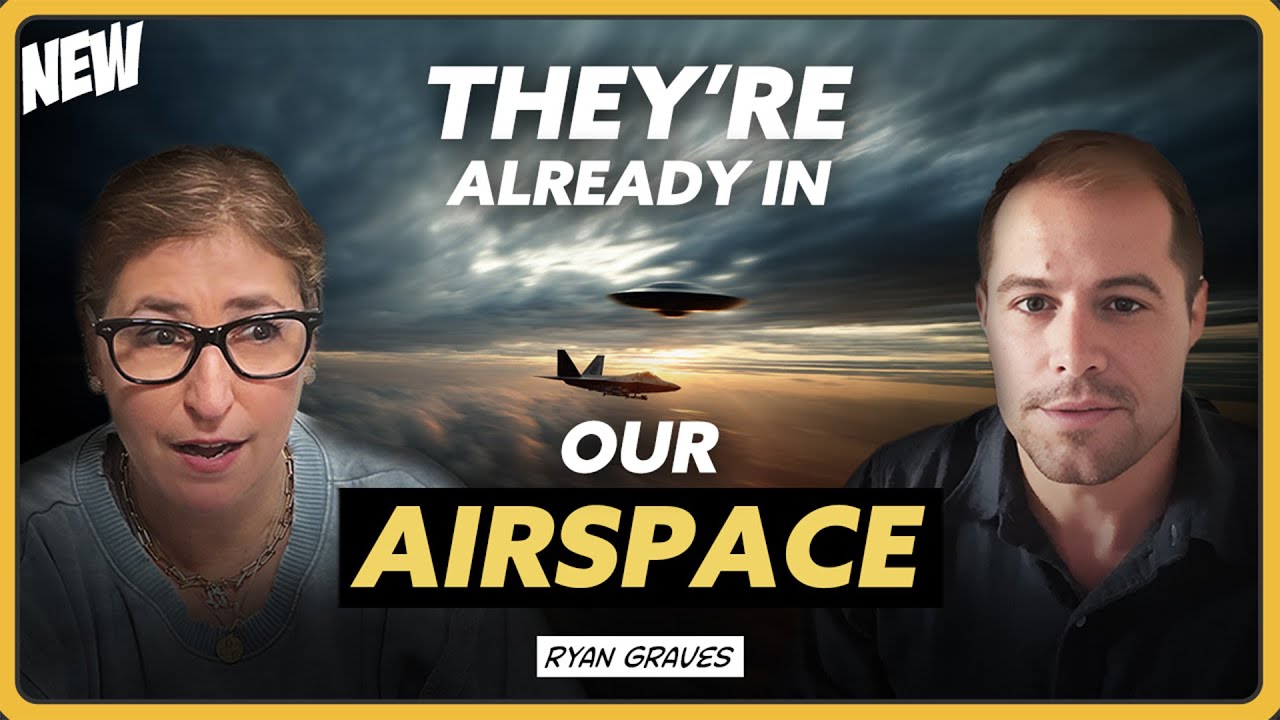
Ryan Graves is a former U.S. Navy F/A-18F fighter pilot who became the first active-duty military pilot to testify before Congress about unidentified anomalous phenomena (UAP) sightings in controlled airspace. After experiencing unexplained radar contacts and near-miss incidents off the U.S. East Coast beginning around 2012–2015, he founded Americans for Safe Aerospace to reduce stigma, collect pilot reports, and push for government transparency. This conversation took place hours after the Department of War released its first tranche of previously withheld UAP evidence, marking what Graves called a major milestone in a long effort to bring credible data into public view.
The Radar Upgrade That Changed Everything
In late 2012, Graves’s squadron upgraded from the APG-73 mechanically scanned radar to the APG-79 actively electronically scanned array (AESA) radar, which he described as going from a black-and-white TV to an OLED screen in terms of situational awareness.
The new system could detect much smaller objects, scan faster, and produce high-confidence “weapons-quality” track files.
Almost immediately, pilots began detecting objects in training areas off the coast of Virginia Beach that shouldn’t have been there.
These objects exhibited unusual kinematics:
Often completely stationary in winds of 120–130 knots.
Seen at speeds ranging from 250–350 knots up to supersonic (1.1–1.2 Mach).
Only observed heading due east at high speed.
Initially, pilots assumed the contacts were radar errors or software glitches, despite the high-quality track data.
From Radar Ghosts to Physical Objects
When pilots flew close enough, other sensors began corroborating the radar contacts:
The ATFLIR (Advanced Targeting Forward-Looking Infrared) system detected infrared emissions, confirming a physical object.
Electronic warfare sensors also correlated.
This multimodal detection made it impossible to dismiss the contacts as radar artifacts.
Yet when pilots visually approached the objects:
They could not see them with the naked eye, even with augmented reality helmet cues directing them to the exact location.
Sensors tracked the object throughout the pass, but nothing was visible at the merge point.
This created a disorienting “stomach drop” moment, as pilots had placed themselves in close proximity to an invisible unknown.
The Near Miss That Forced the Issue
About two weeks after the initial sightings, two F/A-18s in formation, about 150 feet apart, entered a working area when an object passed between them—within 50 feet of the lead aircraft’s cockpit.
The lead pilot described it as a dark gray or black cube inside a clear sphere, with the cube’s points touching the inner circumference of the sphere.
This was the first visual description of a UAP by a squadron member.
The incident was a documentable near miss, requiring a hazard report.
During the safety investigation, it emerged that four other near misses had occurred in the previous five to six weeks—all unreported.
Eight aircrew across those incidents had collectively stayed silent, allowing the issue to percolate without official action.
Graves found this shocking: highly trained, safety-conscious pilots had failed to report multiple dangerous encounters, indicating a deep stigma around UAP reporting.
The GoFast and Gimbal Encounters
In 2015, during a training deployment off the coast of Jacksonville, Florida, Graves’s friends—two experienced Navy pilots—detected numerous objects about 350 miles east of the aircraft carrier.
They encountered a group of four objects in a wall formation, then a larger “gimbal-like” object with a small fleet of five to eight craft in a V formation behind it.
All objects turned 180 degrees simultaneously and reformed in the opposite direction; the gimbal object twisted and followed.
The twisting motion was later reconstructed to represent a vertical turn—something an F-18 requires about 6,000 feet of radius to perform.
The pilots captured FLIR footage that was later released as the “GoFast” and “Gimbal” videos in a 2017 New York Times article.
Graves watched the footage in a classified debrief and observed an admiral react with clear recognition—making a sound and walking out after only six seconds—suggesting prior knowledge.
The admiral subsequently sent an urgent “safety of flight” email to major East Coast commands, warning of dozens of near misses and raising the possibility of canceling the entire training exercise.
Why It’s Probably Not U.S. or Chinese Technology
Graves outlined why he believes the observed UAP are not attributable to U.S. or foreign adversary programs:
Not U.S. technology: Testing a highly classified “blue” program over international waters where adversaries can observe it, while simultaneously having near misses with own-force pilots who are not read into the program, would be illegal and strategically nonsensical. No pilot has ever been briefed into such a program in connection with these incidents.
Not Chinese or Russia: Exposing exotic capabilities that exceed U.S. technology off the U.S. coast for years would make them vulnerable to being shot down and reverse-engineered. China and Russia have satellites that can gather intelligence without risking exposure of novel platforms. Balloons have been used, but they do not exhibit the described performance.
Graves emphasized that while some reports may involve misidentified blue technology or Chinese intelligence programs, these do not account for the most compelling cases.
Modern UAP Behavior: More Aggressive and Visible
Through his organization, Americans for Safe Aerospace, Graves has collected reports from military and commercial pilots that suggest UAP behavior has evolved since 2012–2015:
Objects are now seen more frequently with the naked eye and captured on cell phone cameras.
Pilots report metallic spheres, elongated spheres, and “cube in a sphere” objects.
Speeds up to 8.9 Mach while maneuvering have been reported.
Objects now exhibit more aggressive behaviors: approaching jets from behind, passing at close proximity, stopping instantaneously, then shooting off tangentially.
They appear to traverse air, water, and space seamlessly—true transmedium capability.
Near misses are now common in commercial aviation:
An estimated four to five UAP passes within 1,000 feet of commercial aircraft occur per day in the United States.
Objects have been reported joining on aircraft in flight, hanging out on wings for up to 90 minutes, then departing.
Black triangles with lights at each corner are frequently reported at lower altitudes (1,500–2,000 ft) near airports.
The Afghanistan “Disco Ball” Incident
Graves described a case from Afghanistan in which five military vehicles observed high-altitude lights maneuvering in ways inconsistent with orbital mechanics:
The lights descended over 20–30 minutes to about 2,000 feet, with one coming within 20 feet of the soldiers.
The object was described as a 15-foot-diameter “disco ball”—multifaceted, reflecting light, with some panels generating their own light.
It circled the group, hovered stationary for 20–30 minutes, then rejoined the other object and ascended.
There was no sound.
Nuclear Sites and UAP Patterns
Graves acknowledged a consistent pattern of UAP activity near nuclear sites, both historically and in modern reports:
He is aware of efforts using nuclear materials to lure UAP, which have been successful.
Possible interpretations include:
An interest in monitoring or preventing nuclear self-destruction.
Concern that nuclear weapons pose a risk to the visitors or their environment.
Nuclear sites being a cutting-edge technological area worth monitoring, similar to supercolliders or AI systems.
He stressed these are speculative and that more data is needed.
The Information Problem: Disinformation and AI
Graves acknowledged that the UAP information space is intentionally messy:
Disinformation and misinformation are spread both by purposeful actors and by well-meaning but misinformed individuals.
AI-generated images and deepfakes make it increasingly difficult to distinguish real evidence from fabrication.
Americans for Safe Aerospace is building tools to address this:
A system to scrape satellite data, air traffic data, and military test range data to corroborate reports.
Hardware kits at various price points that the public can deploy to collect sensor data.
An upcoming podcast (the Safe Aerospace podcast) to share documented cases, including air traffic controller observations of Chinese balloons accelerating to high speeds and performing aggressive maneuvers.
Stigma, Safety, and the Path Forward
Stigma around UAP reporting has decreased significantly since 2014–2015 but has not been eliminated.
Pilots still fear professional repercussions, ridicule, or being labeled as mentally unstable.
The lack of official training or guidance forces pilots to operate in a state of uncertainty, which Graves compared to the “normalization of deviance” that contributed to the Challenger disaster.
Graves emphasized that the core issue is aviation safety:
Near misses are happening daily, and statistically, a collision should have occurred by now.
The absence of a crash suggests either extraordinary precision by the UAP or some other explicable factor not yet understood.
Even without a collision, the psychological impact on pilots—and the risk of an unintended control input during a close encounter—represents a real danger.
His personal motivation is not legacy or fame but resolving the safety issue that his colleagues still face today off the eastern seaboard.
Where to Learn More
Americans for Safe Aerospace: safeaerospace.org
Ryan Graves on X: @UncertainVector
The Safe Aerospace podcast launches at the end of May, featuring pilots, air traffic controllers, and fighter pilots sharing documented cases.