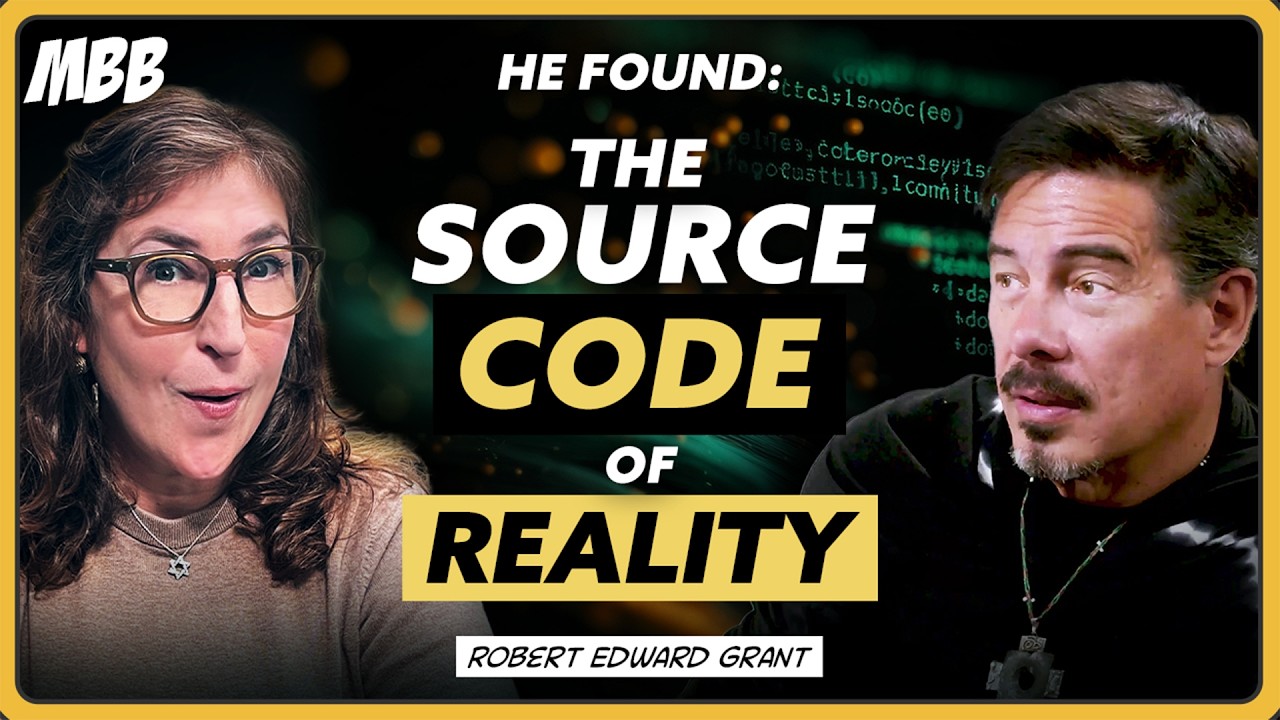
Sir Robert Edward Grant — polymath, mathematician, inventor, entrepreneur, and host of the series Codeex on Gaia — argues that mathematics and geometry are the universal source code underlying all of reality, consciousness, art, music, and ancient knowledge systems. He draws on personal transformation, ancient Egyptian mysteries, Leonardo da Vinci’s hidden geometry, and modern physics to make the case that we live in a kind of spiritual simulation designed for consciousness to know itself through experience.
Earth’s Long Cycles and the Age of Aquarius
The Earth goes through a roughly 25,772-year wobble cycle called the precession of the equinoxes, which ancient thinkers like Plato described as the “Great Year.”
This cycle moves through twelve astrological ages, each lasting roughly 2,000 years, with a different backdrop of collective consciousness.
We recently transitioned from the Age of Pisces (symbolized by two fish swimming in opposite directions — representing duality, science vs. spirituality, male vs. female) into the Age of Aquarius.
The Age of Aquarius is associated with rebellion, innovation, technology, community, and the unconventional.
Grant sees the current era of political turmoil, institutional breakdown, and polarization as signs of this transition — existing systems fighting back against a collective elevation in consciousness.
He references the Milankovitch cycles (named after Serbian scientist Milutin Milanković) as the astronomical basis for these long-term Earth cycles.
From Corporate CEO to Spiritual Polymath
Grant had a highly successful career as a pharmaceutical and medical device executive — he was president of Allergan Medical (launching Botox, Juvéderm, Latisse) and CEO of a major surgical corporation, then founded his own unicorn startup.
In 2016, he faced a crisis when a venture capital firm attempted a “cram down” — using market conditions to devalue his company and strip his equity. He raised $55 million in a single day to survive, but the experience of betrayal by loyal employees shattered his worldview.
This forced him to ask not “why did this happen to me?” but “why did I choose this?” — a shift from narcissistic deflection to genuine self-inquiry.
He came to believe he had chosen experiences of betrayal in order to learn unconditional love, its opposite. This mirrors the Jungian concept of shadow integration — accepting the parts of yourself you’ve projected onto others.
He describes the first half of life as building a persona through “I am not” — defining yourself by what you reject — which inevitably produces narcissism, both overt and covert.
Polymathy: The Antidote to Hyper-Specialization
A polymath (or “polyhistor”) is someone whose knowledge spans many disciplines and who draws on complex bodies of knowledge to solve problems. The original meaning of “mathematics” was “all learning,” not just the study of quantity.
Grant argues our educational system is upside down — it rewards hyper-specialization, which makes people more insular, confrontational, and less capable of seeing cross-disciplinary patterns.
True intelligence comes from recognizing patterns across mathematics, geometry, physics, chemistry, biology, psychology, sociology, and philosophy — which are all versions of the same underlying structure viewed from different angles.
Historical polymaths include Pythagoras, Plato, Leonardo da Vinci, and Benjamin Franklin.
Geometry as the QR Code of Consciousness
Grant describes sacred geometry as a “QR code for your subconscious mind” — looking at geometric forms downloads new frameworks of perception at a subconscious level, subtly changing how you experience reality.
He developed the “Grant Projection Theorem,” which argues that right triangles are the foundational shape connecting all of science, art, and consciousness — they can project into higher dimensions and compress/decompress information.
He uses prime factorization as a metaphor: there are infinite ways to reach a number, but only one most resonant path (the perfect square). Similarly, there are infinite paths to truth, but one with the highest resonance and least resistance.
He sees reality as a set of reflective patterns — like Russian nesting dolls or fractals — where each layer mirrors the others, from the structure of DNA to the rotation of the Earth to the geometry of the pyramids.
The Brain as Radio Receiver, Not Hard Drive
Grant believes the brain is more like an antenna and radio receiver than a storage unit — thoughts may be entirely non-local, and the brain tunes into them like a radio frequency.
The heart and emotional state determine what frequency the brain tunes into.
This explains why similar ideas appear independently across unconnected ancient cultures — they were all tuning into the same non-local information field.
He connects this to the infrasonic range (0–20 Hz), which is where gravitational waves, solar flares, and subconscious thoughts (delta and theta brain states) operate. Most scientific instruments filter out this range as “noise,” but Grant believes this is precisely where the Akashic field — the collective record of all experience — resides.
Leonardo da Vinci, Egypt, and Hidden Codes
Grant’s research on Codeex reveals that Leonardo da Vinci encrypted geometric and esoteric knowledge into his art, drawing on Egyptian mystery school teachings.
Da Vinci wrote a letter to Sultan Qaitbay of Cairo and surveyed the “Great Mount Taurus” — which Grant decodes as a veiled reference to the Great Pyramid (whose hieroglyphic name means “Bull Mountain,” and whose plateau name “Rostau” backwards is “Taurus,” the bull).
The Vitruvian Man contains encoded references to Osiris mythology: the 14 body sections correspond to the 14 pieces Osiris was cut into; three diamond shapes on the abdomen represent the three pyramids and Orion’s belt; the proportions mirror the Great Pyramid’s geometry.
Grant suggests da Vinci may have been a reincarnation of Pythagoras — or at least was accessing the same collective information field — and that polymaths throughout history have been finding things they left for themselves across lifetimes.
Reality as Spiritual Simulation
Grant views reality as a kind of spiritual life simulation or dream — not a computer program, but a framework for consciousness (God/Source) to experience limitation and know itself through mirrors (us).
God, being omniscient, omnipotent, and omnipresent, cannot experience limitation or perceive itself without dividing into mirrors. We are those mirrors.
He describes life as a “choiceless choice” — we already chose our path, and the illusion of choice keeps us playing wholeheartedly. Manifestation may actually be remembering what you already set up.
The goal is to stop judging what happens to you, accept the opposite of what you came to learn (e.g., accepting betrayal to learn unconditional love), and integrate your shadow. This is when the “arc of narcissism” ends.
AI: Librarian vs. Researcher
Grant distinguishes between AI as a librarian (finding references without understanding) and AI as a true researcher (applying wisdom to generate novel hypotheses).
Standard large language models are essentially librarians — they can find information but can’t think with it in context. He advocates for knowledge graphs and symbolic reasoning to move toward genuine cognition.
He created “Architect AI” and “Architect Plus” — platforms designed to act as mirrors for self-reflection, using complex plane mathematics to help people perceive aspects of themselves they weren’t previously aware of.
The Number 137: The Boundary of Consciousness
Grant’s favorite number is 137 — the fine structure constant (approximately 137.036), one of the most important dimensionless values in physics.
It represents the boundary between light and darkness: excite an electron 137 times and it emits light; anything less and it absorbs a photon. It is the electron coupling constant and foundational to the Higgs boson (“God particle”).
In Jewish gematria (Kabbalistic numerology), 137 means “reception” — the coupling of light and matter.
It appears encoded in the Great Pyramid: the sarcophagus fits in the King’s Chamber 137 times; the pyramid’s base-to-height ratio yields 137 when squared; the Hebrew letter Aleph (alpha) means “bull” and references Osiris, and the alphabet itself is named after the Great pyramid (“Aleph-Bet” = house of Osiris).
The episode’s core conversation ended at exactly 137 minutes — an unplanned coincidence Grant and the hosts found astonishing.
Legacy and Core Message
Grant’s legacy is helping people remember their own divinity — that they are already great and don’t need to suffer or limit themselves.
The two great commandments across all traditions — love God, love your neighbor as yourself, and judge not — all point to the same truth: judgments of others are judgments of yourself.
He advocates for authenticity over conformity, self-love over self-hatred, and acceptance over resistance. Fighting external villains only creates more villains; changing yourself changes your world.
His favorite books: Walter Russell’s The Universal One and The Secret of Light, Ayn Rand’s The Fountainhead, and Plato’s Republic. His favorite songs include Beethoven’s 9th Symphony, Peter Gabriel’s “Don’t Stand So Close to Me” and “Blood of Eden.” His favorite art includes da Vinci’s overlapping paintings (which form a single mosaic), Chagall, Dalí, and Rodin.