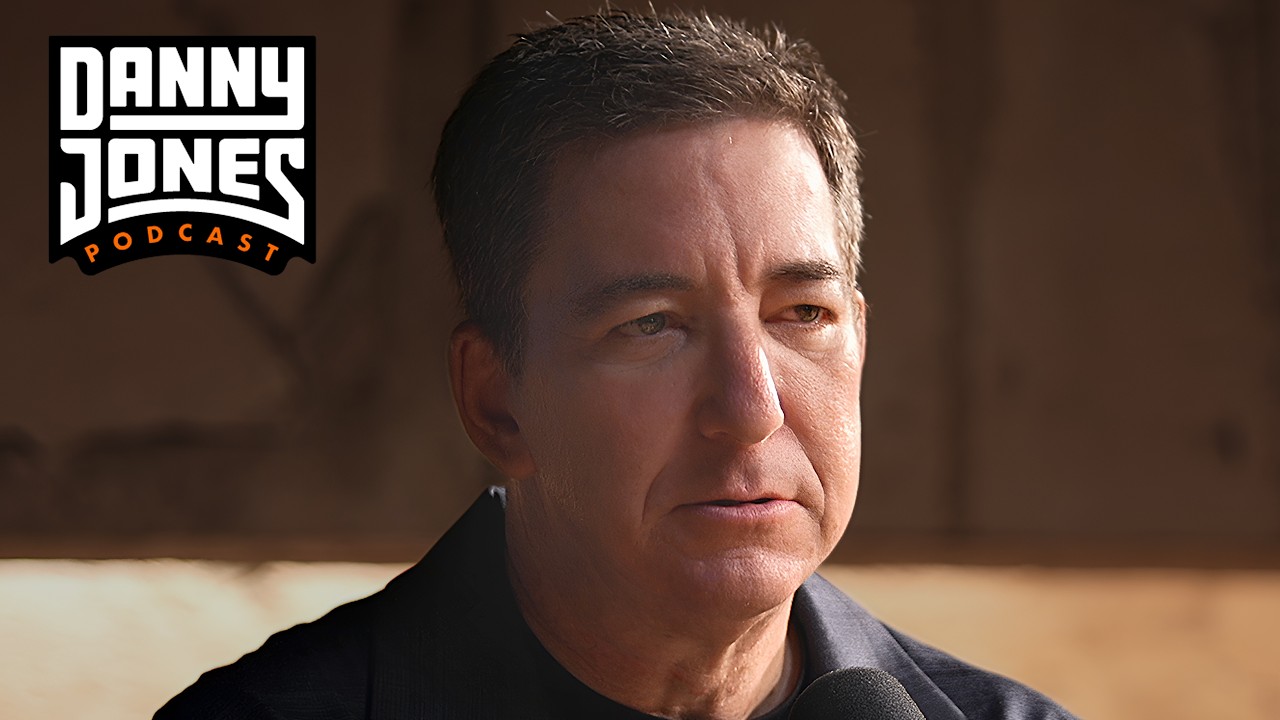
Glenn Greenwald — Pulitzer Prize-winning journalist known for publishing the Edward Snowden NSA revelations — discusses the Iran war, the Epstein files, the Israel lobby’s grip on American politics, and the deep state’s playbook for destroying whistleblowers, arguing that all of these stories are interconnected and reveal a transnational elite class that operates above governments and nation-states.
The Joe Kent case and the whistleblower playbook
Joe Kent, a decorated Green Beret with 11 combat tours and a top counterterrorism position, resigned and revealed that the U.S. went to war with Iran based on fabricated imminent-threat claims, essentially fighting for Israel.
The administration’s response — attacking his mental health, launching an FBI investigation, threatening imprisonment — follows the same playbook used against Daniel Ellsberg, Julian Assange, Edward Snowden, and Chelsea Manning: when the government can’t dispute the truth of a revelation, it destroys the messenger’s character.
Kent maintained his top-secret clearance throughout his tenure; had there been genuine concerns about his handling of classified information, his clearance would have been suspended immediately.
Greenwald notes that the harder the government attacks someone, the more damaging the underlying truth must be.
The 6-to-7-year ceiling in intelligence agencies
Former CIA officer John Kiriakou’s observation: people who stay in the CIA past about 6–7 years tend to be either true believers in the mythology or careerist ladder-climbers with “dead souls,” while those with independent minds leave to use their skills in the private sector.
Greenwald relates this to his own experience leaving a lucrative Wall Street law firm after 18 months — he couldn’t stomach serving the wealthiest and worst people on the planet — and observes that many who stay for decades seem trapped by lifestyle or hollowed out by institutional culture.
Why Trump’s second term went wrong
Greenwald was initially optimistic about Trump’s second term because Trump had learned from being “steamrolled” by Washington insiders in his first term and was determined to consolidate power.
However, Trump was also fighting for his life — facing potential life imprisonment from the Stormy Daniels conviction and Jack Smith’s felony cases — which made him vulnerable to co-option by billionaires with their own agendas, particularly Zionist donors who wanted wars.
Greenwald draws a parallel with Barack Obama, who also ran as an outsider promising to change Washington but quickly became the ultimate establishment figure, continuing and expanding the very civil liberties erosions he had campaigned against.
The pattern: there is a permanent power faction in Washington — the “deep state” — that pressures every president through institutional leverage, threats, and the implicit message that stopping certain programs will result in blood on your hands.
The Epstein files and the transnational elite
The most important revelation of the Epstein files is not the sexual crimes per se but the exposure of a transnational class of billionaires, oligarchs, and intelligence operatives who operate above nation-states — an “Epstein-Rothschild layer” that profits from arms deals, conflicts, and manipulation of governments.
Hacked emails from Iranian intelligence of Israeli officials including Ehud Barak confirm that Epstein performed high-level foreign policy and intelligence functions for Israel and Mossad, as well as for other countries.
Photos of Epstein with Saudi Crown Prince Mohammed bin Salman — casual, social, arm-around-the-shoulder — illustrate how deeply embedded Epstein was in the highest levels of global power.
Despite being a convicted sex offender and registered felon, Epstein faced zero social consequences in elite circles, revealing the utter depravity of that world.
Epstein’s wealth appears to have surged in the early 1990s, coinciding with the death of Robert Maxwell — a media baron and alleged Mossad agent whose daughter Ghislaine Maxwell became Epstein’s closest associate. The source of Epstein’s money remains opaque but likely traces to Maxwell and later to billionaires Leon Black and Leslie Wexner, whose only political cause was pro-Israel advocacy.
Howard Lutnick, Trump’s Commerce Secretary and Epstein’s next-door neighbor, told an elaborate public story about being “disgusted” by Epstein after a 2005 meeting — a story completely contradicted by emails showing years of friendly correspondence and visits to Epstein’s island. He remains in office with no consequences.
Bill Clinton, after his deposition on Epstein, unprompted added to the record that he believed Trump was innocent — and Trump reciprocated with kind words about Clinton. Greenwald argues this reveals that the public hatred between political figures is performance; they are all part of the same club, and the Epstein files threaten all of them equally.
The “9/11 shadow commission” email to Ghislaine Maxwell from neocon journalist Edward Jay Epstein, along with a suspicious gap in released emails from 1999–2002, suggests the most damaging documents are still being withheld — a classic “limited hangout” strategy.
The Israel lobby’s grip on American politics
Greenwald traces the Israel lobby’s power back decades: Barry Goldwater in 1988 openly said every president knows Middle East policy is dictated by Israel; Richard Nixon’s secret tapes are full of references to Jewish power over foreign policy; John Mearsheimer and Stephen Walt’s 2007 book “The Israel Lobby” was career-ending despite being rigorous scholarship.
The lobby operated in shadows for decades, achieving near-unanimous bipartisan votes in Congress (e.g., 90–2 in the Senate) on pro-Israel resolutions while the public remained unaware.
Hillary Clinton’s 2006 Senate campaign finance director Hank Shenkoph openly told a neocon Jewish newspaper that “Jewish donors are the ATM of New York politics” and you cannot succeed without being fanatically pro-Israel.
36 U.S. states have anti-BDS laws requiring government contractors to sign oaths that they do not boycott Israel — meaning an American citizen can be denied a government contract for boycotting a foreign country, even as American politicians freely boycott their own states over domestic policy disputes.
Greenwald profiled a Texas speech pathologist who was fired from her school district contract for refusing to sign the anti-Boycott oath, depriving children of a specialist they desperately needed.
The IHRA (International Holocaust Remembrance Alliance) definition of anti-Semitism has been weaponized to criminalize speech describing Israel as a racist endeavor, comparing Israel to Nazi Germany, or even stating that a Jewish person has greater loyalty to Israel than to their own country. The Trump administration forced universities to adopt IHRA as a condition for receiving federal research funding.
The most understated story of the year: TikTok was banned not because of China but because it was the one platform the government couldn’t control on Israel. After the ADL declared a “TikTok problem” in January 2024, the ban suddenly gained momentum. It was sold to Larry Ellison — the largest private donor to the IDF — who put an IDF soldier in charge of content moderation, then bought CBS News and installed Bari Weiss.
The panic is visible: Israel’s PR power has collapsed, especially among young people, because of independent media and phone footage from Gaza. The old subtle approach has been replaced by overt, desperate measures because they can no longer control the narrative.
The Iran war
The U.S. is losing the Iran war: Iran controls the Strait of Hormuz, has destroyed or rendered uninhabitable every American military base in the Persian Gulf, and has pummeled Israel. Regime change was always a fantasy.
Trump cannot end the war because he cannot extract terms that credibly represent a victory, and he cannot admit defeat — the same dynamic that has prolonged the Ukraine war.
Pete Hegseth has made biblical justifications for the war, framing it as Christianity versus Islam, echoing generals in 2003 who said “our God is bigger than their God.”
There are reports that Israel told Trump they would nuke Iran if he didn’t carry out the bunker-buster strike (Operation Midnight Hammer). Trump has alluded to nuclear weapons use, and Israeli officials have threatened destruction “unlike anything in human history.”
The war may escalate through special forces deployments — if soldiers are killed, the political pressure to “avenge” them makes withdrawal impossible, exactly as in Vietnam.
The only steel-man argument for the war: Iran is the most formidable opponent in the region, and removing it would give the U.S. and Israel full control of the Middle East and its oil. Iran also funds resistance groups like Hezbollah and Hamas.
Greenwald’s counter: by this logic, the U.S. should attack China, its biggest counterbalance. The real lesson of the war is that it proves to every rational world leader that the only way to deter American/Israeli aggression is to acquire nuclear weapons — making proliferation more likely, not less.
He estimates the probability of nuclear weapons use at below 50% but not zero, noting that humanity’s fear of nuclear war has atrophied over 80 years and that some voices in mainstream media now casually discuss “limited” nuclear strikes.
Religion, culture wars, and the left-right psyop
Greenwald argues that the left-right divide is deliberately inflamed to prevent Americans from uniting on shared class interests — opposition to wars, deindustrialization, the lobbyist capture of Washington, and the importation of cheap labor.
Steve Bannon’s original plan for Trump was to raise taxes on the wealthy and corporations to fund infrastructure — a policy that is neither left nor right but populist. Immigration restriction was historically a left-wing position (Bernie Sanders called open borders “a Koch brothers proposal”).
The culture war issues — trans rights, abortion, race — are amplified by elites to distract from the vertical class conflict between the population and the elite. On the ground, in workplaces and communities, people of different backgrounds coexist and joke with each other naturally; the hatred exists primarily on social media and in elite discourse.
Islam is far more compatible with the West than commonly portrayed. American Muslims have integrated well, and the Quran explicitly instructs Muslims living in non-Muslim countries to respect local laws. The “Islam is the real threat” narrative is a coordinated effort by Israel loyalists to redirect attention away from the Israel lobby.
Zohran Mamdani’s rise as mayor of New York is a case study in effective politics: he went to neighborhoods that shifted to Trump, listened to their grievances (cost of living, wars in Ukraine and Israel), and built his campaign on affordability. He is a mainstream left-liberal, not a radical, and Trump likes him because Trump likes winners.
The future of free speech and surveillance
The Biden administration’s censorship regime — banning debate on COVID origins, masking, vaccines; getting a sitting president banned from all social media — was so brazen that it created a bipartisan backlash. The Missouri v. Biden case, though thrown out on standing grounds by the Supreme Court, exposed the worst First Amendment assault in American history.
The emergence of independent media (Rumble, X, Substack) created market pressure against censorship: platforms that censor lose users to platforms that don’t.
Australia recently criminalized pro-Palestinian slogans like “from the river to the sea,” leading to arrests of young women wearing t-shirts. Similar laws exist across Europe and the UK. The U.S. is protected by the First Amendment, but the IHRA framework is being imposed on universities through funding threats.
Snowden’s revelations did produce some positive changes: increased use of encryption, pressure on big tech to adopt end-to-end encryption, the creation of platforms like Telegram. But the surveillance state quickly reconstituted itself around new threats (ISIS, Russia).
Greenwald is pessimistic about the long-term trajectory: ubiquitous spying on the American population continues, and there is no such thing as a truly secure communication platform — if the CIA didn’t build it, they can likely break into it.
Snowden himself remains trapped in Russia, unable to leave. The Obama administration canceled his passport mid-flight, bullied Cuba into revoking his safe passage, and even forced down the Bolivian president’s plane on suspicion Snowden was aboard. Trump came close to pardoning him in the first term but was threatened with impeachment by Republican senators if he did.
How Greenwald met Snowden
Snowden was a long-time reader of Greenwald’s blog and reached out in late 2012, insisting on high-level encryption that Greenwald initially couldn’t be bothered to install.
Snowden then contacted documentary filmmaker Laura Poitras, who had learned encryption from being on a government watch list after her Iraq war film. She convinced Greenwald of Snowden’s authenticity.
Greenwald flew to Hong Kong after receiving a sample of documents so explosive he “couldn’t breathe” — including the Prism program (big tech dropboxes for NSA surveillance) and a secret FISA court order forcing Verizon to turn over every American’s phone records.
He expected a grizzled, world-weary source; instead, Snowden was a 29-year-old who looked like a kid who worked at the mall — clean-cut, from a military family, with a high school sweetheart girlfriend and a bright future.
Greenwald interrogated him for 4 hours before being convinced of his genuineness. Snowden’s answer: the internet was the greatest emancipation technology in human history, and learning it had been turned into the greatest weapon of coercion and control was an evil he could not live with himself for exposing — citing the same sentiment as Daniel Ellsberg, who said prison would be better than living as a coward.
Greenwald’s husband David Miranda was detained for 12 hours at Heathrow under terrorism threats while carrying part of the Snowden archive. British agents stood over Guardian staff and forced them to physically destroy computers containing the documents.
Snowden’s plan was to transit through Moscow and Havana to South America, but the Obama administration canceled his passport and bullied Cuba into revoking safe passage, trapping him in Russia — then used his presence in Russia to imply he was a Russian spy.