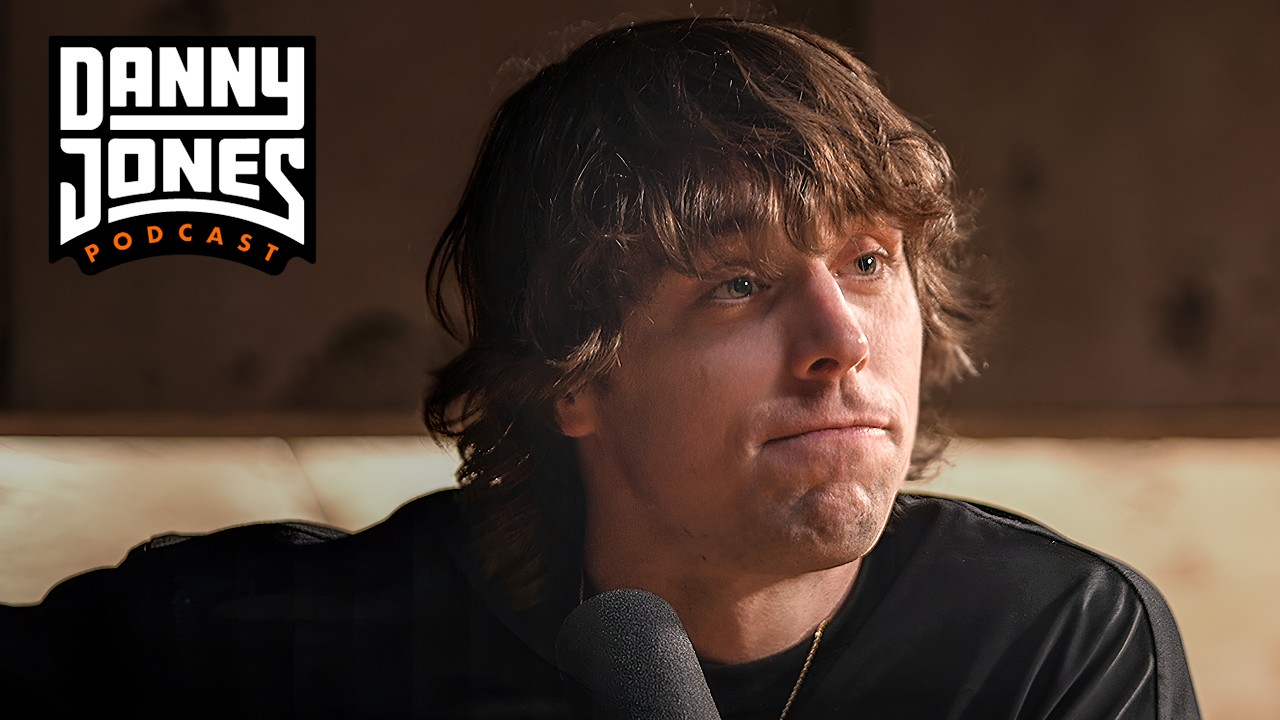
Danny Jones visits Julian Dory in Florida, catching up in person for the first time in over two years and touring Julian’s elaborate studio — a pyramid-cathedral hybrid in the Florida sun — while discussing the grind of weekly podcasting, the challenges of raising kids, and the broader cultural moment defined by information overload, institutional distrust, and the Epstein case.
The information age and its toll
Both hosts reflect on how the internet has made it impossible to ignore global crises, corruption, and conspiracy, creating a tension between staying informed and preserving mental health.
Julian describes a pattern he’s noticed: people who went deep into conspiracy research over the past 10–15 years often end up miserable, stuck in worse jobs, and more unhappy in relationships because they became consumed by things they can’t control.
Danny argues there’s a healthy middle ground — being aware enough to make informed choices without letting every headline become the meaning of your life.
They discuss how the pandemic was a turning point that “woke up” many people who had previously been tuned out, living for sports and leisure, and how that awakening has been both necessary and psychologically costly.
Citizen journalism and on-the-ground reporting
They celebrate figures like Tommy G and Arab (Arab on Arab), independent journalists who go directly into dangerous environments — from New York’s underground street racing scene to Iran on the eve of war — to document reality firsthand.
Danny recounts his experience hosting Tommy G’s documentary with “The Swim Team,” New York’s most wanted illegal street racers, who wore ski masks and required 32 hours of post-production voice editing.
Arab was in Tehran the week before the 2026 Iran war broke out, illustrating how independent reporters can access places and moments traditional media cannot or will not.
Both hosts emphasize that even first-person video reporting captures only a thin layer of reality — editors can selectively cut interviews to push any narrative, and AI makes fabrication increasingly undetectable.
The Epstein case and Andy Boamonte’s investigation
Danny discusses his recent trip to Colorado to appear on Andy Boamonte’s new show, where Boamonte had built a full-scale replica of Jeffrey Epstein’s prison cell.
Initially, Danny expected Boamonte to downplay Epstein’s role as a blackmailer, as he had in earlier appearances. Instead, Boamonte went all-in on investigating Epstein’s death.
Using a dummy and physics demonstrations, they showed that a 66-year-old man could not have hanged himself in the manner depicted in the official account.
Boamonte revealed that the cell had a structural feature — essentially an escape hatch — that was not on the official prison schematic and was unique to that cell.
He also demonstrated that the FBI released footage of the wrong cell, and that government reports contained photos of a different cell entirely, suggesting a deliberate coverup.
Danny came away convinced Boamonte was serious and that the evidence pointed to Epstein being extracted from the prison rather than committing suicide.
Palm Beach Pete and the culture around Epstein’s death
They discuss “Palem Beach Pete,” a Florida man who went viral for resembling Epstein, appearing on TMZ, late night shows, and Cameo.
Pete has leaned into the fame, doing Cameo birthday messages and claiming he attended parties where Epstein was present.
The hosts note the absurdity of overnight celebrity for resembling an international pedophile, and the broader cultural obsession with whether Epstein is actually dead.
They reference Epstein’s documented meeting with a face-transplant surgeon the year before his arrest, lending credibility to the theory that he could have undergone plastic surgery and escaped.
John Kiriakou and CIA whistleblowing
Danny recounts his recent off-the-record conversation with John Kiriakou, the former CIA officer who exposed the agency’s torture program and served time as a result.
Kiriakou shared a detailed story about the Iran war being imminent — correctly predicting it within days — demonstrating his continued high-level intelligence sources.
The hosts discuss how Kiriakou was set up by John Brennan, who pushed for his prosecution despite the FBI finding no case after a year-long investigation.
They express frustration that Trump has not pardoned Kiriakou, despite pardoning far worse offenders, and despite Brennan being one of Trump’s chief political enemies.
Kiriakou’s off-camera stories are described as even more extraordinary than what he says publicly, and he is praised for changing his mind when presented with better evidence.
The CIA torture program and its architects
The conversation turns to the CIA’s enhanced interrogation program, designed by psychologists James Mitchell and Bruce Jessen under an $82 million contract.
Mitchell lives in a mansion near Julian in Florida, and there’s a Vice interview with him conducting a canoe interview surrounded by alligators.
They discuss Jolly West, a CIA mind control researcher who was present in Jack Ruby’s cell, at Charles Manson’s clinic, and on the set of 2001: A Space Odyssey — and whose wife and children all committed suicide.
The Dulles brothers are cited as archetypals of men who believed so completely in their own righteousness that they never questioned whether they had become the villains, from the Treaty of Versailles through the Kennedy assassination coverup.
The long arc of history: good vs. evil
Julian articulates his philosophy that evil can win in the short term but good prevails over the long run of human history.
He uses the Dark Knight ferry experiment as a metaphor: if 99 good people and one evil person share a room, the evil actor can destroy everything in the short term. But over time, good compounds and evil self-destructs.
Danny agrees, noting that while current events — the Epstein coverup, the Iran war, economic suffering — are objectively terrible, they represent a moment of exposure that could lead to improvement.
Both acknowledge that living through this moment requires a balance of dark humor and serious engagement, and that the average American is more aware of institutional corruption than ever before.
Tucker Carlson and the supra-government
They discuss Tucker Carlson as a potential future president, noting his unique ability to run left of neocons, right of woke, and his celebrity charisma.
Julian references Carlson’s concept of the “supra-government” — a shadow structure above elected leaders consisting of banking families at the top, a “fixer class” in the middle, and visible politicians at the bottom.
Epstein is placed in the fixer class, and Steve Bannon is discussed as someone who may also occupy that layer, given his improbable presence at the center of cultural and political events for decades.
Danny reveals that in the released Epstein emails, Epstein was constantly chasing Bannon — sending multiple emails to which Bannon would respond with a single word — suggesting Epstein saw Bannon as a valuable PR ally as his world began to collapse.
Bannon’s financing of Seinfeld, his role in Trump’s election, his documentary that was announced and never released, and his current daily podcast are all cited as evidence of a chaos agent whose true allegiances remain unknowable.
Steve Bannon, Netanyahu, and the Iran war
They discuss Bannon’s recent public statement that Netanyahu’s son should be sent to Iran, which both hosts agree with despite their general distrust of Bannon.
The Iran war, now five to six weeks old at the time of recording, is described as having successfully buried the Epstein files from public attention.
They criticize the Trump administration’s handling of the war, including Scott Bessent (Treasury Secretary and former Soros Fund Management chief investment officer) being pulled from a meeting on March 13th looking visibly spooked, and Bessent’s subsequent comment that he’d trust the president to send his children to fight.
The Artemis rocket launch on April 1st (April Fools’ Day) and a broken toilet on the spacecraft are discussed with characteristic dark humor.
Generational politics and the Boomer critique
Tim Dillon’s rant about Boomers accepting propaganda in exchange for material comfort is discussed approvingly.
The Boomers are characterized as the first generation in human history whose actions, through passivity and self-interest, have made the world worse for their children and grandchildren — not through malice but through the attitude of “I’ve got my house, my equity, it’ll work itself out.”
The American dream of a house, white picket fence, and family of four is described as dead, with even successful podcasters unable to buy homes in major cities.
The college debt crisis is cited as a systemic trap: 17-year-olds signing papers they don’t understand for degrees that don’t deliver value, now carrying unpayable debt into their 30s.
UFO files and government secrecy
Duncan Trussell’s tweet about UFO disclosure is discussed — the government’s excuse that “the public can’t handle the truth” is called the most inadvertently condescending possible justification.
Julian plays devil’s advocate, noting that governments can now simulate societal reactions using emotional data from social media and AI, and may have determined that disclosure of certain truths (aliens, religious implications) would cause mass existential crises.
Both agree that at this point, after everything the public has already absorbed — Epstein, government torture, election manipulation — people are desensitized and could handle almost anything.
Closing reflections
The hosts close with mutual appreciation, reflecting on their friendship and the role podcasting plays in processing an increasingly chaotic world.
Danny praises Julian as self-made, humble, and the de facto source of Epstein news for his audience.
Julian credits Danny with being an early supporter and a consistent voice cutting through noise.
Both acknowledge that despite having microphones and audiences, they may still be “cattle” in the larger system — but that talking about it, with honesty and dark comedy, is the best they can do.