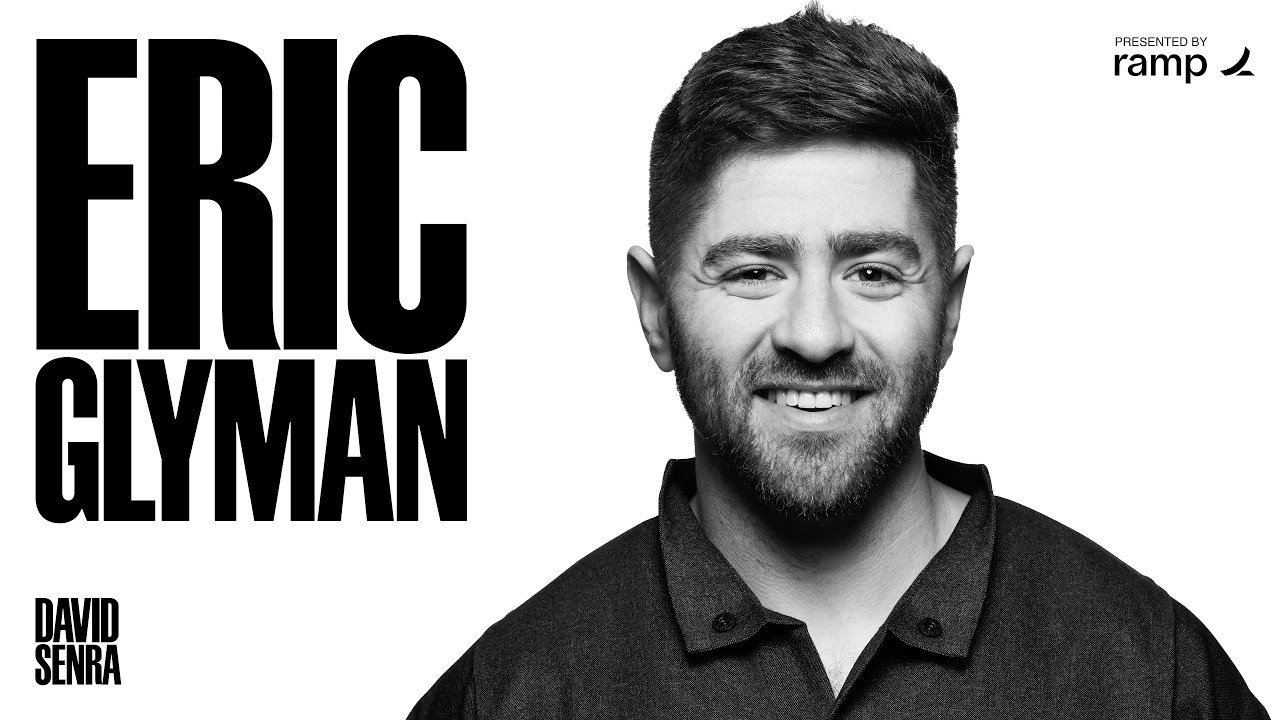
This episode features Eric Glyman, CEO of Ramp, a $44B financial infrastructure company that provides corporate cards, expense management, bill pay, procurement, and accounting automation to over 70,000 businesses. The conversation covers Ramp’s mission to save customers time and money, how AI is reshaping talent strategy and organizational design, their hiring philosophy centered on high-agency “determined generalists,” the importance of consumer-grade design in B2B software, aligning incentives through a transparent “scoreboard” metric, and why Glyman views AI labs as Ramp’s true competitors as the company builds toward “self-driving money” that automatically optimizes every dollar and hour.
Ramp’s Core Mission And North Star
Ramp’s mission is to help every business owner get more out of every dollar and hour; products like cards, expense management, and bill pay are just scaffolding to deliver that service.
The north star metric is whether Ramp saves customers money and time: the median customer cuts expenses by 5% per year and grows revenue 16% annually versus the US average of 3-4%.
Glyman inverted the industry assumption that rewards programs drive adoption; instead of encouraging more spend, Ramp builds tools to help companies spend less and waste less time.
This inversion led to unifying previously separate systems (cards, expenses, bills, procurement, treasury) into a single platform where policy drives real-time behavior and automation handles the drudgery.
Glyman applies Elon Musk’s algorithm — question every requirement, delete unnecessary parts, simplify, accelerate, then automate — to every dollar and hour flowing through customer organizations.
AI’s Impact On Talent And Organization Design
AI makes the returns to talent more extreme: the most effective person can now be 1,000x more effective in a domain, so hiring for “spikes” remains critical.
More profoundly, LLMs let a determined generalist extend far beyond their traditional craft boundaries — an engineer can now sell, design, and analyze data without waiting for specialists.
This erodes the “Tower of Babel” problem in large companies where people identify by craft (sales, engineering, design) and information gets lost crossing silos.
Glyman expects organizations to radically simplify: fewer specialties, more generalists equipped with AI tools, flatter structures with faster decision cycles.
The competitive advantage shifts to companies that redesign around this reality rather than layering AI onto legacy org charts.
Hiring Philosophy: High Agency And Proof Of Work
Glyman looks for two things: evidence of exceptional drive (a “spike”) and alignment of personal motivation with Ramp’s mission.
Spikes appear in unconventional places: a teenager who built a Minecraft server paying his way through college, athletes with obsessive training regimens, creators with bodies of work — proof of work matters more than credentials.
Referrals and asymmetric information (people who know the candidate’s real output) outweigh long interview loops; two days of working together reveals more than 15 hours of interviews.
Motivation screening: Glyman asks where candidates want to be in 5-15 years and whether that trajectory naturally coincides with Ramp’s mission; if not, he doesn’t try to convince them.
He wants to work with people early, give them outsized responsibility, and retain them for decades — compounding trust and communication efficiency creates “ESP” that multiplies organizational velocity.
Organizational Culture And Long-Term Retention
Glyman favors the Spotify model of deep, decade-long cohesion among a core kernel over constant turnover; shared history lets people complete each other’s sentences and move faster.
He cites Buffett and Munger eventually not needing to call each other because they’d internalized each other’s thinking — that depth of trust enables purer pursuit of mission.
Free-riders destroy culture: if people with similar pay and equity aren’t pulling their weight, high performers lose faith in the organization’s standards.
Glyman’s job is creating conditions for people to do their life’s work: find great people, make Ramp a place they want to stay, unblock them, and enforce high standards.
Consumer-Grade Design In B2B Software
Ramp insisted on elegance from day one; Glyman compares it to the Breville toaster’s “A Bit More” button — derived from observing real behavior (people re-toasting) rather than asking for feature lists.
Most B2B software bloats into button-filled disasters by literally building every customer request; great design solves the underlying job (perfect toast, zero-touch expenses) not the stated feature ask.
Ramp’s design question: “Why do expense reports exist at all? The data is digital — expenses should do themselves. Books should close themselves.”
The goal is not a better expense app but eliminating the category of work entirely, respecting users’ time and attention.
Aligning Incentives: “We Win When Our Customers Win”
One of Ramp’s six values, printed on merch: “We win when our customers win.” Glyman rejected generic value lists in favor of a few non-negotiables everyone viscerally agrees with.
The scoreboard: every month Ramp measures aggregate dollars saved, hours saved, and per-customer experience improvement — connected to accounting software for ground truth.
Example: finance teams wasted hours cleaning messy merchant strings (e.g., “UBR*478”); Ramp automated merchant matching after measuring that pain, compounding time savings across 20,000+ companies.
The scoreboard lives on internal dashboards, Slack’s largest channels, and the first slide of every prospect meeting — constant visibility prevents drift.
AI Labs As Ramp’s True Competitors
Banks sell money (rewards, loans, yield); Ramp sells time by automating knowledge work around money movement — making labs the real competitive peer set.
If intelligence becomes functionally free, the durable differentiator is controlling the layer where money actually moves: stopping waste before it leaves, not analyzing it after.
Glyman is energized by the competition: five consecutive quarters of accelerating revenue growth while doubling on a multi-billion scale.
He draws a historical parallel: air conditioning created Las Vegas and Miami, but the fortunes went to the ecosystems built on top, not the AC inventors — similarly, the value from cheap intelligence will accrue to applications that harness it.
Token Spend Management And Agentic Future
Token spend is becoming a third mega-category alongside payroll and vendor spend: Anthropic and OpenAI alone may pass $300B/year run rate (~1% of US GDP) within a year.
Unlike traditional SaaS, every AI job has marginal cost; CFOs need new tools to classify (OpEx vs R&D), attribute, measure ROI, and route tasks to 1/100th-cost open-weight models that match frontier performance after ~6 months.
Agentic spend: organizations already delegate limited spend authority to employees; soon agents will negotiate with agents to renew software, optimize seat counts, and enforce policy programmatically.
Ramp is building the substrate to manage both compute spend and agentic resource allocation — an operating system ensuring the highest-return dollar gets the dollar.
Vision: Self-Driving Money And The Finance Function Transformed
Today’s finance professionals spend 80-90% of time on backward-looking drudgery because data is fragmented across tools; Ramp collapses the stack and connects policy to real-time financial data.
The end state: a small business owner obsessed with their craft (e.g., podcasting) hires Ramp to handle books, vendor payments, working capital optimization — “self-driving money.”
Finance shifts from recording history to allocating the next dollar: who is our customer, what products should we build, where should capital flow?
Glyman wants this to be his life’s work: compounding impact over decades, making entrepreneurship accessible by eliminating the tedious work that defines most corporate life.