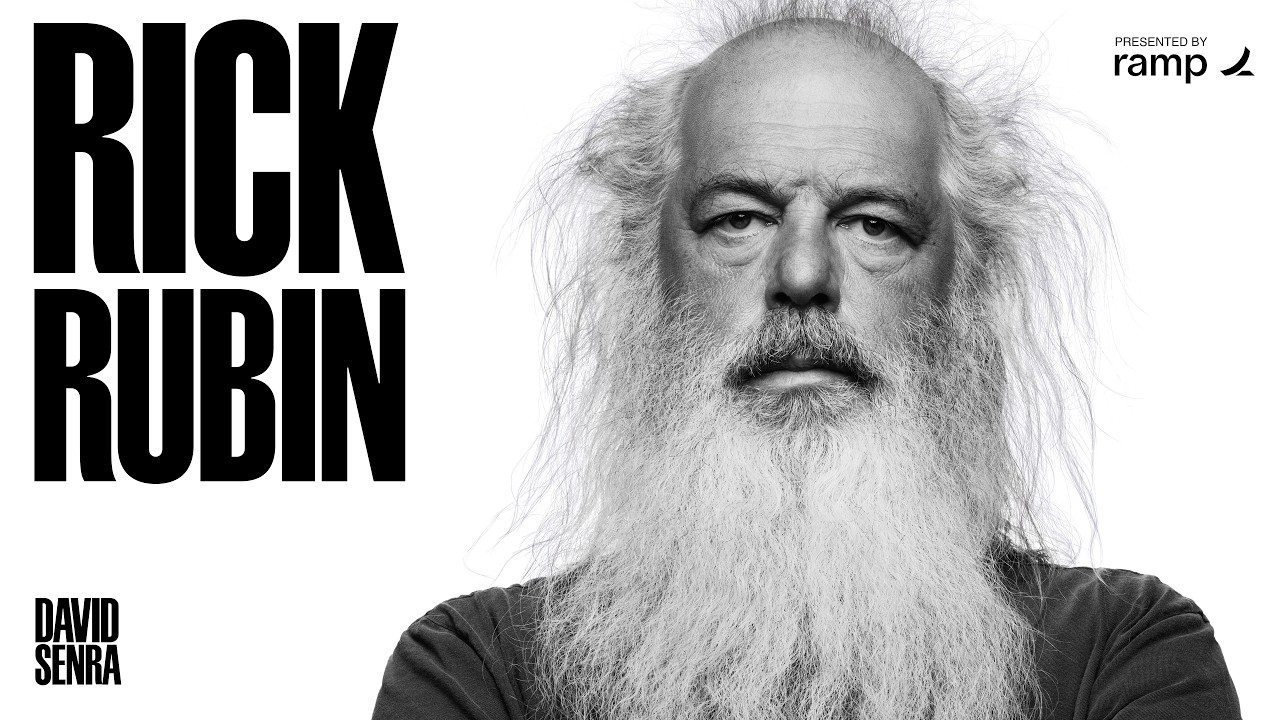
Rick Rubin is one of the most influential music producers in history, having shaped the sound of hip-hop, rock, country, and pop across nearly five decades — from co-founding Def Jam Recordings in his NYU dorm room at 18 to producing albums for Johnny Cash, the Red Hot Chili Peppers, Eminem, Jay-Z, and the Strokes. This conversation explores his philosophy of creative reduction, his working methods, his relationship to obsession and intuition, and why he believes the best art comes from stripping everything away until only the essence remains.
The Philosophy of Less Is More — But Getting There Requires More
The core paradox: “Less is more, but to get less, you have to do more.” When you strip a piece of work down to only a few elements, each one carries enormous weight. Nothing can hide. Every choice must be critically curated.
Guitar example: Many recordings layer multiple guitar tracks into a wall of sound — you hear “guitar” but not a person playing guitar. When one person plays and you can hear their fingers on the strings, it has personality and humanity. Rubin always looks for the singular essence to show through.
“Reduced by Rick Rubin”: Early in his career, Rubin rejected the word “produced” because he felt it meant building up. What he actually did was take things apart. He started crediting himself as “reduced by” on records, beginning with LL Cool J’s debut, because reduction was more accurate.
The ruthless edit: Instead of whittling down from 100% to the desired 70%, Rubin forces himself to cut all the way to 40%, then add back only what’s necessary. This creates a deeper understanding of what the work actually needs.
With the Red Hot Chili Peppers: They might record 40–50 songs for an album, then vote democratically. Only songs everyone agrees are “A” material make the cut. The process is about finding the ones you can’t live without, however few there are, and building outward from there.
How It Started: Hip-Hop’s Underground and the Birth of Def Jam
The scene: In the early 1980s, hip-hop was entirely underground in New York City — confined to community centers, outdoor parties, and one club that played it once a week. No albums existed, only occasional 12-inch singles.
The gap between records and reality: The few hip-hop records that existed were made by professionals from other genres. They didn’t capture the energy of the club, which was stripped down to scratching, breakbeats, drum machines, and rapping. Rubin wanted to capture what the club actually felt like.
“It’s Yours” by T La Rock: Rubin’s first hip-hop production, made when he was essentially still a teenager. He had no professional training, which was an advantage — his ignorance kept the record true to what hip-hop actually was. It sold around 100,000 copies over 18 months, a massive number for something that would never be on radio and that most people didn’t even acknowledge as music.
Rubin’s age-tracking habit: When reading biographies, he writes down the year events happened and calculates how old the subject was, to understand what was happening in their life at that moment.
LL Cool J’s first record followed shortly after, and it was on this record that Rubin first used “reduced by” and listed his dorm room address on the sleeve.
Rubin’s Working Method: Four Decades, Same Essence
Surprisingly consistent: Rubin says his process today is not dramatically different from what he did with LL Cool J forty years ago. The essence is always about stripping down to what the artist truly is.
With solo rappers like LL, that meant minimal, stripped-down tracks.
With a five-piece band like the Strokes, it sounds like five people — but each element is curated to serve the whole.
The Beatles as structural model: Early hip-hop records were more like monologues or Jamaican toasting — someone rapping over a beat without song structure. Rubin grew up on the Beatles and applied their tight, organized song structures to rap music, helping shape hip-hop into a more structured art form.
Democratic vs. authoritarian bands: Different bands operate differently. The Red Hot Chili Peppers are democratic — everyone has to like a song or it doesn’t happen. Tom Petty and the Heartbreakers had Tom as the final decision-maker. The Beatles had John and Paul as opposing creative forces. Rubin adapts to whatever model the band uses.
Constraints as a Creative Tool
Self-imposed rules define great albums: The albums Rubin admires most are ones where you can identify them immediately — that seventh album sounds like nothing else in the artist’s catalog. This happens when the artist creates a specific set of constraints for that project.
Johnny Cash example: The American Recordings series started with demos in Rubin’s living room — just Cash, his voice, and an acoustic guitar played with fingers, no pick. When they tried recording with a full band in a studio, it wasn’t as interesting. The constraint emerged through the process, not from a premeditated plan.
Material selection as constraint: Rubin viewed the songs through the lens of “the Man in Black” — the mythical, legendary version of Johnny Cash. Funny songs or songs without gravitas were excluded. Only songs the mythological character would sing made the cut.
Constraints force creativity: When you can’t do everything, you’re forced to make bolder, more interesting choices within a defined palette.
Obsession, Work Ethic, and the “Lazy Workaholic”
Eminem as the most obsessive artist: Rubin has worked with the best of the best over nearly half a century, and he says Eminem might be the most obsessive artist he’s ever worked with. Eminem’s entire life centers around writing words — he always has a notebook, writes tiny letters, constantly makes notes. When Rubin asked if he was working on a new song, Eminem said no, he’s just keeping the skill active. Ninety percent of what he writes will never be in a song. He writes because that’s what he does.
Eminem treats it like a job: He shows up at 9 a.m., takes lunch at noon, goes home at 5 p.m. He doesn’t wait for inspiration — he does the work, knowing that if he shows up, the inspiration will come.
Jay-Z vs. Eminem: They represent opposite approaches. Eminem is studious, writes lyrics down, does take after take. Jay-Z is entirely spontaneous — he listens to beats on loop for 20–30 minutes in silence, then jumps up and records the whole thing from his head in one or two passes. Most of his albums were made very quickly, though some ideas had been refining in his mind for a long time.
Rubin calls himself a “lazy workaholic”: He has to force himself to go to the studio most days. He’d rather be outside, having lunch with friends, going for a walk on the beach. But he forces himself because he’s committed to showing up. The craft itself — the hours of waiting, experimenting, listening to things that don’t work — is not fun. It’s like fishing: you can spend a whole day and catch nothing.
What he’s addicted to: Not the process, but the moment of magic — when something goes from not good to genuinely great, seemingly by miracle. Nobody knows how or why it happens. It’s not in anyone’s control. That moment of discovery is what keeps him going, and then the rest of the process is about protecting that delicate thing from being ruined.
The fishing analogy: You can work in the studio for a week and nothing good happens. But when it does happen, that’s why you’re there. The key is being patient enough to wait forever for it.
Intuition, Ego, and the Rejection of Human Knowledge
Guided entirely by intuition: Rubin makes all his decisions based on what feels right to him. He’s stayed true to his instincts his entire life, and by grace, those instincts have resonated with other people. If they hadn’t, he’d just make things for himself on a small level and have a regular job.
“We don’t know anything”: Rubin deeply believes human knowledge is minimal. He references Thomas Edison’s idea that we don’t know one-thousandth of one percent of anything. If you truly accept that you don’t know anything, intuition becomes the only reliable guide.
No self-critical inner monologue: Unlike many high achievers who are driven by paranoia or self-criticism, Rubin says his inner monologue is rarely critical. It starts apprehensive when beginning something new (because it could be anything), then relaxes as soon as there’s a glimmer of something good. Once a direction emerges, even tentatively, he can move forward.
Diary entry framework: He views each piece of work as an entry in a diary — it represents the best he could do in that moment. He doesn’t regret past work because it was true to who he was then. Tomorrow’s work might be different, and that’s fine.
Ego and confidence: Rubin has enormous self-confidence but doesn’t think he has a big ego. He’s confident in sharing what he experiences — he can feel when something is amazing or when it’s not good enough, and nothing anyone says will change that. But he never claims to be right or to know what’s best. He’s always open to information and wisdom from others; he just might not always use it.
Meditation: He learned to meditate when he was young, and it’s been a major part of his life. It’s kept him grounded and ensured his work is never about ego.
Sustaining Success Without Imploding
The four pitfalls Jimmy Iovine identified: Drugs, alcohol, women, and megalomania. Many talented people destroy themselves through these. Megalomania and insecurity are two sides of the same coin — one person becomes boastful (“I’m the greatest”), another becomes paralyzed (“They’ll find out I’m a fake”), but both stem from the same imbalance caused by overnight success.
How Rubin has avoided implosion: Two things — learning to meditate young (staying grounded) and knowing the magic isn’t from him. He sees himself as a conduit, someone who sets the stage and waits patiently for something to happen. When it’s great, he doesn’t think “I did a great job.” He thinks “I got to be in the room when it happened.”
No rearview mirror, no trophy room: Like Jimmy Iovine and Jeffrey Katzenberg, Rubin doesn’t dwell on past successes. He’s always focused on what he’s working on now. Sustained greatness comes from treating each new project as if it’s the first — making something great today, then trying to do it again tomorrow.
The organizing principle: Make things that you yourself want to exist in the world. Rubin’s version of James Dyson’s method: see something that exists, ask how to make it better, make it better, put it back down, and repeat. He did this from the very beginning — the club records didn’t represent the energy he felt, so he made the records he wanted to hear.
The House on the Mountain: Creating for Yourself
The metaphor: Imagine moving to a house on top of a mountain that no one can ever visit. You curate it entirely to your taste. That’s how Rubin approaches all his work — he’s not making things to impress others. He’s making the version of the thing he wants to inhabit.
He’s rearranged friends’ furniture because he could see a better version of what already existed.
He decorates his home for himself, not for guests. Other people often love it, but that’s a byproduct, not the goal.
The paradox of making what you love: Rubin makes music to be the perfect version of what he wants to hear, but in the process of making it, he listens to it so many times that once it’s done, he never wants to hear it again. He wants to hear something new.
Life’s work advice: What are you already doing? What will you do no matter what? What won’t you stop doing regardless? If you truly love what you do, they couldn’t pay you to stop.
Podcasting as an Extension of Who He Already Was
Professional listening: Rubin believes his skill as a podcaster comes from being a professional listener — a skill developed through decades of listening to music with total attention. He closes his eyes, goes into the music, and is transported by it. He listens the same way in conversations.
No judgment, only curiosity: In conversations, he has no agenda to form opinions. He wants to truly understand how the other person sees the world. If someone says something different from what he believes, he wants to know more — how did they get there? This is disarming to guests because real listening is so rare.
The Dana White moment: The podcast began when Rubin spent three hours talking to Dana White and realized he was going to forget the stories. He asked to record it, and that was the breakthrough — he’d always done this in his life (seeking out interesting people and asking questions), he just hadn’t been recording it.
Why podcasting now: He likes meeting people and learning how they think, how they follow through on their visions, and the roller coaster ride of building things. It’s an outgrowth of his normal life. He’s a researcher at heart — anything he’s interested in, he goes deeper and deeper, reading opposing opinions, trying to truly understand.
The Conduit, Not the Source
Service to the artist: Rubin sees his role as being in service to the artist. His job is to help them become the best version of themselves. He takes a sincere interest in each person, whether in the studio or on a podcast, and adapts his approach to what they need — sometimes hands-off, sometimes starting from scratch together.
Holding up a mirror: When people come to Rubin seeking counsel, they often already know what they want to do. They’re just afraid — of what people will say, of whether they can sustain success, of whether the last success was a fluke. Rubin’s role is usually to reflect back to them: go with the hopes and dreams. The fears don’t matter.
No one produces him: When asked if anyone plays the Rubin role in his own life, he says he doesn’t think so. But he has friends and family who aren’t particularly interested in what he does, which keeps him grounded. They tell him when ideas are crazy, and sometimes they’re right.