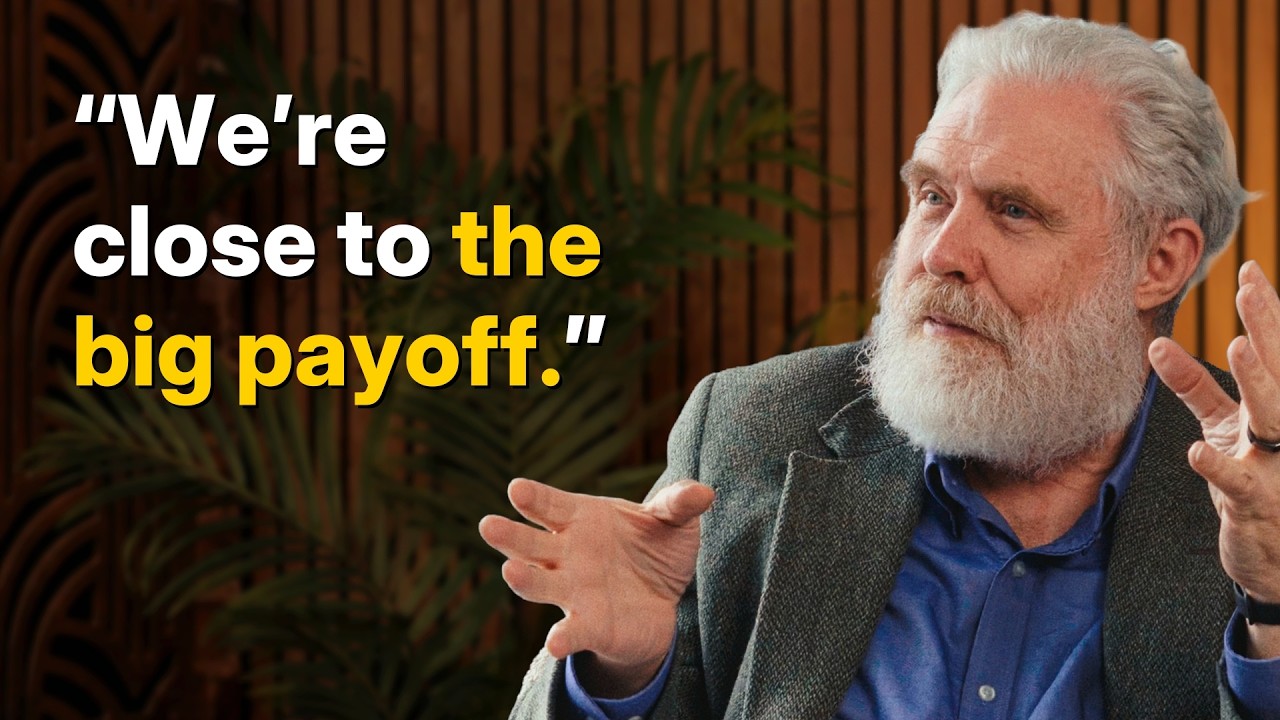
George Church is one of the most consequential biologists alive, involved in nearly every major breakthrough of the last few decades — the Human Genome Project, CRISPR, age reversal, de-extinction, cheap DNA synthesis, and more. His lab has spawned over 100 biotech companies. This conversation spans aging, gene therapy, synthetic biology, biodefense, AI, and the future of life itself.
Aging and escape velocity
Church estimates that by around 2050, we may reach “escape velocity” for aging — the point where lifespan increases by at least one year per year, effectively outrunning death.
This is based on two converging trends: exponential improvements in biotechnology and the emerging ability to reverse broad subsets of the aging phenotype, not just individual age-related diseases.
He emphasizes it won’t be a sudden cliff — people alive today are likely to be healthier in 25 years than they expect, with incremental gains compounding.
He acknowledges unknown economic or complexity barriers could arise, but doubts a fundamental physics wall exists.
Somatic gene therapy is the near-term path for age reversal, since germline editing is irrelevant to the 8 billion people already born.
Aging is largely a cellular and blood-signaling phenomenon, so replacing nuclei or cells throughout the body could in principle reset biological age without returning to an embryo.
The hardest organ is the brain, but even there, a Ship of Theseus approach — gradually replacing neurons while maintaining connections and memories — is conceivable.
Whole-body gene delivery doesn’t exist yet, but there’s no law of physics preventing it.
Dyno Therapeutics (a Church company) achieved a hundredfold improvement in targeting brain neurons using AI-designed capsids.
For many therapies, you don’t need 100% delivery — even 1% of cells producing a missing enzyme can suffice, and you can make enzymes in the wrong tissue (e.g., liver instead of brain) if the goal is blood distribution.
De-extinction and the minimum genome
Colossal’s dire wolf project didn’t recreate an exact dire wolf — it was “Direwolf 2.0,” a successive approximation that illustrates the technology.
The real question isn’t “can we make a perfect copy?” but “what’s the minimum set of changes needed to achieve a desired function?”
This approach teaches us that highly complex, multigenic traits can sometimes be controlled by very few genetic changes.
The mammoth-elephant difference may be only about a million base pairs, and not all of those matter for function.
The goal is functional restoration (e.g., Arctic ecosystem impact), not perfect replication.
The same logic applies to other traits: height in humans involves ~10,000 genes, but growth hormone (somatotropin) alone can produce extreme variation — a “master switch” example.
Reductionism in biology is a tool, not a worldview — finding single-gene levers for complex traits enables therapies and engineering, even if the full system is complicated.
Church’s lab has shown that most cell types in the body can be produced from stem cells using just 1–7 transcription factors, a dramatic reduction from what one might expect.
Biodefense and mirror life
Mirror life — organisms built from reversed chirality molecules — is a serious existential risk that Church co-authored a paper warning about.
If weaponized, mirror life could wipe out all natural life, since natural immune systems wouldn’t recognize it.
The concern is that once the technology matures enough, weaponization becomes easy — and it only takes one bad actor.
It’s possible mirror life already exists somewhere in the solar system or even on Earth, just not yet weaponized.
Offense currently has the advantage in biotech, unlike nuclear weapons where difficulty of construction provided a natural barrier.
Biotech enables smaller, harder-to-detect efforts with catastrophic potential.
Church argues for surveillance, consequences, and whistleblower mechanisms — moratoria and voluntary compliance alone are insufficient, as demonstrated by He Jiankui’s unauthorized germline editing.
Recoding the genetic code (remapping codons) could make organisms impervious to natural viruses.
There are roughly 10^80 possible genetic codes, versus only two chiralities, making code space a more robust defense.
However, synthetically manufactured viruses could still potentially overcome this defense — offense retains an advantage.
Church advocates “nipping it in the bud” rather than arms-race dynamics, noting we wasted enormous resources building tens of thousands of nuclear warheads before dialing back.
Why biotech hasn’t had its Moore’s Law moment yet
Sequencing costs have dropped a million-fold, synthesis a thousand-fold, and tools like CRISPR and multiplex experiments exist — yet we haven’t seen an industrial revolution in medicine.
Church argues we actually are on a Moore’s Law-like trajectory in biotech, slightly faster, but more recent and building on electronics’ shoulders.
We already have cures for rare diseases, effective vaccines, and a trillion-dollar biotech industry — the payoff is beginning.
The next 15 years (to 2040) could see 100x more drugs, especially as AI improves design and reduces failure rates, and as drug approval timelines shorten.
The key bottleneck is merging AI with developmental biology and manufacturing.
AI + protein design was a step function; the next ones will be AI + developmental biology, and then conquering developmental biology — the ability to make any arbitrary shape using DNA as programming material.
Biology already operates at 0.4 nanometer resolution in three dimensions — roughly a billion times denser than the best semiconductor processes (~40 nm). The challenge is learning to use the full periodic table at that precision.
Protein design was the hard problem — nucleic acids were easy (Watson-Crick rules), but proteins were intractable until about eight years ago.
Chip-based DNA synthesis (pioneered by Church’s lab in 2004) was ignored for a decade despite being 1,000x cheaper, but is now enabling libraries of 10^17 unique genes.
These massive, barcoded libraries let biology do something electronics never has: make billions of material variations in an afternoon and test them all.
AlphaFold is necessary but not sufficient — it predicts structure accurately but can’t tell you if a protein will actually function.
The path forward combines AI-designed libraries with real-world testing (not simulation), creating a natural computing loop: design → test → harvest data → redesign.
The next revolution will come from nonstandard amino acids — expanding beyond the canonical 20 to incorporate the entire periodic table, enabling entirely new materials (possibly including room-temperature superconductors).
Church’s lab is working toward using 34 nonstandard amino acids simultaneously in E. coli.
Materials science will move faster than medicine because it faces less regulatory burden.
AI and biology
Church is far more excited about scientific AI than language AI or AGI.
AGI is dangerous and unnecessary — we haven’t figured out how to align it with human values, and the rush toward it is an artificial emergency.
Scientific AI (protein design, capsid engineering, etc.) delivers enormous value without requiring general intelligence.
If safe superintelligence existed, its impact on biology is unclear — it might eliminate the need for biological research entirely, or it might be a game changer.
Church is skeptical: a million digital George Churches in a data center can’t run physical experiments, and there may be fundamental bottlenecks (like pregnancy) that more intelligence doesn’t solve.
He cautions against assuming more intelligence automatically translates to faster progress — social and physical constraints matter.
Brain complexity and intelligence
Church has always viewed the brain as “gnarly” but engineerable.
Progress has been made at the broken end (treating severe genetic developmental delays) and the declining end (cognitive enhancement), but the full complexity remains daunting.
A brain has ~10^11 neurons and ~10^14 synapses — vastly more information than the genome’s ~3 billion base pairs.
Replicating a specific brain may require more information than synthesizing one from scratch, analogous to photographing a book versus translating it.
Biobots and hybrid systems
Biological replication speed and human engineering capabilities could theoretically be combined — imagine organisms that double every 30 minutes but also build radio transmitters or other engineered systems.
The key is expanding biology’s material repertoire beyond its natural constraints.
A “bacterial radio” is a plausible challenge goal for synthetic biology; artist Joe Davis created a proof of concept.
Whole genome engineering for novel phenotypes (like wings) requires cracking the language of developmental biology — transcription factors, migration, chemotaxis, diffusion gradients.
We’re on the cusp of having these tools but don’t yet know the full “grammar.”
Life in the universe
The best evidence for extraterrestrial life would come from biology, not astronomy — specifically, demonstrating in the lab that life arises easily from prebiotic conditions via multiple independent pathways.
Conversely, proving life is unique to Earth is nearly impossible, since we can’t test all possible prebiotic conditions.
Church thinks exploration (sampling geysers on Europa and Enceladus, searching for water on Mars) is more promising than simulation.
There is 50 times more liquid water in the solar system than on Earth, much of it in subsurface oceans.
DNA as the ultimate manufacturing system
Church wouldn’t be surprised if DNA, RNA, and proteins remain the basis of advanced manufacturing in 1,000 years — but the system will be radically expanded.
The number of amino acids in use is already growing beyond 20, with nonstandard amino acids incorporating the full periodic table.
DNA’s four-letter alphabet may be sufficient (binary works well for electronics), but the backbone could change, and codon remapping could free up redundancy for other functions.
Evolution didn’t explore more amino acids or radio technology because it’s limited to incremental, justifiable changes — like a bureaucracy that requires justification for each small step before building a city.
Technology can make jumps where intermediates aren’t incrementally useful, which is why synthetic biology can go beyond what evolution discovered.
Underhyped technology: genetic counseling
Genetic counseling is the most underhyped intervention in Church’s portfolio — it’s already competitive with gene therapy for preventing rare genetic diseases.
Programs like Dor Yeshorim (operating since 1985) have virtually eliminated certain serious inherited diseases in specific communities through pre-conception carrier screening.
This is not eugenics — eugenics was forced by the state; genetic counseling preserves individual choice.
It’s underhyped because people don’t think about genetic disease risk while dating (the diseases feel rare at 3% of births), and because of a psychological tendency to avoid responsibility for inaction.
The economics are overwhelming: ~$100 per genome analyzed versus millions in lifetime care costs — at least a 10x return on investment.
Church has advised his own gene therapy companies to focus on common diseases (age-related, infectious) and leave rare recessive diseases to genetic counseling.
NIH/NSF budget cuts
Church is not advocating for the destruction of public research funding, but if a positive story emerges, it might involve:
Greater reliance on philanthropy and industry-sponsored research.
More direct connection between basic research and societal needs.
A geopolitical shift where another nation (e.g., China) becomes the dominant scientific power — “fresh blood” in the cycle of empires.
How one lab spawned 100 companies
Church’s lab benefits from being in Boston — a uniquely dense cluster of world-class universities, biotech, and pharma in a walkable area, creating a positive feedback loop of talent and entrepreneurship.
The lab culture balances basic science with societal impact from day one, which is traumatic at first but builds momentum.
Three criteria for selecting people:
Niceness — highly predictive of success in the lab and afterward; the alumni network is collaborative despite working in competitive fields.
Multidisciplinarity — people who have already learned multiple skills can bridge to new ones.
Tolerance for failure — the lab works with libraries of millions of candidates where most fail, which requires an engineering mindset distinct from traditional biology.
The vision: bio-AI co-evolution
If safety is handled, the likely outcome is almost perfect health for humanity.
Regular AI (without AGI) will already accelerate biology enormously; AGI would compound this further.
The positive feedback loop: more healthy people → more people contributing to AI prompting and hybrid human-machine systems → faster progress.
Church’s closing vision is one of people and machines working together in harmony toward near-perfect health.