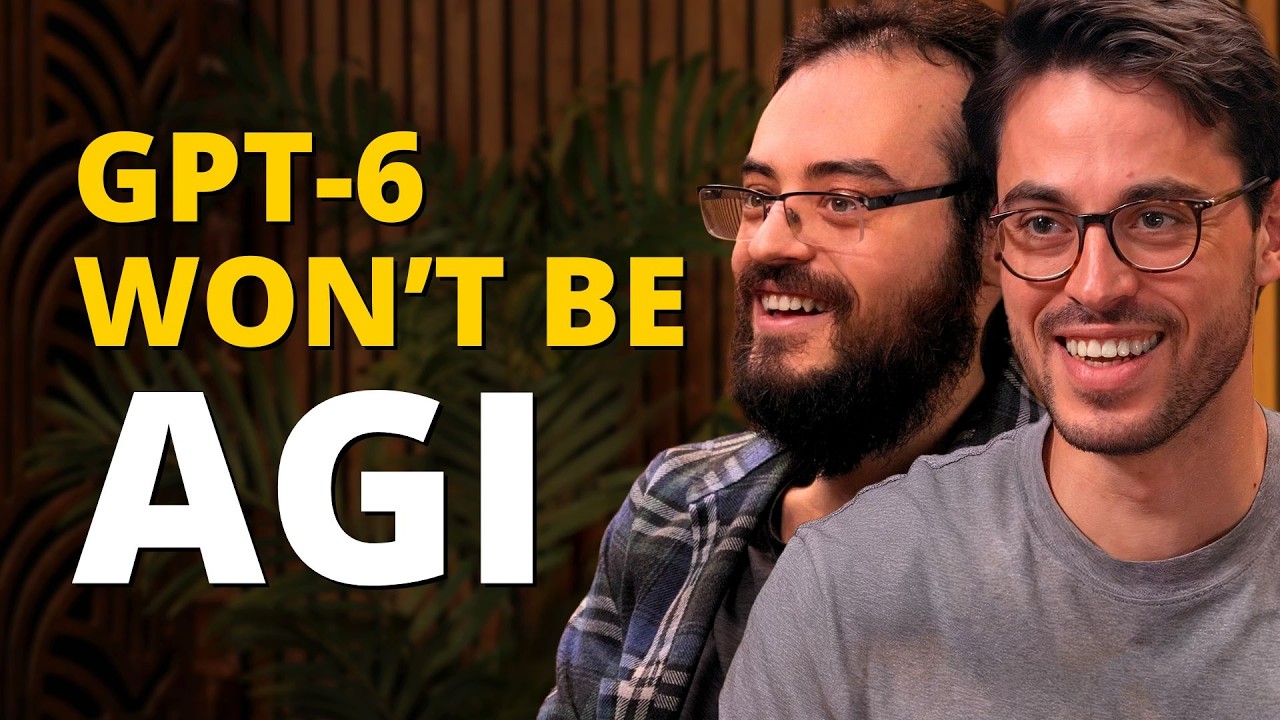
Tamay Besiroglu and Ege Erdil, formerly of Epoch AI, have launched Mechanize, a company aimed at automating all work. They argue that the path to AGI and explosive economic growth is slower and more complex than commonly believed in San Francisco, estimating full automation of remote work around 2045 (Ege) or ~2050 (Tamay). Their view emphasizes that intelligence alone is not the bottleneck—instead, broad economic transformation requires simultaneous scaling of compute, infrastructure, supply chains, data, and complementary innovations across many sectors, much like the Industrial Revolution was not simply a “horsepower explosion.”
The intelligence explosion is a misleading framing
The concept of an “intelligence explosion”—where AI recursively self-improves and rapidly leads to superintelligence—is not useful, analogous to calling the Industrial Revolution a “horsepower explosion.”
The Industrial Revolution involved complementary changes across agriculture, transportation, law, finance, and urbanization—not just more physical power.
Similarly, AI progress depends on many moving parts beyond raw reasoning: infrastructure, data collection, hardware scaling, and integration into the real economy.
Moravec’s paradox explains why AI excels at tasks humans find hard (chess, math, coding) but struggles with things humans find easy (sensorimotor skills, long-term agency in novel environments).
Tasks AI solves quickly are evolutionarily recent (e.g., language, abstract reasoning ~100k years old), so evolution had less time to optimize them.
Tasks animals can do (e.g., navigating diverse environments, pursuing long-term goals) are harder for AI and require real-world data and embodied experience.
Current reasoning models, while impressive, lack animal-level agency: they cannot reliably execute long-horizon tasks in unfamiliar environments (e.g., playing a new game from Steam, booking a flight end-to-end).
Example: Claude playing Pokémon Red gets stuck for 48 hours despite having explicit knowledge of how to progress—showing a disconnect between knowledge and action.
Why AGI is still ~30 years away
Compute scaling is slowing: Over the past 10 years, AI has benefited from ~9–10 orders of magnitude more training compute, unlocking capabilities like gameplay, language, and reasoning roughly every 3 years or every 3 OOMs of compute.
But further scaling faces hard constraints: energy, GPU production, fab capacity. Only ~3–4 OOMs of compute scaling remain before requiring a non-trivial fraction of global GDP.
Many core capabilities remain unlocked: Full remote work automation requires coherence over long horizons, full multimodal understanding, agency in arbitrary digital environments, and integration of reasoning with action—none of which are solved.
Current models fail at tasks requiring creativity, novel conceptual synthesis, or operating in messy, open-ended contexts (e.g., real AI R&D, not just solving benchmark problems).
Empirical evidence from METR evals shows AI task-length doubling every ~7 months, but extrapolating this to human-month or human-year tasks by 2030 ignores diminishing returns and the difficulty of integrating capabilities.
Unhobbling is not enough: The idea that current models are “baby AGIs” held back by narrow training or lack of context ignores that fundamental architectural and training innovations (not just more data or scaffolding) are needed for agency and robustness.
Why the intelligence explosion argument fails
The “software-only singularity” hypothesis—that AI automates AI R&D, leading to runaway improvement—ignores complementarity between software and hardware.
Historical evidence shows software progress closely tracks hardware progress (e.g., Moore’s Law). In AI, major innovations (transformers, flash attention, Chinchilla scaling) were motivated by better harnessing compute.
GPU-rich labs (OpenAI, Anthropic) drive most progress; academia and smaller institutes lag despite cognitive talent.
Returns to R&D are diminishing: Economic studies show that doubling research effort yields less than double innovation. In AI, algorithmic progress alone cannot substitute for experimental compute.
Surveys of AI researchers suggest compute reductions slow progress less than expected, but these are local observations—global scaling requires both cognitive effort and hardware.
AI R&D is harder than people think: Real research involves vague instructions, large codebases, long time horizons, and fuzzy objectives—unlike clean benchmark tasks. Current models excel at narrow, well-specified problems but struggle with open-ended discovery.
No reasoning model has produced a novel mathematical concept of interest to human mathematicians, despite knowing more than any human.
Explosive growth (>30% GDP/year) is possible but requires scaling everything at once: compute, capital, labor (AI workers), data, supply chains, and complementary innovations.
China’s rapid growth (~10%/year) came from capital accumulation and technology adoption, but without scaling the labor force. AI enables scaling both capital and labor (via AI workers), enabling much faster growth.
The Industrial Revolution saw not just more output but entirely new products and sectors (transportation, healthcare, entertainment). AI-driven growth will similarly expand product variety, not just quantity.
Infrastructure build-out is critical: Inventions like the light bulb required power plants, grids, and durable materials. Similarly, AI deployment requires data centers, energy, robotics supply chains, and real-world data collection.
“Learning by doing” and deployment feedback (e.g., ChatGPT’s user data) are essential for discovering viable applications and improving systems.
A separate “AI economy” is unlikely: AI will integrate into the existing global economy, leveraging current supply chains, markets, and labor. A standalone “Shenzhen in the desert” is less efficient than broad deployment.
Regulatory and political barriers may slow adoption in some jurisdictions, but economic and national security incentives will drive deployment in others (e.g., UAE, US), creating growth differentials.
Superintelligence and human relevance
Superintelligence is coherent but not a useful concept: AI will surpass humans on many tasks, but “superhuman at everything” is vague and not predictive of economic impact.
AI systems will be diverse; some will exceed human capabilities in specific domains, but humans need not understand all advanced technologies to benefit from them.
The trade-off between accessibility and advancement favors living in a world with advanced technology even if individuals don’t comprehend it.
Value lock-in is unlikely: Cultural and technological change is driven by economic and social forces, not just initial conditions. Digital information is not preserved forever (link rot, cultural drift), and competition between AI systems will prevent stable value alignment.
Historical analogies (e.g., abolition of slavery) show that values change due to economic incentives and functional pressures, not just moral arguments.
Policy and epistemic humility
Central planning may become more feasible due to AI’s advantages in communication, replication, and alignment, but complexity and scaling needs will still favor markets and decentralized decision-making.
Regulation is the strongest objection to explosive growth: Global coordination (e.g., banning AI deployment) is unlikely but possible (~10–20% chance), especially if AI is perceived as risky or taboo (like human cloning).
Epistemic humility is essential: Given deep uncertainty about timelines, mechanisms, and outcomes, society should prioritize flexibility, decentralization, and adaptability over rigid, high-stakes plans.
Historical war planning (e.g., pre-WWII casualty estimates) shows how badly experts predict the impact of new technologies.
Classical liberalism—decentralized knowledge and decision-making—is the best framework for navigating uncertainty.
Practical advice for aspiring contributors
Focus on key literature: Prioritize foundational papers (e.g., Romer on growth, transformer circuits, scaling laws) over general reading. Use spaced repetition and deep study.
Leverage the internet and social networks: Trace influential thinkers (e.g., via podcasts like 80,000 Hours) and engage with their work. Cold-email interesting people—quality outreach often gets responses.
Join communities: Contribute to organizations like Epoch, attend Bay Area events, collaborate with high-bandwidth peers. Reasoning alone is insufficient; progress requires collective intelligence.
Be aggressively curious: Read Twitter and arXiv, but prioritize signal over noise. Seek out people who have thought deeply about what matters.