-
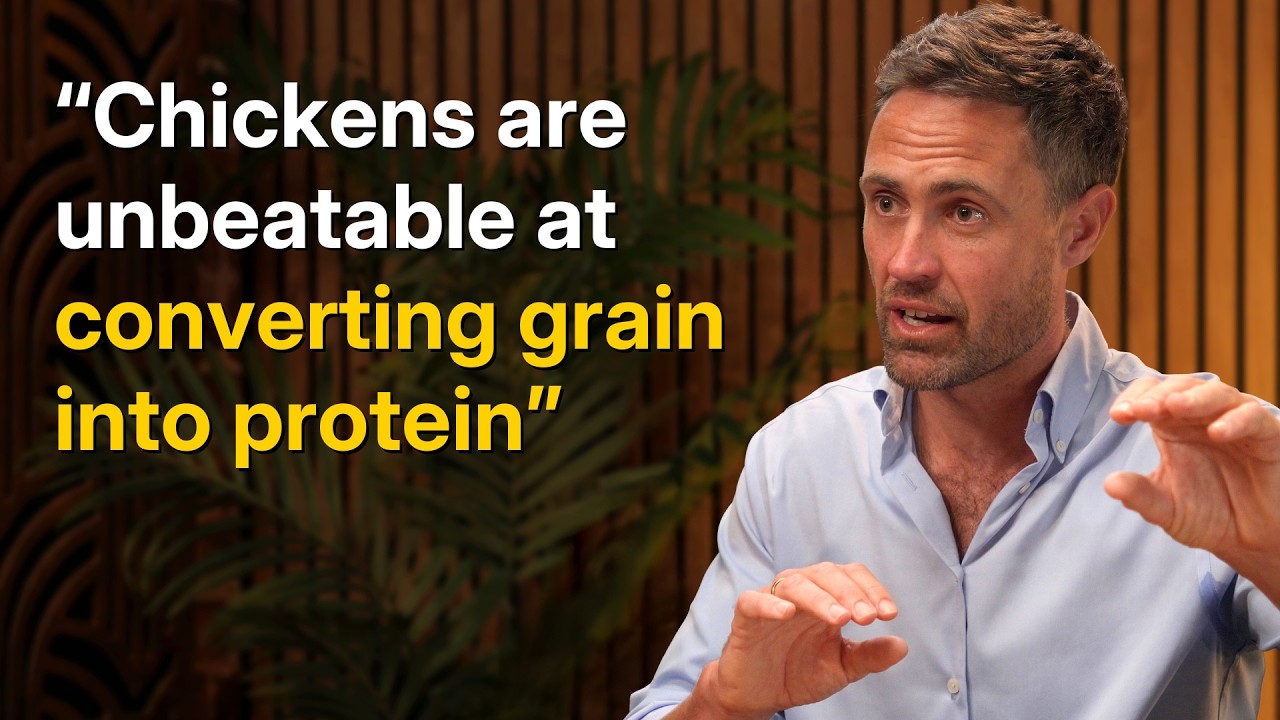
Factory farming is a massive, growing, and deeply entrenched system of animal suffering — roughly 10 billion land animals are factory farmed in the US alone each year, and global numbers are rising about 2% annually. Lewis Bollard, who directs the Farm Animal Welfare program at Open Philanthropy (the largest funder in this space), argues that ending factory farming is far from inevitable, even with advances like AGI. The system is extraordinarily hard to displace because evolution has spent billions of years optimizing animals like chickens to convert grain into meat with stunning efficiency — a feed conversion ratio of just 2:1 — and the industry has stripped away every cost that doesn’t contribute to production. This makes factory-farmed chicken insanely cheap, and competing with that price point is a genuinely difficult technological and economic problem.
-
Cultivated meat is not on a path to beat factory-farmed chicken on price anytime soon
- Companies are already selling cultivated meat in tiny volumes at very high price points, but scaling down to compete with the cheapest animal protein is an enormous challenge that current venture capital funding and startup trajectories are not on track to solve.
- Even if AGI accelerates progress, cultural barriers (many people want “real” meat) and political barriers (cultivated meat is already illegal in 7 US states and may soon be banned EU-wide) mean it might not be widely available even if technically solved.
- Bollard estimates VC investment in alternative proteins has been in the billions, while investment in “humane technology” — incremental welfare improvements within existing systems — is probably less than $10 million a year, despite potentially having more immediate impact.
-
The movement made a strategic mistake by focusing on personal diet rather than systemic change
- Early animal welfare activism focused on individual vegetarianism/veganism because advocates felt powerless to achieve larger change. This became self-reinforcing as a purity culture, easier to measure than actual impact.
- The movement has shifted significantly in the last decade toward impact-oriented strategies: government policy, corporate reform, and technology. People can be effective advocates and funders regardless of their personal diet.
-
Three proven levers have already helped billions of animals
- Government policy: The EU setting basic animal welfare standards affects billions of animals annually.
- Corporate reform: McDonald’s cage-free egg pledge alone removed 7 million hens from cages per year. Over 3,000 corporate pledges have been secured globally.
- Technology — in-ovo sexing: This technology scans eggs before hatching to identify sex, allowing male eggs (which would be killed at birth) to be removed early. It has already spared ~200 million chicks from being ground up or suffocated, went from idea to a third of the European egg industry in about 10 years, and is now entering the US. It was kickstarted by roughly $10 million in public and philanthropic funding.
-
There is enormous low-hanging fruit for technologists in animal welfare
- The industry is a commodity business that has only invested in reducing costs, not in animal welfare, so many practices remain archaic — e.g., piglets are castrated with a blunt knife and no pain relief. Immunocastration (an injection achieving the same effect) was an easy fix.
- Bollard suggests technologists could find many similar opportunities by simply spending time on farms and looking for welfare problems that could be solved with modest innovation.
-
Factory farming has essentially manufactured animals optimized for suffering
- Decades of selective breeding have created chickens that grow 4x faster than in the 1950s, causing them to collapse under their own weight, develop chronic pain, and suffer cardiovascular failure. Breeding birds must be starved to ~30% of their natural feed intake to survive past puberty.
- The industry’s efficiency model means it’s collectively more profitable to cram in more animals even if more of them die or suffer — individual animal welfare losses are outweighed by throughput gains.
- Pigs taken indoors and bred for fast growth became aggressive and bit each other’s tails, leading to tail cutting, teeth clipping, gestation crates, and antibiotics — each “solution” addressing symptoms while sometimes making things worse.
-
Higher welfare breeds exist and are commercially viable, but need advocacy to be adopted
- Companies in Denmark, France, and elsewhere have moved to breeds with broader legs, better cardiovascular systems, and more balanced growth — they still grow fast but don’t destroy their bodies. They are slightly less economical because they haven’t been ruthlessly optimized only for breast meat yield and feed conversion.
- The LDC Group, France’s largest chicken producer, just committed to moving its two main brands to higher welfare genetics.
- Without government or corporate commitments maintaining a welfare floor, the industry will race back to the bottom — as seen when an industry study found broiler chickens self-selecting pain relief-laced feed (suggesting chronic pain), the industry strengthened their legs, then used that to make them even bigger.
-
The scale of the problem is almost incomprehensible, and scope sensitivity fails
- A single battery cage farm with 100,000 hens, each experiencing weeks of pain, would be a moral emergency if it were the only one. But there are ~10 billion chickens alive at any point globally — the problem is five orders of magnitude larger than any single farm.
- Dog fighting and cockfighting (thousands of animals) are felonies in every US state, while factory farming (billions of animals, often subjected to worse treatment) is classified as commerce.
-
This is one of the most cost-effective philanthropic opportunities in existence
- Less than $300 million annually is spent globally on all farmed animal welfare work; less than $200 million of that goes to evidence-based interventions. For comparison, climate advocacy philanthropy is 50x larger, and US cat/dog shelters alone are 25x larger.
- Corporate cage-free campaigns have already spared over 200 million hens per year from battery cages, and broiler chicken reforms have benefited over a billion animals — all for less than $100 million per year in spending.
- Bollard estimates roughly $1 of smart philanthropic spending can avert ~10 years of animal suffering, a ratio that exists because the space is so systematically neglected.
- The host is offering a $250,000 donation match through FarmKind (farmkind.giving/dwarkesh), which regrants to the most effective animal welfare charities. A single listener could meaningfully increase total effective funding in this space.
-
The political battleground: state-level reforms vs. the meat lobby’s congressional power
- Advocates passed ballot measures in Florida and Arizona banning gestation crates, but the pork industry imported crated pork from other states. California and Massachusetts then passed laws banning the sale of crated pork within their borders — a critical move.
- The pork industry failed to overturn these laws at the Supreme Court, but is now pushing language in the federal farm bill to ban states from setting their own animal welfare sales standards. This is likely to pass because it’s buried in a must-pass bill that also contains farm subsidies and food stamps — politicians won’t sink the whole bill over this one provision.
- The industry’s structural advantage: animal welfare bills go through Agriculture Committees dominated by agribusiness interests. A recent House Ag Committee hearing invited only industry lobbyists, no opposing witnesses.
- The industry spends ~$45 million per election cycle and benefits from the “mythos of the American farmer” — even though most contract farmers are essentially indentured laborers with large loans, and the lobbying associations are run by giant agribusinesses, not small farmers.
-
The meat industry’s political economy is puzzling but explicable
- The industry represents less than 1% of Americans, defends wildly unpopular practices, yet has a near-total lock on legislative progress. This is because: (1) allied industries (insurance, pharma, feed) also have stakes; (2) they invoke the romantic image of the family farmer; (3) they are extremely well-organized in DC and state capitals; (4) they function as oligopolies with outsized profits despite being commodity businesses, enabling heavy lobbying.
- Contract farmers are often trapped — promised high incomes, then slowly paid less, with no alternative processors in their area and long-term contracts. Some family farmers who already use higher welfare practices support reform but can’t afford to fly to DC and lobby.
-
Corporate campaigns have been more effective than policy — but companies don’t advertise their progress
- Consumer-facing brands (retailers, fast food) are more responsive to consumer pressure than politicians because: (1) decision-makers aren’t captured by ag lobbies the way Agriculture Committees are; (2) companies have found consumers are genuinely outraged and will act.
- Companies rarely advertise their animal welfare improvements because consumers already assumed they weren’t using caged eggs — advertising “we’re cage-free now” reveals past practices consumers didn’t know about. Phase-in periods (e.g., “cage-free by 2033”) also make advertising awkward.
- Retailers like Walmart and Kroger have marked up cage-free eggs far beyond the actual cost difference (~19 cents production cost vs. ~$1.70 retail markup), using them as a price differentiation tool for less price-sensitive consumers, which slows adoption. Costco, by contrast, went 100% cage-free at the same price as competitors’ caged eggs.
-
The sustainability framing of animal welfare is partly strategic and partly misguided
- Some animal charities emphasize climate/sustainability on their landing pages to attract broader support, but this can backfire — Tyson Foods has argued against higher welfare breeds because they have a slightly larger carbon footprint.
- Bollard notes that switching from beef to chicken for climate reasons actually increases total animal suffering (23 more animals consumed per year) for marginal climate benefit.
- Meat company executives privately admit animal welfare matters more to consumers than climate, but they’re more responsive to what investors and fast-food buyers demand — and those stakeholders are obsessed with ESG climate targets.
-
Developing countries: the problem is growing but there are opportunities
- As countries get wealthier, they eat more meat, and factory farming has spread globally because it’s cheaper. However, countries without deeply entrenched factory farming industries can leapfrog — e.g., China is investing heavily in cultivated meat research and now produces the majority of global patents in the field.
- Multinational companies (Unilever, Nestlé, Burger King) are extending cage-free and other welfare standards globally through their supply chains.
- There may be an animal welfare Kuznets curve: Germany may have passed the peak of total animal suffering, with reforms now reducing it — but this only happened because talented advocates mobilized public opinion into corporate and government policy changes. It doesn’t happen automatically with wealth.
-
Mislabeling undermines higher welfare producers
- Much factory-farmed chicken is labeled “all-natural,” which consumers mistakenly think means the animals had outdoor access. This makes it nearly impossible for genuinely pasture-raised producers to compete on a level playing field.
- Pasture-raised egg producers face the same problem, compounded by supermarkets marking them up heavily as a premium product. Clearer labeling in eggs has helped the pasture-raised sector grow rapidly, but it’s still handicapped.
- Attempts to build alternative supply chains (like Cooks Venture for pasture-raised chicken) have failed partly because of this rampant mislabeling.