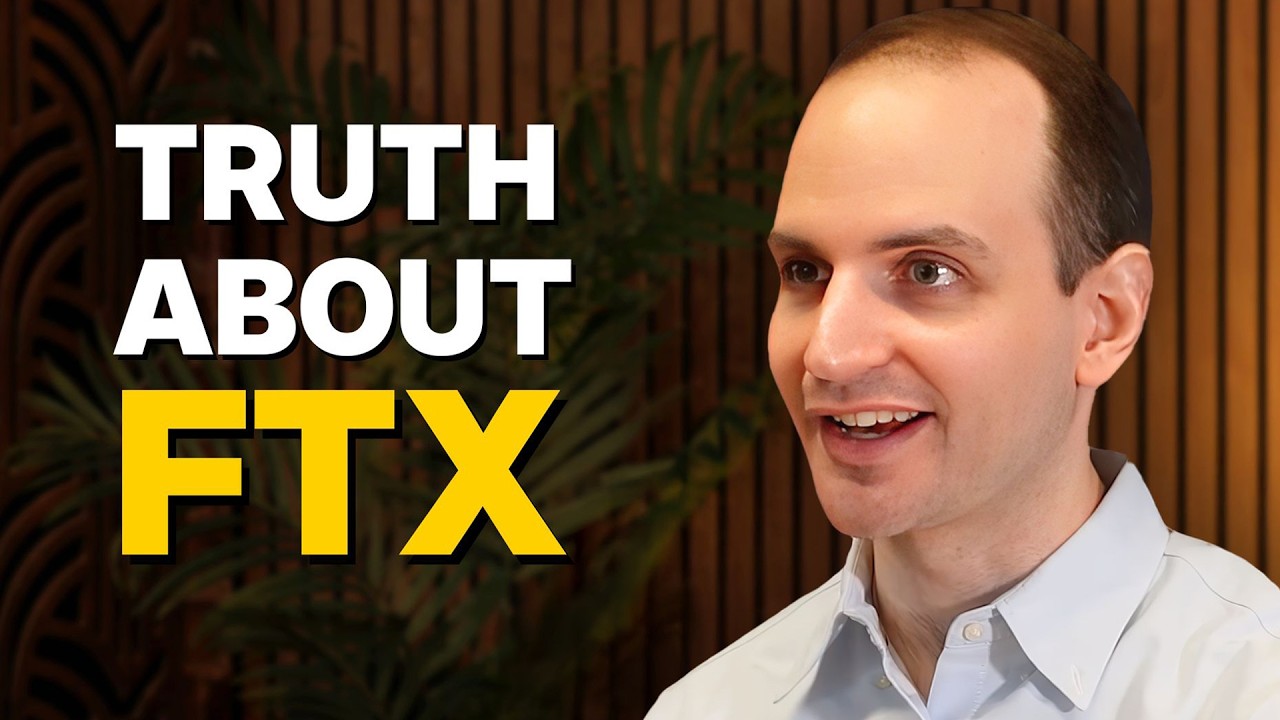
Brett Harrison, former President of FTX US and founder of Architect, shares his first long-form interview about his career spanning Jane Street, Citadel Securities, FTX, and his new venture. The conversation covers market structure, high-frequency trading culture, the inner workings and collapse of FTX, and his vision for crypto infrastructure.
Passive Investing, ETFs, and Market Structure
Brett led ETF technology at Citadel Securities and believes passive investing is net positive: it dramatically lowers costs for individual investors and diversified index investing is the right move for most people.
One potential downside is correlated price movements between stocks simply because they share an index, which can create temporary dislocations, especially in less liquid instruments like ADRs.
Arbitrageurs like James Street and Citadel Securities work to close these gaps over time, but short-term dislocations can persist due to liquidity differences.
Different quantitative trading firms occupy distinct niches: some focus on microstructure alphas (milliseconds to seconds), others on relative value conversions (hours to days), and some on longer-term quantitative strategies (days to months).
Infrastructure needs are broadly similar across firms—exchange connectivity, market data, simulation platforms, visualization tools—but the actual strategies and profit mechanisms differ significantly.
HFT Hacks and the Social Value of Speed
Brett describes a famous HFT optimization: pre-constructing an entire TCP/IP message to NASDAQ with only the price bytes left blank, pre-loading it into the network card’s buffer, so that when a signal fires, the trader only needs to insert the price and send—minimizing latency to nanoseconds.
The analogy to gaming is apt: the goal isn’t theoretical perfection but “good enough” results delivered as fast as possible.
On whether ultra-low-latency trading is socially useful: Brett argues that as long as liquid, tight, efficient markets are valuable, you want sophisticated technologists competing at the margins.
He rejects the idea that society can identify an optimal speed threshold beyond which further investment becomes wasteful.
The resources spent are justified by the profits firms capture, meaning a real service is being provided.
He notes that technologies built for finance (like microwave networks) may have spillover benefits for society, though this is a contingent rather than guaranteed benefit.
Rare Events: Finance vs. Civilizational Risk
Working in high-speed finance teaches you to better estimate the probability of rare events, which makes someone like Brett more attuned to civilization-level risks.
However, the mental models don’t transfer well to solutions: financial risk is a closed system you can model and hedge, whereas pandemics or AI risk involve collective action problems and domain-specific unknowns.
People in finance were quicker to act on COVID—fleeing cities early—because they had the financial flexibility and an instinct to avoid adverse selection, but this doesn’t mean they’re better equipped to solve systemic global risks.
Interstellar Markets and Periodic Auctions
Brett explains that there’s nothing in a matching engine’s design that prevents orders from distant locations, but the practical problem is adverse selection: a market order sent from Mars or Alpha Centauri would arrive at a completely different price than expected.
A real-world analog exists in automated market makers on slow blockchains like Ethereum, where prices are set by a deterministic function at the time of execution, so the order always gets a fair price based on prevailing liquidity when it arrives.
Periodic (batch) auctions are another solution: if orders are batched every 30 seconds and filled by price priority rather than time priority, latency advantages disappear.
In practice, however, exchanges that tried periodic auctions (like the Taiwan Stock Exchange) moved away from them due to poor liquidity and price discovery.
Brett considers the US to have the best market infrastructure, though much of the technology (NASDAQ’s matching engine) is licensed globally.
Hiring, Adverse Selection, and Jane Street Culture
Hiring markets are far less efficient than financial markets: the pipeline from elite universities to top firms is liquid, but many talented individuals at lesser-known schools never get noticed.
A trader’s instinct might flag an applicant from an unknown school as adverse selection, but that person could actually be the best in their region—making it a positive selection signal.
Strong brands and mission-driven cultures (like Jane Street’s) create powerful positive selection: the brand attracts top candidates, and difficult interviews filter effectively.
On whether Jane Street should replace OCaml with Rust: Brett says not for existing codebases (too much infrastructure), but if starting from scratch, yes—Rust offers OCaml’s compile-time safety with much faster execution, since OCaml’s garbage collection is problematic for low-latency systems.
He’s been enjoying Rust recently and credits crypto (blockchain and smart contract development) with driving enormous open-source contributions to the language.
Jane Street pays interns $16–17K/month because the talent market is extremely competitive, starting salaries for top graduates are in the low-to-mid six figures, and interns do real work.
Interns are net worthwhile because the program serves as a three-month audition: those who return full-time are already trained and culturally vetted.
There is a free rider problem (competitors poach trained interns), which is why firms invest heavily in making the internship experience exceptional.
Quant Culture vs. Silicon Valley
Quant finance culture (New York/Chicago) is ruthlessly pragmatic: draw a straight line between your work and profitability as fast as possible.
Silicon Valley culture values creativity and novelty—doing things no one has done before.
Brett believes both cultures would benefit from cross-pollination: trading firms could use more creative thinking beyond marginal speed improvements, while tech companies could benefit from the quant approach of shipping products and generating revenue.
Spending habits among young quants are far more inconspicuous than Wolf of Wall Street—closer to Walmart t-shirts—reflecting millennial preferences for experiences over material displays of wealth.
Brett is optimistic that younger generations amassing wealth early will deploy it more dynamically: founding companies, donating to causes, helping family, rather than hoarding it until late in life.
Psychology of High-Stakes Trading and Development
Brett doesn’t lose sleep over the risk of catastrophic errors because mature trading firms have many layers of safeguards: dollar limits per minute, per trader, per desk, firm-wide limits, regulatory compliance rules (like FINRA’s 15c-3-5), and market access controls.
New code is embedded within large, established frameworks designed to be “trader-proof”—limiting how much damage any single person can do.
The times he actually loses sleep are when a trader in London or Hong Kong calls at 3 AM asking for help understanding a system.
On the social value question: at firms with strong, coherent cultures like Jane Street, employees share a clear view—they provide the best pricing and access to markets critical for global capital allocation.
This is made tangible through anecdotes: a state pension fund needing to move a $5 billion portfolio efficiently saves meaningful basis points, which ultimately benefits the pensioners.
FTX: Meeting Sam Bankman-Fried and Joining
Brett met Sam at Jane Street, where Brett ran an annual OCaml boot camp for new trader hires and Sam was among the first cohort. Sam was smart, well-liked, above average but not a standout, and people saw promise in him.
Over time, Brett worked more with Sam’s trading desk on lower-latency ETF and OTC automation systems, and Sam contributed increasingly to system design.
They bonded over shared veganism and interest in animal welfare causes; Sam was already known for donating most of his income to effective altruism.
After both left Jane Street, Sam briefly pursued effective altruism full-time, then started Alameda Research. He called Brett in 2018 saying Alameda had struggled (poor infrastructure, lost tokens to wrong wallets, a bad directional bet, internal fractures) and he was considering political prediction markets—which became FTX.
By the time Brett joined Citadel Securities, Sam had become a billionaire running a major Hong Kong-based crypto exchange. Brett first learned of FTX’s scale from a colleague at Citadel.
In March 2021, Sam approached Brett about joining FTX US. At the time, FTX was the 4th or 5th largest exchange globally by volume, but FTX US was virtually non-existent—just a legal entity with minimal volume.
Sam’s vision for FTX US included growing spot trading, bringing regulated derivatives onshore, and eventually building a single app for all trading (including stocks).
Brett saw it as an opportunity to lead a startup-like operation and build a regulated broker-dealer from scratch.
FTX US: Accomplishments and Organizational Friction
Brett’s key accomplishments at FTX US:
Acquired Ledger X and advanced an innovative CFTC application for real-time, direct-to-customer, 24/7 margining and cross-collateralization.
Established a US broker-dealer for stock trading (similar to Robinhood), writing ~90% of the code himself.
Built out compliance, legal, operational, and support teams, with Chicago as the base (chosen for its derivatives ecosystem: CME, FCMs, prop trading firms).
The central organizational problem: Sam and his inner circle (Gary and Nishad in the Bahamas) refused to grow the US engineering team.
Sam publicly boasted that FTX was built by just two developers and criticized large tech companies for over-hiring.
Brett argued that at a $10B+ valuation with institutional customers, a two-person dev team was unsustainable—especially when US broker-dealer regulations require dedicated, knowledgeable staff.
All code went through a single shared repo; Gary and Nishad controlled pull requests. The codebase was almost entirely written by two people, poorly documented, and unmaintainable by anyone else.
Brett’s push to hire more US developers was repeatedly blocked; when he finally hired one person, the Bahamas team convinced that person to relocate there.
Decision-making authority rested entirely with the small group in the Bahamas. Senior US leaders like Brett were often blindsided by strategic decisions (acquisitions, partnerships) learned about through news or chat groups.
SBF’s Leadership and Media Obsession
Brett’s initial impression of Sam’s leadership: he had good intuitions about product design (cross-collateralization, orderly auto-liquidation, predictable matching engine behavior) but was not a details person and avoided confrontation.
Sam was virtually absent from company management—on calls all day with investors, media, and podcasters, rarely speaking to employees about company matters.
Brett visited the Bahamas and directly told Sam that his PR/media focus was diluting the brand, distracting from management, and causing operational problems. Sam reacted angrily, insisting his PR efforts were the best thing that had happened to the company.
Sam’s media strategy created a self-reinforcing flywheel: constant accessibility made journalists addicted to direct access, celebrities and politicians endorsed him, investors praised him, and the media amplified his image—regardless of underlying reality.
Employees were divided: some were frustrated by the lack of direction, but many hero-worshipped Sam, keeping their life savings on FTX even as problems mounted.
Brett describes a clear deterioration in Sam’s mental and physical state between his early 20s at Jane Street (happy, healthy, sociable) and his time at FTX (angry, depressed, anxious, leg-shaking, snapping easily, unresponsive to messages). He speculates this could have been due to stress, lack of sleep, poor diet, the weight of keeping secrets, medications, or a combination.
Leaving FTX
Brett wrote Sam an ultimatum letter with three demands: (1) weekly one-on-one communication, (2) separate C-level management for the US business, and (3) growing the tech team and moving authority away from Gary and Nishad.
Sam refuted every point: phone calls waste his time, the dev team is the best in the world and adding people would make it worse, and he ignored the leadership delegation point.
After Brett said he’d resign if nothing changed, Sam deputized someone to threaten Brett in person: he’d be fired, and Sam would destroy his professional reputation. They also demanded Brett write an apology letter for Sam to edit—which Brett refused.
Brett stayed 3–6 months to transition responsibilities and protect his team, then officially resigned in late September 2022.
On his last day, Sam announced the closure of the Chicago and San Francisco offices, requiring all employees to move to Miami or leave.
Sam then told investors and reporters that Brett was fired for refusing to move to Miami—a narrative Brett had to publicly correct.
FTX Collapse
Brett had already begun fundraising for his new company, Architect, when FTX collapsed in November 2022. Several investors paused, concerned about their own FTX exposure, and some wanted Sam’s blessing before investing in Brett—illustrating Sam’s continued grip on the industry even post-resignation.
Brett’s first inkling of trouble was the night before the Binance acquisition announcement, when he saw Twitter panic about CZ selling FTT. He dismissed it, unable to connect FTT’s price to exchange solvency.
The morning of the Binance announcement, he was closing Architect’s investment round—the worst timing in crypto fundraising history.
The week that followed was information overload: the Binance deal collapsed, FTX filed for bankruptcy, and a hack occurred simultaneously.
On FTX US solvency: Brett believed it was solvent when he left—separate bank accounts, separate crypto wallets, separate AWS infrastructure. But the shared leadership (Sam as CEO of both, Gary as CTO of both, Nishad as director of engineering for both) meant true separation was never achieved, making it impossible to know what intercompany transfers happened in the final week.
Lessons from FTX
Brett reflects on whether he should have seen the fraud coming: he raised management concerns repeatedly, but management dysfunction doesn’t imply fraud, and every company he’s worked at has had growing pains.
The level of deception was expertly crafted to fool employees, auditors, and investors. Internal records were deliberately manipulated, and audited financials were falsified.
Even someone with Brett’s experience and position couldn’t have detected it without disbelieving audited financials, media reports, investor due diligence, and Congressional testimony simultaneously.
He believes the solution is structural: mandated independent boards at certain stages of company growth, with appropriate regulatory and financial oversight—not the ability of any single employee to detect fraud.
On what to do when seeing bad organizational practices at a company managing other people’s assets: raise concerns through proper channels (manager, HR), document how they respond, and if they retaliate or threaten, make plans to leave.
Brett commends those who speak up but acknowledges it’s easier for someone with financial flexibility and career options.
Regulators and FTX’s Regulatory Legacy
Regulators generally saw FTX as a willing collaborator in bringing crypto within existing regulatory frameworks—unlike many crypto firms that tried to skirt regulation.
Brett’s Ledger X proposal (24/7 direct-to-customer margining, cross-collateralization, orderly auto-liquidation) was innovative and could have modernized US derivatives market structure.
Critics (like CME) worried about liquidation cascades from algorithmic auto-liquidation, though Brett notes that existing CCPs already have margin breaches regularly and the current system is far from perfect.
The proposal’s association with FTX has set it back, but Brett and industry figures like Walt Lukken believe the underlying ideas remain worthwhile.
Brett disagrees that crypto’s purpose is regulatory arbitrage: while it’s easier to build in crypto while it’s unregulated, most institutional participants expect and want proper regulation, and working with regulators is the responsible path.
The FTX Mafia
Brett draws a parallel to the PayPal Mafia: when a company exits quickly, young, talented, ambitious people with strong networks and skills disperse and go on to build great things.
FTX alumni are in a somewhat different position (more like actual mafia people), but many came from impressive backgrounds before FTX and will rebuild their careers.
He expects several to emerge and do something great.
Architect.xyz
Architect provides unified infrastructure for accessing the entire digital asset ecosystem: centralized exchanges, DeFi protocols, qualified custodians, self-custody—all through a single API.
The problem it solves: institutions and sophisticated individuals currently have to build custom integrations for each venue (5–10 engineers per firm, all solving the same problem), or manually click through multiple platforms.
Architect wraps the complexity of different exchanges and protocols into a clean, institutional-grade API so traders can focus on strategy and alpha.
The target market starts with institutions and high-net-worth individuals but extends to a growing class of semi-professional individual traders enabled by crypto’s open, low-cost market access (free market data, cheap cloud servers, simple JSON/WebSocket protocols).
Architect is asset-class agnostic: crypto is the starting point, but the infrastructure is designed to be general.
Brett doesn’t want to predict whether crypto trading will centralize further, move to DeFi, or be absorbed by traditional exchanges like NASDAQ and ICE—so he’s building connectivity to all of them.
FTX experience informed Architect in two key ways: (1) appreciation for how a well-designed API should work (FTX’s was excellent), and (2) designing so users never need to share private credentials with Architect—they connect their own wallets.
On hiring: Brett has hired several former FTX US employees and notes that the current tech hiring market is so oversupplied with laid-off talent that recruiting has been effortless.
Institutional interest in crypto remains strong post-FTX: every major investment bank has blockchain initiatives, top trading firms continue to trade crypto, and the main barriers are regulatory clarity and professional-grade tools—both of which are being addressed.
The Social Value of Crypto Trading
Brett grounds the value of crypto trading in the same logic as commodity trading: if people have legitimate use for an underlying asset, efficient price discovery matters.
Bitcoin as a store of value, ether as gas for a decentralized computer, and security-like tokens that fund real projects all benefit from fair, efficient pricing.
Some tokens function almost exactly like equities, with initial offerings funding products and secondary trading serving as a barometer for the health of the underlying project.
On whether crypto settlement could improve traditional markets: Brett points out that equity settlement still takes two business days, settlement files are frequently wrong (missed dividends, incorrect splits), and a transparent, decentralized settlement layer could be a major improvement—which is why banks are experimenting with on-chain fixed income settlement.
On whether the marginal crypto trader should stop: Brett believes crypto markets are less efficient than equity markets, creating more room for informed traders to have edge, and that increased access to sophisticated tools has enabled more people to trade systematically and profitably.