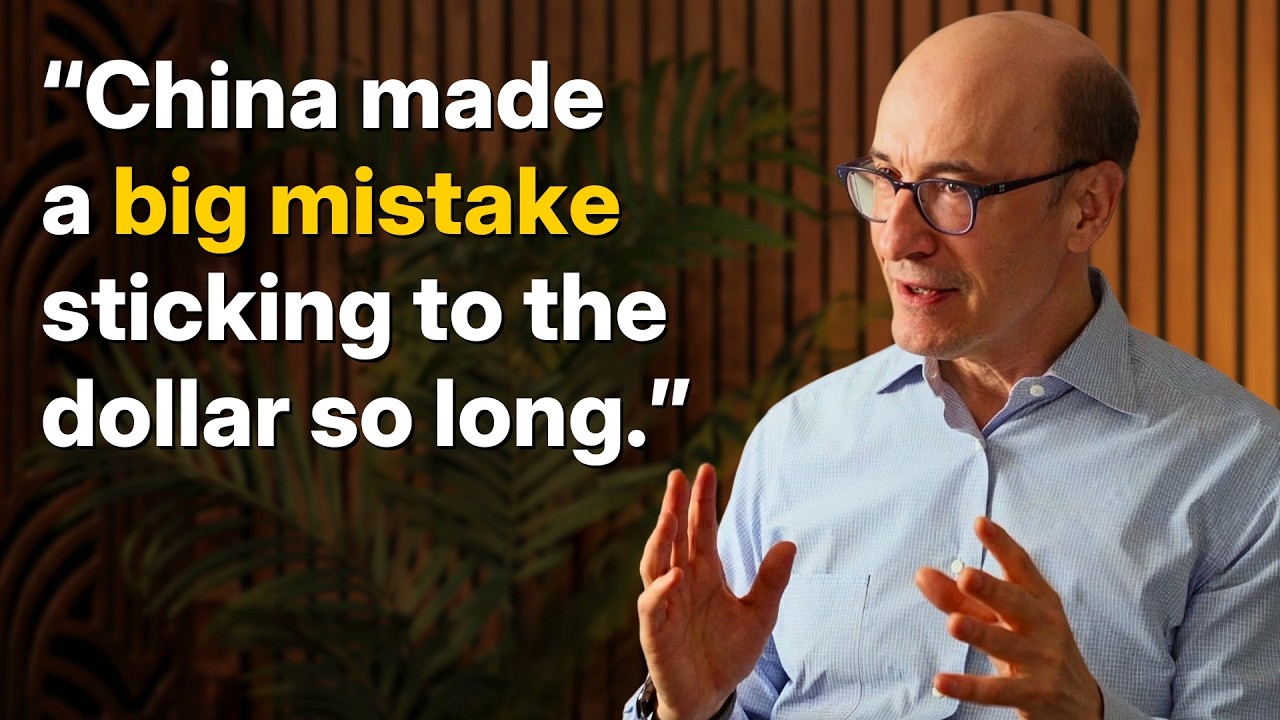
- Ken Rogoff, Harvard professor, former IMF chief economist, and author of Our Dollar, Your Problem, argues that China is mired in a deep economic crisis rooted in overinvestment in real estate and infrastructure, while the United States faces a looming fiscal reckoning that could erode its global financial dominance.
- China’s crisis stems from a long-running model of debt-fueled construction and export-led growth that has run its course, with Xi Jinping centralizing power and failing to rebalance toward consumption, leaving the economy overbuilt, demographically strained, and increasingly misallocated.
- The US benefits enormously from the dollar’s reserve currency status—borrowing cheaply, running deficits, and wielding sanctions—but this “exorbitant privilege” masks unsustainable fiscal trends, and Rogoff warns that a combination of rising debt, political dysfunction, and external shocks will likely force a painful adjustment via inflation, financial repression, or austerity within the next decade.
- Despite China’s nominal GDP reaching ~75% of US levels, Rogoff is deeply bearish on its long-term trajectory, projecting it will grow only ~1% per year faster than the US—nowhere near enough to overtake it by 2040—due to collapsing real estate, weak consumption, demographic decline, and declining policy competence under Xi.
- Past challengers to US economic dominance—the Soviet Union, Japan, China—all failed not just due to American strength but because of their own structural flaws and policy mistakes, though Rogoff stresses that US success has also involved significant luck, and that current policies (tariff wars, attacks on institutional independence, fiscal profligacy) risk squandering that advantage.
China’s Economic Model Has Hit a Wall
-
The core problem is overinvestment in real estate and infrastructure, which accounts for roughly a third of China’s economy.
- Local governments were allowed to sell land and fund construction companies to generate revenue—a system initiated in the 2010 stimulus under Hu Jintao but left running long past its usefulness.
- Tier-three cities (e.g., population ~500,000) feature massive, underutilized infrastructure: huge train stations, empty tourist complexes, oversized housing developments—built without regard to actual demand or demographic trends.
- Young people don’t want to live in these cities, and jobs aren’t there; the model assumed decentralization would relieve overcrowding in megacities, but market forces pulled people toward urban centers anyway.
-
Consumption remains dangerously low—around 45% of GDP vs. ~70% in the US—because households lack social safety nets.
- No robust public healthcare or pension system forces high personal savings.
- Citizens are largely barred from investing abroad, trapping savings in domestic assets like housing or low-yield bank accounts.
- Now that housing prices are collapsing—the primary household savings vehicle—consumer confidence and spending are falling further.
-
Official growth figures are unreliable and likely overstated.
- From 1980–2012, official growth averaged ~10%, but purchasing power parity (PPP)-adjusted estimates suggest ~7%.
- Under Xi Jinping (post-2013), growth has slowed significantly—officially to 6–7%, possibly as low as 3.5%—and the gap between reported and actual performance has widened.
- Even if China reports 5% growth, Rogoff believes it’s not achievable sustainably given current imbalances.
-
Xi Jinping has undermined technocratic governance, replacing competent officials with loyalists.
- Earlier Chinese leaders actively solicited diverse expert views, including from Western economists like Rogoff.
- At the 2016 China Development Forum, Rogoff warned top leaders directly about overcentralization and housing risks—and was thanked, not punished—but the system has since become less open and more rigid.
- Rogoff fears that in a crisis, both US and Chinese leadership are now less competent than in past decades, increasing the risk of miscalculation.
The US Fiscal Path Is Unsustainable
-
America’s debt dynamics are on an unstable trajectory, with no political will to correct course.
- Debt is rising rapidly, and neither party faces institutional constraints to curb spending.
- Fiscal councils (like the UK’s Office for Budget Responsibility) have limited impact; the US Congressional Budget Office is constrained by congressional assumptions.
- Rogoff sees no viable mechanism—term limits, campaign finance reform, voting system changes—that currently addresses the structural incentive to deficit-spend.
-
Four ways out of high debt—default, financial repression, austerity, inflation—are all politically or economically painful.
- Default is unlikely because the US borrows in its own currency.
- Financial repression (forcing domestic institutions to hold government debt at low rates) is harder in the US than in Japan or post-WWII America because of deep, market-driven capital markets and foreign holders who can’t be coerced.
- Austerity (spending cuts/tax increases) is politically toxic.
- Inflation (10–20% over several years) is the most likely outcome, acting as a stealth default that reduces the real value of debt—but only temporarily if underlying fiscal imbalances persist.
-
Markets underestimate the risk because they overtrust Federal Reserve independence.
- The Fed has successfully anchored inflation expectations for decades, but its independence is legally fragile.
- In a crisis (e.g., war, pandemic, financial shock), Congress or the President could override the Fed—especially after recent Supreme Court rulings expanding executive power over agencies.
- Rogoff, who wrote the seminal paper advocating central bank independence, now believes markets place too much faith in its permanence.
-
AGI could ease fiscal pressures but won’t eliminate political dysfunction.
- A massive productivity surge from AGI could boost growth above interest rates, making debt more manageable.
- However, Rogoff emphasizes that debt crises are driven by politics, not arithmetic: even fast-growing countries (e.g., 19th-century US) have defaulted or inflated when distributional conflicts prevent orderly adjustment.
- If AGI causes deflation, the Fed can still manage it by allowing nominal interest rates to rise less than they otherwise would—avoiding the zero-lower-bound trap.
Geopolitical and Financial Shifts Are Underway
-
China is quietly preparing for financial decoupling from the US.
- It holds an estimated $2 trillion in US Treasuries directly and via proxies, but is diversifying into gold and other non-Western assets.
- More critically, it’s building alternative payment systems (“rails”) to reduce dependence on US-controlled financial infrastructure.
- Countries in Africa, Latin America, and Iran are being pressured or incentivized to accept RMB-denominated transactions.
- Russia’s pre-invasion financial preparations offer a template; China is following suit, though gradually.
-
The dollar’s dominance is slowly eroding—not because of a better alternative, but because of US policy choices.
- Tariff wars, threats to Fed independence, and weaponization of sanctions are pushing allies and adversaries alike to seek alternatives.
- Europe is advancing a central bank digital currency partly to gain payment autonomy.
- Rogoff stresses that the US has been “lucky” as much as good—benefiting from others’ mistakes (e.g., China’s delayed reforms, Eurozone’s flawed architecture)—and that luck may be wearing thin.
-
US equities are likely to underperform foreign stocks in the coming decades.
- The dollar is overvalued, and mean reversion suggests it will weaken, boosting returns on foreign assets when converted back to dollars.
- Europe, despite current stagnation, has significant catch-up potential—especially if remilitarization drives investment and innovation.
- Rogoff advises international diversification, particularly into Europe, not because the US will collapse, but because others may grow faster from a lower base.
Historical Parallels and Lessons
-
Japan’s “Lost Decade” (actually decades) illustrates how financial crises can permanently lower a nation’s wealth.
- In the late 1980s, Japan was richer per capita than the US by market exchange rates; today it’s far poorer.
- The Plaza Accord (1985) forced rapid yen appreciation and financial deregulation, which—combined with loose monetary policy—fueled asset bubbles that burst in 1992.
- Rogoff initially blamed Japan’s slow response, but now believes US pressure to liberalize too fast was a major mistake: gradual reform would have avoided the crisis.
- Japan’s consensus-driven culture prevented creative destruction, prolonging stagnation.
-
Post-WWII financial repression worked for the US, but conditions were unique.
- Debt was ~120% of GDP, but private debt had been wiped out; capital markets were underdeveloped.
- Patriotism and command-economy controls made repression feasible.
- Today, with vast private debt and globalized capital markets, similar repression would be far more disruptive.
-
China’s trajectory mirrors Japan’s: export-led growth, aging population, asset bubble, and reluctance to reform.
- But China is poorer, less technologically advanced, and faces greater geopolitical headwinds.
- Unlike Japan, it lacks a democratic safety valve, making adjustment harder.
Final Outlook
-
Rogoff expects a US inflation crisis within 10–20 years, triggered by a shock (geopolitical, technological, or financial) that exposes fiscal fragility.
- This will be followed by partial austerity and slower growth—not a Greece-style collapse, but a prolonged period of adjustment.
- Global ripple effects will be severe due to dollar centrality.
-
China will not overtake the US economically.
- Even with PPP adjustments, its total productive capacity is constrained by inefficiency, demographics, and political risk.
- Its military advantages (cheaper shipbuilding, lower personnel costs) don’t offset US technological superiority—for now.
-
The greatest risk is complacency: Americans assume their dynamism and institutions are self-sustaining.
- Rogoff quotes chess grandmaster Bent Larsen: “Would you rather be lucky or good?” Answer: “Both.”
- The US has been both—but luck is finite, and current policies (attacking independent institutions, embracing protectionism, ignoring debt) threaten the foundations of long-term success.