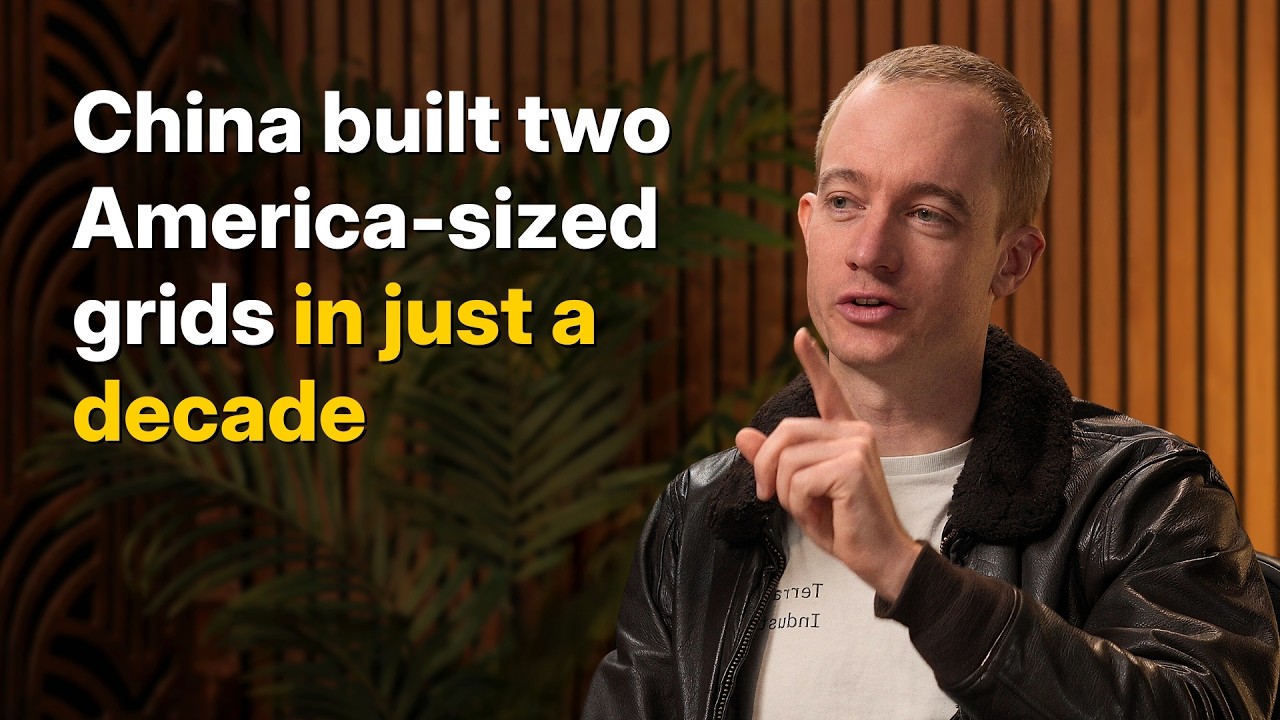
- Casey Handmer, founder of Terraform Industries and former NASA JPL engineer, argues that the US can compete with China in the AI race because energy—not chips—will become the decisive bottleneck, and solar power’s extraordinary learning rates give the US a path to overwhelming advantage if it can reform its regulatory environment.
- The core thesis is that AI is becoming an industrial scaling problem: whoever can deploy the most energy fastest wins, and solar is the only energy source with a steep enough learning curve (43% cost reduction per doubling of cumulative production) to keep pace with exponential AI compute demand.
- China currently dominates solar manufacturing (20x US annual output) and has a massive head start in batteries, but Casey argues this advantage is less decisive than it appears because the US has cheaper natural gas, abundant land, world-leading automation, and the ability to rapidly scale solar manufacturing domestically if given Manhattan Project-level urgency.
- The key insight is that hyperscalers are not power-cost-sensitive—they are power-availability-sensitive. Electricity costs are a tiny fraction of total AI infrastructure costs (GPUs dominate), so even expensive energy is worth it. This means whoever can deploy energy fastest, not cheapest, wins.
Why China doesn’t win by default
- China’s geographic and strategic vulnerabilities undermine its energy dominance narrative.
- China imports almost all its oil from the Middle East via tankers it cannot defend, surrounded by mostly hostile neighbors with no natural geographic barriers. The US is bordered by oceans and friendly allies.
- Parts of China are as wealthy and innovative as the US (Shanghai, Guangdong), but autocratic governance creates capital allocation inefficiencies—CCP inspectors on corporate boards, bribery, weak rule of law—that the US can exploit with automated manufacturing.
- If China tried to export-control solar and batteries against the US (mirroring US chip export controls), it would hurt China worse because it depends on US export markets, whereas the US is only about five years behind in solar manufacturing capability and could close that gap in two years with sufficient urgency.
Why hyperscalers currently choose natural gas—and why that will change
-
Right now, hyperscalers are building 1–5 gigawatt data centers powered by natural gas because it’s the fastest path to deployment.
- xAI’s Colossus facility in Memphis tapped into existing gas lines because gas turbines can be rented and delivered on trucks, while building solar farms and transmission lines takes years.
- Gas pipelines have far higher energy transmission capacity than electrical grids, and upgrading gas delivery is easier than building new transmission infrastructure.
- However, this is a short-term expedient. Gas turbine manufacturing is already spoken for through ~2030, and scaling further requires expensive factory expansion with long lead times. At 50–100 gigawatts per year of new data center demand, gas hits hard supply elasticity walls.
-
Solar’s learning rate makes it the inevitable winner for new load by the late 2020s.
- Solar costs drop ~40% every 2–2.5 years as production doubles, and demand elasticity exceeds the learning rate—meaning the market keeps expanding faster than costs fall. This trend is accelerating, not saturating.
- Natural gas turbines use Brayton cycle technology (essentially jet engines) that is inherently expensive to build—$35/megawatt-hour just for the spinning components, before fuel or cooling. There is no comparable learning curve.
- Casey predicts that by 2027, the majority of new data center groundbreakings will be mostly solar-powered, and by 2035–2040, new load will be asymptotically approaching 100% solar.
How solar-powered data centers actually work
-
A 1-megawatt data center running at four nines (99.99%) uptime requires roughly 10 acres of solar panels, six Tesla Megapacks of battery storage, and one truckload of computing equipment.
- Solar arrays in Texas operate at ~25% average utilization, so 4 megawatts of panels are needed for 1 megawatt of average load, with an additional 2.5x overbuild to guarantee winter reliability.
- Batteries handle temporal arbitrage—storing midday solar surplus for evening and nighttime use—and can be scaled by simply adding more units on trucks.
- A 5-gigawatt facility would need approximately 50,000 acres (for comparison, the Manhattan Project’s Hanford site was 100,000 acres), but land cost is negligible (~0.1% of total project cost) because GPUs dominate capital expenditure ($250 billion for 5 gigawatts of compute).
-
These are essentially self-contained industrial farms: solar arrays, batteries, and data centers on private land, connected to the outside world only by fiber optic cable.
- They can use Starlink, microwave links, or laser links for connectivity, requiring no grid interconnection.
- Overbuilt solar capacity means the data center produces far more power than it needs 360+ days per year, which can be shared with local utilities at near-zero marginal cost—turning the data center from a grid burden into a grid asset.
The real bottleneck: environmental regulations, not land or resources
-
The primary obstacle to US solar deployment is not cost, land, or technology—it’s regulatory irrationality.
- NEPA (National Environmental Policy Act) and state-level regulations can trigger four-year environmental impact reviews for solar projects on private land, even in industrial zones. The irony is that solar arrays arguably improve desert ecosystems by shading ground and retaining soil moisture.
- Casey describes cases where solar projects face more stringent review than parking rusting cars that leak oil into aquifers, because solar is “new” and triggers chemical-plant-level scrutiny.
- Texas is out-deploying California 10-to-1 because of its lighter regulatory touch. A categorical exemption for solar deployment would be the single highest-impact policy change.
-
Transmission grid limitations are real but will be circumvented by batteries.
- Grid expansion has stalled for decades due to eminent domain litigation, unionized labor costs, wildfire liability, and Baumol cost disease. DOE projections for needed grid buildout exceed actual construction by an order of magnitude.
- Batteries perform the same spatial arbitrage function as the grid but with higher utilization (300+ days/year vs. rare peak utilization for high-voltage transmission assets), making them increasingly cost-effective substitutes.
- The average distance between power generation and consumption will decrease radically as batteries are deployed at solar sites, substations, and behind the meter.
The asymptotic future: silicon, energy, and the nature of cognition
-
In the long run, the economy will be measured not by GDP but by total energy consumption and cognitive output.
- GDP is a broken metric for AI value creation because it captures only monetary transactions, not consumer surplus or deflationary abundance. A data center that automates $60 trillion in global labor might show up in GDP as merely the cost of chips and electricity.
- If AGI can perform human-level cognition, the value is bounded below by global labor compensation (~$60 trillion/year) but could be far higher for new categories of work AI enables.
- The marginal cost of AI tokens will approach the cost of electricity, which approaches zero as solar costs continue falling—creating massive deflation in nominal GDP even as real economic value explodes.
-
The ultimate physical form of cognition is a silicon wafer in space: a solar sail with an integrated compute die.
- One square meter of silicon in space, receiving uninterrupted sunlight, can simulate a human brain’s worth of computation. No batteries, transformers, or grid needed.
- Silicon is abundant (extracted from ordinary dirt), and refining it is primarily an energy problem—which becomes trivial with unlimited solar power.
- Casey speculates that the trajectory of evolution—increasing complexity over 4 billion years—may collapse back to the simplest possible thermodynamic-to-cognition stack: fusion in stars, silicon conversion in space, beamed laser communication between computational nodes.
-
Terraform Industries is working to accelerate this transition by making synthetic fuels from sunlight and air.
- Their technology converts electricity into synthetic natural gas and methanol, which can replace fossil fuels for the two-thirds of energy use that electricity alone cannot serve (transportation, industrial heat, chemicals).
- This asymmetrically helps energy-import-dependent countries like China, but also enables the US to fully electrify its industrial base using domestic solar resources.