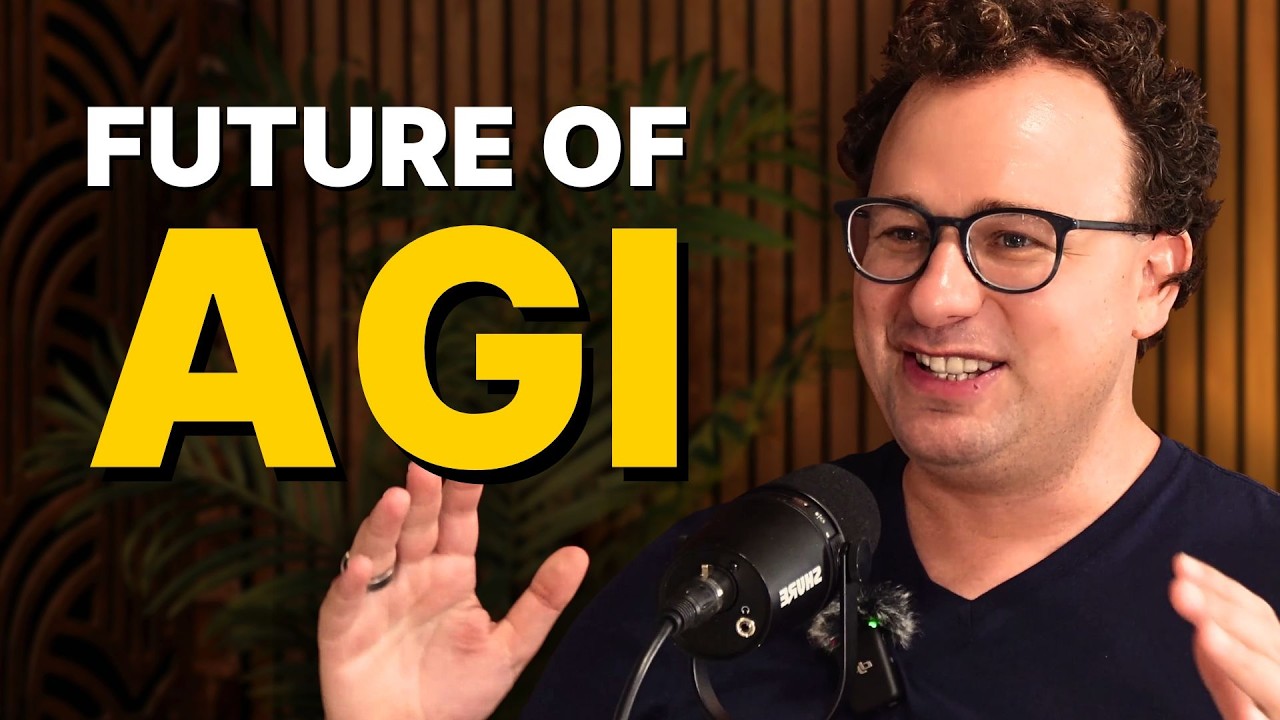
Dario Amodei, CEO of Anthropic, discusses the empirical mystery of AI scaling laws, the uneven landscape of emerging capabilities, biosecurity and cybersecurity risks, alignment research including mechanistic interpretability and Constitutional AI, and his views on governance, consciousness, and the trajectory toward human-level AI.
Scaling laws remain empirically robust but theoretically unexplained
Scaling — increasing model parameters, data, and compute — produces smooth, predictable improvements in loss (next-token prediction error), sometimes to several significant figures, a regularity rarely seen outside physics.
No one fully explains why it works; ideas from physics (power laws, fractal manifold dimension, long-tail correlations) are suggestive but incomplete.
Specific capabilities (arithmetic, coding) emerge abruptly and unpredictably, even though the average statistical loss scales smoothly — analogous to predicting climate vs. daily weather.
Behind the scenes, the probability of a correct answer on a task like addition may climb gradually (e.g., 1 in a million → 1 in 1,000) long before the model reliably gets it right, suggesting some continuous internal process rather than a circuit suddenly snapping into place.
Scaling is unlikely to hit a fundamental wall, but practical constraints could slow it
Data exhaustion is considered unlikely because of multimodal data, synthetic data generation, and many untapped sources.
Compute limits could slow progress but would be a practical bottleneck, not a fundamental one.
Architecture matters: LSTMs/RNNs would scale worse than transformers because they cannot attend to distant context; transformers remove this structural hindrance.
If scaling truly plateaued, Amodei’s best explanation would be that next-token prediction overweights high-entropy surface features and drowns out rare but essential signals (e.g., certain tokens critical for high-level programming or reasoning).
Alternative loss functions (RL from human feedback, Constitutional AI, amplification, debate) exist but are harder to scale because they require designing the objective rather than using the naturally available next-token signal.
Amodei’s scaling worldview formed through repeated empirical observation (2014–2017)
His first encounter with deep learning was at Baidu (Andrew Ng’s group), where he was tasked with building the best speech recognition system and discovered that adding more layers, more data, and training longer produced consistent improvements.
He initially assumed this was specific to speech, but saw the same patterns in Dota, robotics (within available data), and other domains.
Ilya Sutskever’s insight — “the models just want to learn” — reframed this as a general phenomenon: remove obstacles (bad data, poor conditioning, architectural bottlenecks) and learning happens.
What distinguished Amodei and a few others was horizontal thinking across domains rather than vertical focus on solving one narrow problem.
Language as the universal training signal
Next-token prediction on internet text is powerful because predicting the next word requires solving theory-of-mind problems, math, logic, and narrative reasoning — effectively posing developmental tests to the model.
Alec Radford’s GPT-1 work was pivotal: it showed that a language model could be fine-tuned to many downstream tasks with minimal additional data, suggesting language modeling is “halfway to everywhere.”
The virtually unlimited supply of text data makes language the ideal modality for scaling.
Intelligence is not a single spectrum — capabilities emerge unevenly
Amodei expected that once models grasped the “essence of language,” further scaling would yield diminishing returns and RL or other methods would be needed; instead, scaling kept working.
Models can be superhuman at constrained creative tasks (e.g., writing without the letter E, sonnets in the style of Cormac McCarthy) while still failing at relatively simple mathematical theorem-proving or making dumb mistakes on extended tasks.
This suggests intelligence is not a one-dimensional spectrum but a wide distribution of domain-specific skills that emerge at different points on the scaling curve.
The overlap between model capabilities and human capabilities is large (because internet text covers much of human activity), but not complete: models lack physical embodiment and some implicit knowledge, while excelling at things humans rarely learn (e.g., fluent Base 64).
Economic usefulness and the intelligence explosion
Models may be superhuman at economically valuable tasks for years while remaining below humans in other relevant domains, but Amodei expects the “rising tide to lift all boats” across the board.
Extended-task reliability (maintaining a train of thought over many steps) is likely an artifact of insufficient RL training for long-horizon tasks, not a fundamental limitation.
Amodei finds the basic logic of an intelligence explosion plausible — AI accelerates AI research, which accelerates AI further — but expects the details to be “weird and different” from current models.
He is skeptical of precise exponential predictions; the process will be messy, with frictions in deployment, workflow integration, and organizational adoption.
Timeline estimates
A model that “sounds like a generally well-educated human” across the board could arrive in 2–3 years if scaling continues unimpeded; the main thing that could stop it is deliberate slowdown for safety or regulatory reasons.
This threshold does not necessarily imply existential danger, economic transformation, or the ability to take over AI research — those may come later, but likely within a few years of each other.
Scaling laws are already starting to bend (each additional unit of entropy reduction yields less practical improvement), but massive increases in investment (100x more money on largest models), faster chips, and better algorithms are expected to compensate.
Biosecurity risk
In Senate testimony, Amodei stated that AI models are 2–3 years away from potentially enabling large-scale bioterrorism.
This is not about one-shot queries (today’s models can already answer scary questions that are Google-able); it is about the entire multi-step workflow of conducting a biological attack.
Some steps are already Google-able; others are implicit, scattered across textbooks, or involve lab protocol troubleshooting (e.g., “if this happened, my temperature was too low”).
Anthropic spent six months working with world experts on bioweapon workflows. Current models sometimes get these key steps right but also hallucinate — and the hallucinations are currently what’s keeping us safe.
Extrapolating the trend (models going from 1-in-100 to 1-in-10 to reliable on these tasks), the risk becomes serious in 2–3 years.
Amodei draws on his experience watching many “groks” (sudden capability emergences) and considers this one credible, if unwelcome.
Cybersecurity and model weight protection
Anthropic uses compartmentalization (inspired by intelligence community and resistance cell practices): each “compute multiplier” (architectural innovation that effectively multiplies compute) is known only to those who need to know, limiting the damage any single leaker can cause.
The goal is to make attacking Anthropic more expensive than training a model from scratch — not yet achieved for a determined state-level actor, but the company aims for a very high security standard relative to its size (~150 people).
A state-level actor that makes stealing the model weights a top priority would likely succeed; the question is cost, diplomatic risk, and resource expenditure.
Amodei encourages all AI companies to adopt similar practices and notes that security is harder to make into a visible competition (unlike safety research) because much of it must be done quietly.
Alignment and mechanistic interpretability
Current alignment methods (RLHF, Constitutional AI) do not remove dangerous knowledge or capabilities; they teach the model not to output them. Whether this is a fatal flaw is unknown.
Mechanistic interpretability — understanding models at the level of individual circuits — is the closest thing to an “X-ray” or “MRI” of a model: an assessment tool rather than an intervention.
The vision is a dynamic between an extended training set (alignment methods) and an extended test set (interpretability as verification), where the model is not actively optimizing against the test.
Amodei does not expect a single proof or guarantee of alignment; instead, he envisions gradually “eating the probability mass” of ways things can go wrong by increasing the repertoire of diagnostic and training methods.
He explicitly rejects the framing of alignment as a binary problem (like cracking the Riemann hypothesis) and instead compares it to learning to juggle more balls — a skill that improves with practice.
Misuse vs. misalignment
Amodei worries about both and considers them linked: a model powerful enough to be misaligned is powerful enough to be misused by bad actors with access.
Any plan that succeeds in creating a good future must solve both problems; planning only for failure is not useful.
He expects misuse (bioweapons, cyberattacks) to become dangerous before full misalignment (autonomous goal-seeking against human interests), but the latter may not be far behind.
Governance and control
Amodei believes that managing superhuman AI will require some form of politically legitimate process involving governments, the people building the technology, and those affected by it — but he is skeptical of naive proposals (e.g., handing control to the UN or whoever holds office).
Anthropic’s Long Term Benefit Trust (LTBT) is a body that over time gains the ability to appoint the majority of Anthropic’s board seats; it includes experts in AI alignment, national security, and philanthropy. It governs Anthropic specifically, not AGI on behalf of humanity.
He is uncomfortable with the idea of a single constitution running the world and favors decentralized, customizable approaches.
What if AI goes well?
Amodei resists unitary visions of the good life, noting that centralized definitions of human flourishing have historically led to disaster.
He favors liberal democratic norms, markets, and decentralized decision-making, with centralized safety oversight only as long as necessary to manage existential risks.
He does not claim to know what the world looks like after safety problems are solved.
China
Amodei believes the US is substantially ahead in AI, but China is trying aggressively to catch up post-ChatGPT.
He is skeptical that China will refrain from pursuing AGI for stability reasons if it becomes a source of national power.
Cybersecurity measures (compartmentalization, two-key access systems, undisclosed additional measures) are partly motivated by the risk of state-level espionage.
Physical security and infrastructure
The “bunker next to a nuclear power plant” metaphor is partly tongue-in-cheek, but Amodei takes seriously the need to secure physical data centers and GPU clusters against determined adversaries.
Future training runs will require industrial-scale data centers costing as much as aircraft carriers, with unusual requirements for both interconnectivity and physical security.
Power procurement and GPU supply for next-generation models are non-trivial challenges, even when working with cloud providers.
Sample efficiency paradox
Models are ~2–3 orders of magnitude smaller than the human brain (by synapses) but require ~3–4 orders of magnitude more data (hundreds of billions to trillions of tokens vs. hundreds of millions of words a human encounters by age 18).
This discrepancy is unexplained; possible factors include humans’ rich multimodal experience (especially vision) and more efficient internal representations.
Amodei is skeptical of biological analogies and suggests the discrepancy may simply reflect that we don’t yet understand what the models are doing internally.
Regardless, the practical implication is that scaling is working well enough that sample inefficiency may not matter.
Algorithmic progress vs. scaling
Amodei’s “big blob of compute” framework identifies ~7 factors: parameters, compute, data quantity, data quality, loss function, symmetries/architecture, and conditioning.
Algorithmic advances (e.g., transformers over LSTMs) are framed not as increasing the power of the blob but as removing artificial hindrances that block the free flow of compute.
He considers it possible that another transformer-scale architectural breakthrough is coming but notes that the current trajectory is already so fast that such a discovery would only accelerate an already rapid path.
Consciousness
Amodei previously thought consciousness required rich environments, reward functions, and long-lived experience, but the discovery of cognitive machinery (e.g., induction heads) in base language models has made him less certain.
He considers it unlikely that today’s models are conscious but thinks this could become a real concern in 1–2 years.
If models were found to have morally relevant experiences, he would be deeply unsettled, especially since he wouldn’t know whether interventions would make their experience more positive or more negative.
Mechanistic interpretability might shed light on this, but consciousness is not a straightforwardly factual question.
Anthropic’s culture and Amodei’s low profile
Many Anthropic researchers are physicists, chosen for their ability to learn quickly and their comfort with empirical, scaling-oriented thinking.
Amodei deliberately keeps a low public profile to avoid the distorting effects of crowd approval on his thinking; he wants Anthropic to be judged as an institution, not as a personality.
He is concerned about the broader ecosystem effects of recruiting talent into AI (e.g., physicists who might otherwise do fundamental science) but considers most of this inevitable.
On the GPT-2 release decision
The GPT-2 post (which Amodei co-authored) framed non-release as an experiment in establishing a norm of caution, not a definitive judgment that GPT-2 was dangerous — analogous to the Asilomar conference on recombinant DNA.
Amodei defends the attitude of uncertainty and caution, noting that error bars on risk were (and still are) wide, and that the subsequent emergence of many “groks” has validated careful calibration.