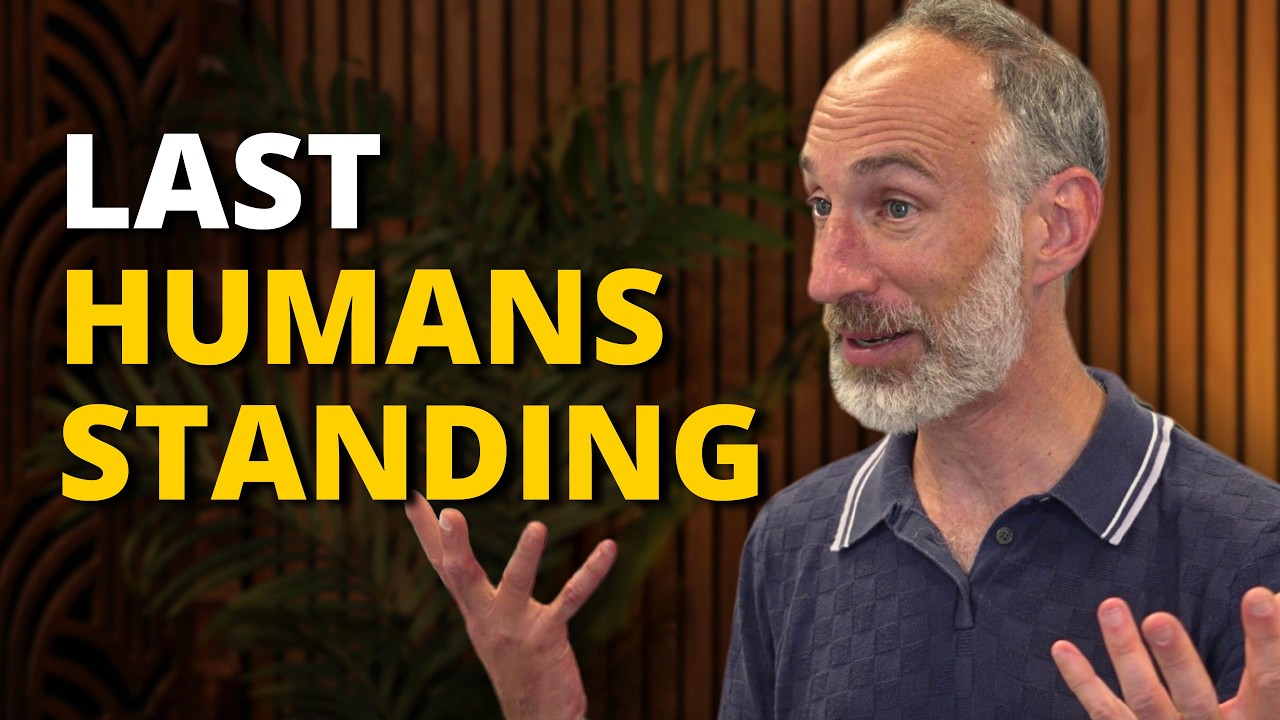
Geneticist David Reich discusses how ancient DNA research is overturning long-held models of human evolution, revealing a far more complex, braided, and contingent history than previously understood—one in which the boundaries between “modern” and “archaic” humans are blurred, massive population replacements were common, and cultural innovation (not just biology) drove the dominance of one small lineage that spread across the world.
The standard model of human-archaic relationships is breaking down
The conventional model holds that modern humans split from a Neanderthal-Denisovan ancestor around 500,000–750,000 years ago, with only minor subsequent mixing—but multiple lines of evidence now contradict this.
Mitochondrial DNA (inherited maternally) and Y chromosomes (inherited paternally) suggest a much more recent shared ancestor between Neanderthals and modern humans—around 300,000–400,000 years ago—while Denisovans remain distant at ~700,000–1,000,000 years.
This means the story told by these parts of the genome is incompatible with the story told by the rest of the genome.
One explanation is that 3–8% of Neanderthal DNA came from gene flow from the modern human lineage into Neanderthals a few hundred thousand years ago, but invoking natural selection to explain why both mtDNA and the Y chromosome were replaced this way requires two coincidental selective sweeps, which seems implausible.
Reich and others are exploring radically different models in which Neanderthals and Denisovans are not sisters, and modern humans and Neanderthals share much more ancestry than the standard 3–5%—perhaps 30–70%—raising the question of who is “modern” and who is “archaic.”
Modern African populations also show extreme substructure, suggesting that deeply divergent lineages within Africa mixed to form people living today, further complicating any simple narrative of a single African origin.
Human populations were fragmented into thousands of tiny groups
Ancient DNA from African hunter-gatherers up to 15,000 years old shows that most groups existed in very small populations (hundreds of people) with very little genetic exchange between them, losing diversity over time.
The great genetic diversity seen in Africa today is maintained not within individual groups but across the ensemble of many rarely-mixing groups, which occasionally merge and “recharge” diversity.
This archipelago-like structure likely characterized much of human existence for hundreds of thousands of years across Africa and Eurasia.
What made one lineage dominate the world?
Brain size had already reached modern levels in the common ancestor of Neanderthals and modern humans, so the dramatic expansion of one lineage ~50,000–70,000 years ago cannot be explained by brain size alone.
A striking epigenetic finding suggests that changes specifically on the modern human lineage affected genes involved in the vocal tract (laryngeal and pharyngeal development), potentially enabling the full range of sounds used in modern language—a capability absent in Neanderthals and Denisovans.
This could represent a qualitative shift in language ability coinciding with the Upper Paleolithic revolution (~50,000–100,000 years ago).
Reich favors a cultural innovation explanation: humans exist in bands that accumulate shared knowledge, but small groups are vulnerable to information loss (key elders die, natural disasters strike).
Once a critical mass of shared cultural knowledge is crossed, a runaway process begins—larger groups support more innovation, which supports larger groups.
With tens of thousands of such groups existing simultaneously across the globe, this process was likely to take off somewhere eventually.
The initial expansion out of Africa involved a very small founder population—perhaps 1,000–10,000 people—thousands of years before the major mixing with Neanderthals (~50,000 years ago).
The first wave of modern humans into Eurasia (the Initial Upper Paleolithic, ~45,000–40,000 years ago) shows remarkably high rates of recent Neanderthal ancestry (many had Neanderthal ancestors within 2–8 generations), suggesting sparks of expansion that mixed locally with Neanderthals.
These early groups largely went extinct. The ancestry of most living Eurasians comes from a later wave from the Near East after ~39,000 years ago.
This pattern of repeated expansion, mixing, and local extinction—rather than a single triumphal march—characterizes the spread of modern humans.
Disease as a driver of population replacement
Yersinia pestis (the agent of plague) has been found in 5–10% of randomly sampled individuals who died 4,000–5,000 years ago in western Eurasia—implying that a very large fraction of all deaths during this period were caused by this pathogen.
The strain lacked the plasmid needed for flea-borne transmission, so it was likely pneumonic (airborne).
A recent study of Scandinavian farming tombs from ~5,000 years ago found even higher rates across multiple generations.
This plague may have originated in steppe rodent populations, meaning steppe peoples had some immunity while farming populations did not—creating conditions analogous to what Europeans brought to the Americas.
The massive population replacement in Europe ~4,500 years ago—when steppe-derived peoples replaced up to 90% of the local population (including the builders of Stonehenge) within a century—may have been facilitated by plague weakening farming societies.
Yersinia pestis also contributed to the fall of the Roman Empire (the Plague of Justinian) and the Black Death, which some argue helped trigger the Industrial Revolution by driving up wages.
This suggests disease-driven demographic disruption has been a recurring mechanism of population replacement throughout history, not a one-off event of the colonial era.
What genetics reveals about agriculture’s impact
Analysis of ~8,500 ancient DNA sequences from the last 10,000 years in western Eurasia shows the genome is “seething” with changes, with strong signals of selection on immune and metabolic traits but not on cognitive or behavioral traits.
There is strong selection against genetic variants predisposing to high body mass index and type 2 diabetes, possibly reflecting a shift from feast-famine cycles to more regular food availability under agriculture.
This could be read as evidence that agriculture, while perhaps worse for individual health (skeletal evidence shows more disease), was better at supporting population-level survival—consistent with a strategy of having more offspring with less investment per child.
The question of whether agriculture was “terrible” for humans may depend on whether you measure individual well-being or population-level success.
How population replacements actually happened
The Yamnaya (steppe pastoralists north of the Black and Caspian Seas, ~5,300–4,600 years ago) were likely the first horse-using mobile pastoralists, exploiting open steppe lands with carts and wheels.
They could not expand into forested Europe directly, but their ancestry was absorbed by the Corded Ware complex, which then expanded further—a two-step process.
The Yamnaya expansion was male-biased, but the subsequent Corded Ware and Beaker expansions involved both sexes because Corded Ware males absorbed Yamnaya females (and farmer females) into their communities, then expanded with both male and female steppe lineages.
In Iberia, the Y chromosomes were completely replaced while mitochondrial DNA was not—a pattern that in the Americas is known to reflect violent European male dominance over Native American women, but which could in principle reflect female mate choice or other mechanisms.
The replacement happened rapidly in each local area, even if the overall process spanned ~500 years.
A parallel process occurred in the Pacific: the Lapita expansion (~3,000 years ago) brought East Asian ancestry from Taiwan/Philippines to Vanuatu and Fiji, but ~500 years later, Papuan males from New Guinea expanded into these islands in a male-driven migration, so that today the ancestry is overwhelmingly Papuan despite the initial East Asian settlement.
These examples show that the direction of genetic replacement does not always match intuitive expectations about which group was “dominant.”
Neanderthal ancestry and the question of who replaced whom
While non-Africans today carry ~2% Neanderthal DNA, the proportion of ancestors who were Neanderthals is estimated at 10–20%, because Neanderthal DNA was rapidly selected against after mixing (Neanderthals had accumulated thousands of slightly deleterious mutations during hundreds of thousands of years in small populations).
This raises a provocative reframing: perhaps non-Africans are better understood as Neanderthal populations that were progressively “modernized” by waves of African ancestry, rather than modern humans who picked up a little Neanderthal DNA.
The survival of only one lineage of many (Neanderthals, Denisovans, hobbits, and various modern human groups all existed ~70,000 years ago) may reflect numerical advantage and repeated waves of mixing rather than innate superiority.
Contingency versus determinism in human history
Agriculture arose independently in multiple parts of the world within a few thousand years after the last ice age (~10,000–8,000 years ago), suggesting some deterministic process—perhaps a set of pre-existing cultural capacities that, once climate stabilized, triggered rapid innovation simultaneously.
Yet agriculture did not occur during previous warm periods (marine isotope stages 3, 5, 7, 9), which is puzzling.
Reich is agnostic on whether the rise of civilization was contingent or inevitable: with many human groups existing in parallel, some were likely to cross the threshold eventually, but which specific group did so was highly contingent.
There is no evidence for “lost civilizations” comparable to early Sumer or the Yamnaya in earlier warm periods—burials from marine isotope stage 3 (~30,000–60,000 years ago) show symbolic behavior but not extensive settled societies.
Cultural persistence: India’s caste system
South Asian populations today are almost entirely a mixture of two ancestral poles—Ancestral North Indians (steppe-related) and Ancestral South Indians (local hunter-gatherer-related)—in varying proportions, like African Americans with European and West African ancestry.
This mixing began ~4,000–2,000 years ago and then froze with the establishment of the caste system, creating a stable gradient that has persisted for millennia.
The three-step process was: arrival of very different populations (steppe, farmer, hunter-gatherer), convulsive mixing, then cultural locking via caste endogamy.
The Patels are an exception—they fall off the main gradient, likely due to additional Central Asian ancestry.
This system has preserved a snapshot of the mixing process for ~2,000 years, documented in texts like the Rigveda.
The future of ancient DNA research
The most important unsolved need is ancient DNA from Africa—from 50,000, 100,000, even 200,000 years ago—which would reveal how the deeply substructured modern human lineages within Africa braided together and how they relate to archaic lineages like Neanderthals and Denisovans.
Current African ancient DNA goes back only ~15,000 years; older samples are needed to probe the critical period of modern human origins.
A deeper challenge is learning to “read” the genome to understand how biological adaptation actually works—whether through many small polygenic shifts or through simple, dramatic changes in a few genes (as the vocal tract methylation findings suggest).
Reich draws an analogy to neuroscience: researchers have successfully decoded how macaque brains represent images by mapping neural activity to photograph eigenvectors, but genomics cannot yet decode how the genome codes for development or traits.
The rich dataset of frequency changes over 10,000 years in Europe (selection coefficients at ~10 million genomic positions) could potentially reveal deep principles of how evolution operates—if new ways of thinking are brought to bear.
Reich compares the discovery of ancient DNA to opening a room still echoing with lost languages—an unexpected gift—and suggests there are likely other such surprises ahead that we cannot yet imagine.