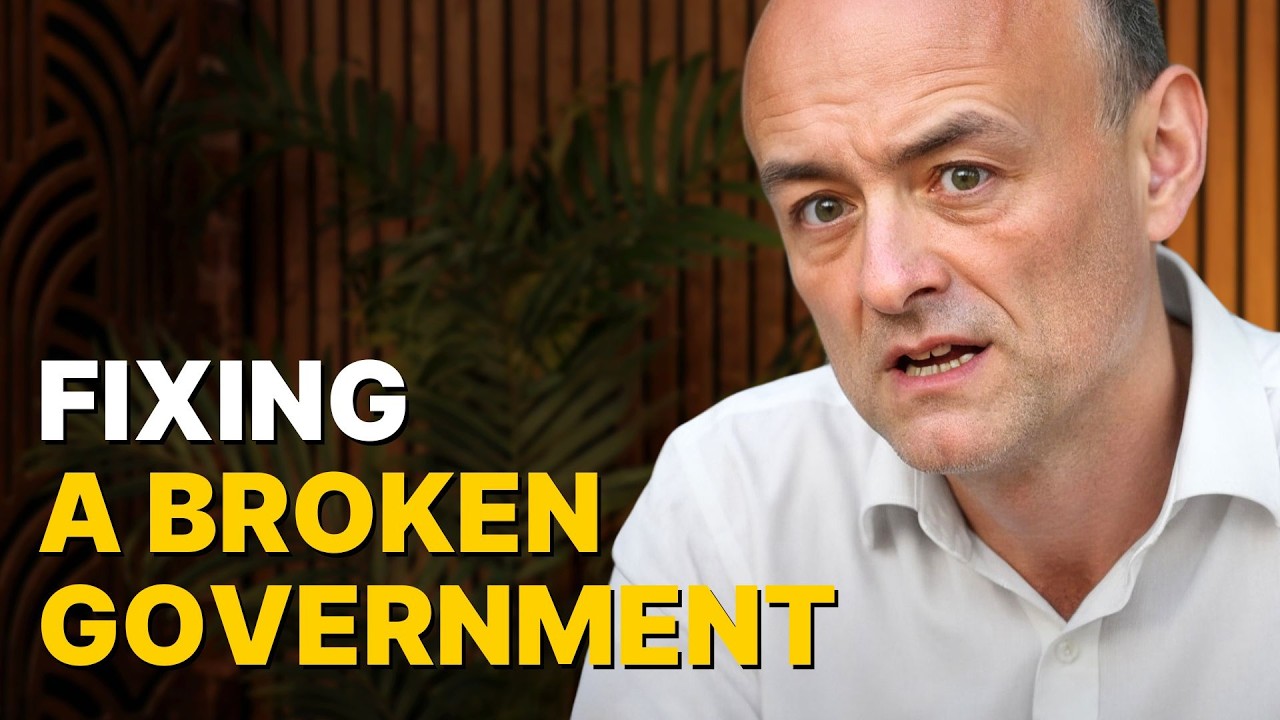
Dominic Cummings, former chief advisor to Boris Johnson and mastermind of the Brexit campaign, argues that Western governments—particularly Britain’s—are structurally dysfunctional, unable to prioritize, execute, or learn from failure, and are drifting toward catastrophic crises without meaningful reform.
The physical and bureaucratic reality of power: Number 10 Downing Street is a chaotic, antiquated environment where the Prime Minister’s time is consumed by media crises, ceremonial duties, and bureaucratic bottlenecks, leaving almost no capacity for strategic priorities.
The media trap: Politicians and ministers are incentivized to optimize for media performance rather than actual governance. Promotion and career success depend on being seen as good media performers, which encourages leaking, performative politics, and a complete divorce from operational reality. Ministers who tried to break this pattern faced fierce backlash from both the media and their own colleagues.
The permanent civil service as a closed caste: The British civil service is internally promoted, risk-averse, and operationally incompetent. The most talented young people self-select out because they don’t want to spend decades navigating HR-compliant mediocrity. What remains is a gerontocratic leadership that treats two-and-a-half-year timelines for eight-week projects as normal. Only the Prime Minister has the legal authority to fire senior civil servants, creating an extreme bottleneck where all critical decisions cascade upward.
COVID as a stress test that changed nothing: The pandemic revealed the full horror of the system’s dysfunction—PPE shortages, no file-sharing systems, procurement failures—but the people who were most wrong were promoted and honored, while those who were right left. The vaccine task force, a rare success created by exempting a team from normal rules, was dismantled after the crisis. Legal challenges were brought against rapid testing and the vaccine task force for moving too fast, sending a clear signal that the system rewards process compliance over results.
The structural conflict between Number 10 and the Treasury: The Treasury hides financial data from the Prime Minister and operates as a competing power center. Cummings and Johnson briefly integrated the two, making data transparent and creating a unified team, but this was reversed within hours of Cummings’s departure.
Defense and intelligence dysfunction: The Ministry of Defence is catastrophically mismanaged—the Watchkeeper drone program was known internally to be a complete disaster (drones falling out of the sky) but was never shut down. Nuclear weapons infrastructure has tens of billions in hidden costs and neglected safety issues. China’s infiltration of British critical infrastructure is far worse than almost any MP realizes. Intelligence agencies have extraordinary technical capabilities but are badly prioritized, risk-averse, and focused on the wrong threats—AI was considered eccentric in 2019-2020.
The opportunity wasted in 2020: With an 80-seat majority, a pandemic, and Brexit completed, the conditions for fundamental reform were perfect. But Boris Johnson chose to prioritize reconciliation with the media and insider social networks over structural change, calculating that the opposition was too weak to require serious governance. The “rolling coup” of replacing senior permanent secretaries was met with accusations of fascism from the old system.
Why reform almost never happens: The system is self-reinforcing. Bureaucracies devour new entities by forcing them back into normal processes. Politicians optimize for insider social status, not problem-solving. The few capable people who enter government leave because they can’t actually do anything. Even after a once-in-a-century pandemic that killed tens of thousands unnecessarily, the default was to return to normal.
Historical parallels and the AI alignment analogy: Cummings draws on Bismarck as a case study in the AI alignment problem—a highly intelligent actor that treats all attempts at constraint as enemy action to be destroyed, preemptively defeats every safety mechanism, and cannot be switched off even when those in power realize they no longer control it. Bismarck’s complex alliance system was poorly understood by successors, and removing him led directly to World War I.
The paradox of Western democracy: The same features that prevent a Stalin from taking over also make the system chronically incompetent. Elites are easy to manipulate with emotional propaganda; voters are harder to fool. First-past-the-post voting makes it structurally nearly impossible for new parties to replace old ones, even when both are visibly failing. The rationalist/effective altruist error is assuming political actors care about solving problems rather than maintaining social position.
What would actually be required: A small group of highly capable people with shared goals, willing to alienate the old elite, would need to create parallel institutions and close existing ones, firing 90-99% of current staff in some departments. Long-term change requires institutionalizing constant reinvention—sunsetting, closing, and rebuilding—with public and elite acceptance of this process. Singapore’s model of honest post-mortems and genuine meritocratic culture is held up as a contrast to Britain’s approach of paying lawyers hundreds of millions to avoid accountability.
Cummings’s current view: He expects the Western world to follow the normal historical path of slow rot, elite blindness, sudden crisis, collapse, and bloodshed. He is working on education reform and considering the creation of a new political party, but acknowledges the Catch-22: the worse the system gets, the more disincentivized capable people are to enter politics. His operating principle is “pessimism of the intellect, optimism of the will”—expect disaster, but try anyway.