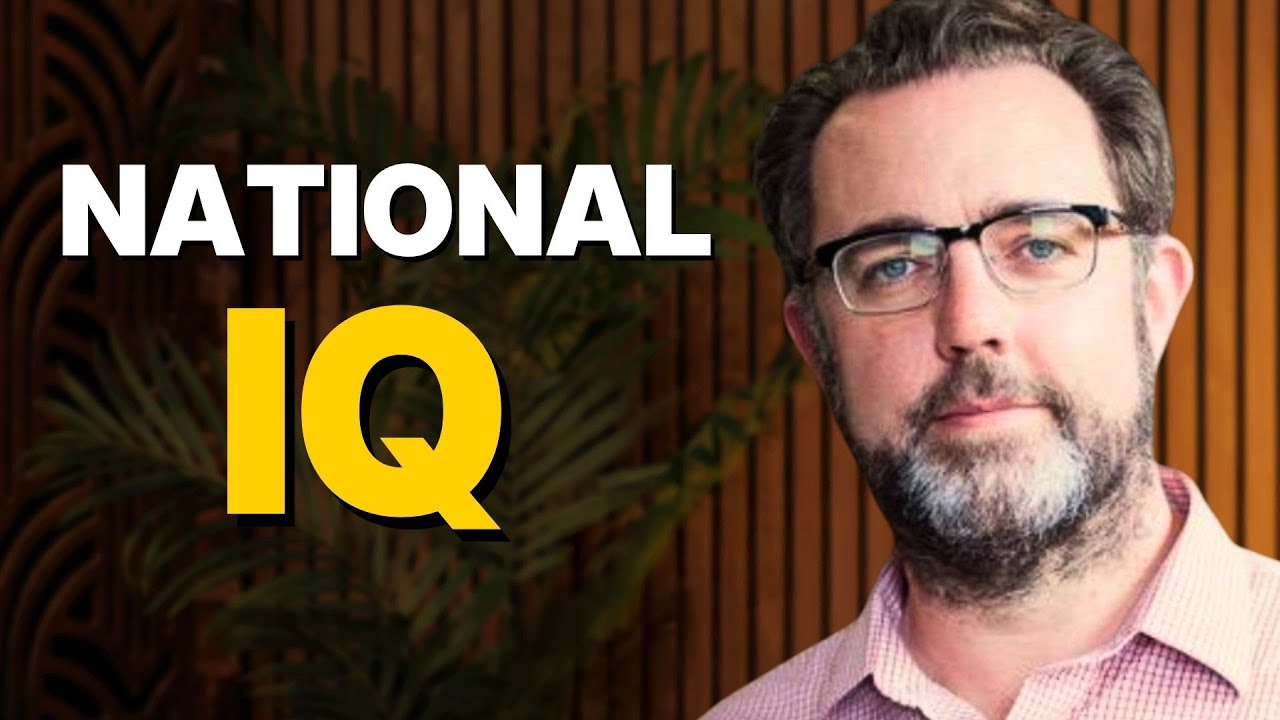
- Garett Jones, an economist at George Mason University and author of The Cultural Transplant, Hive Mind, and 10% Less Democracy, discusses how migration, national IQ, democratic institutions, and cultural norms shape economic productivity and innovation across nations.
- He argues that migrants influence their new countries not only through voting but also through cultural transmission—what he calls “spaghetti theory”—where both natives and migrants converge on shared norms, values, and behaviors over time.
- Jones emphasizes that institutions are downstream of culture, and that even in autocracies, governments must respond to the values and capabilities of their populations.
National IQ: Elites vs. Median Voters
- Jones explores whether national prosperity is driven more by elite cognitive ability (the right tail of the IQ distribution) or by the median voter’s competence.
- He finds that in most countries, average (mean) IQ is the strongest predictor of national productivity—but exceptions exist in non-democracies like Gulf states (Qatar, UAE, Bahrain) and South Africa, where highly skilled migrant elites boost productivity despite lower native averages.
- This suggests elite IQ matters more in contexts where political power is insulated from median voter influence.
- However, Jones cautions against policies that lower the national mean or median IQ—even if they increase variance—because in democracies, the median voter heavily shapes institutional quality and long-term productivity.
Cultural Transmission and Institutional Quality
- Jones critiques optimistic claims (e.g., from Powell and Nowrasteh’s Wretched Refuse?) that immigration does not harm economic freedom.
- Using a simple “change-on-change” regression (inspired by Milton Friedman’s quantity theory of money), he finds a consistent negative relationship between inflows from corrupt countries and subsequent changes in economic freedom.
- He stresses that migrants bring cultural norms—including attitudes toward corruption, savings, trust, and rule of law—that gradually reshape institutions in their new homes.
- While some cultural traits are beneficial, others can degrade institutional quality, especially when migrants come from countries with weak governance traditions.
Deep Roots and the S.A.T. Scores
- Jones relies on the “deep roots” literature, which uses three historical variables to predict modern prosperity:
- S: State history (how long ancestors lived under centralized states)
- A: Agricultural history (duration of settled farming)
- T: Technological sophistication in 1500 (pre-Columbian tech adoption)
- Among these, T (technology history) is the strongest predictor of current GDP per capita, especially after adjusting for migration.
- Critics like Bryan Caplan argue deep roots fail to explain underperformance in China and India—but Jones counters that Caplan omitted the T variable; when included, the predictive power holds.
- Communism, he argues, is a major outlier factor that suppresses otherwise favorable deep-rooted traits in China and India.
Immigration Policy: Should We Only Accept the “Best”?
- Jones is skeptical of open borders but supports selective immigration favoring individuals from countries with high S.A.T. scores, savings rates, and education levels.
- He worries that admitting large numbers of low-skilled migrants—even if they don’t vote—can still reduce average cultural and cognitive capital, generating negative externalities for innovation and institutional quality.
- He frames this as a trade-off: a smaller, higher-productivity country may generate more global positive externalities (via innovation) than a larger, lower-average-productivity one.
- He rejects the analogy of “picking up $20 bills” (accepting equivalently skilled migrants), arguing that even small reductions in average skill can erode the productivity of top innovators through institutional degradation.
Innovation, Externalities, and the I-7
- Jones identifies seven key innovation powerhouses—the I-7: U.S., China, Japan, South Korea, Germany, UK, France—whose R&D output benefits the entire world.
- He warns that diluting the talent pool in these countries via mass low-skilled immigration could slow global innovation, with long-term costs outweighing short-term poverty reduction gains.
- As a compromise, he proposes testing open borders in small, institutionally strong, low-population countries like Iceland—not in core innovation hubs.
Effective Altruism and Raising Global IQ
- For effective altruists seeking to raise national IQ, Jones advocates public health and early childhood interventions:
- Reducing lead exposure, ensuring iodine nutrition, preventing childhood infections—all of which support brain development and contribute to the Flynn Effect.
- He cites evidence that adoptees from poor countries to Sweden close half the IQ gap, suggesting environment plays a major role.
- However, he cautions that even if individual IQ rises upon migration, long-term institutional effects may still be negative if average cognitive capital declines in the host country.
Democracy, Technocracy, and Institutional Design
- In 10% Less Democracy, Jones argues for reducing democratic input in certain policy domains to improve outcomes.
- He contrasts the Federal Reserve (insulated, long-term appointments, self-funded) with the FDA and CDC (dependent on annual congressional funding, subject to political pressure)—and finds the former functions better due to greater independence.
- He supports making more agencies Fed-like: staffed with experts serving long terms, shielded from short-term political cycles.
- He views the EU as a net positive for market reform, especially in Eastern Europe, where accession requirements push countries toward laissez-faire policies.
Genetic Selection, AI, and the Future of Intelligence
- Jones supports voluntary genetic selection for intelligence (e.g., embryo screening) as a legitimate personal choice that could raise national IQ over generations.
- He notes that amniocentesis already constitutes a form of cognitive selection.
- On AI: he acknowledges that models like ChatGPT scoring ~85 IQ signal disruption for knowledge workers, though he hopes fields like economics and programming remain resilient—at least temporarily.
Ethnic Conflict, Trust, and Social Capital
- Jones downplays ethnic conflict as a primary concern, noting that many historical tensions (e.g., anti-German sentiment in the U.S.) fade when cultural values become decoupled from ethnicity.
- The real driver of conflict is when private values (e.g., work ethic, trustworthiness) correlate strongly with ethnic identity.
- High-trust communities like Mormons succeed due to historical selection: only those committed to group norms stayed, while free-riders left.
- Yet high trust also enables exploitation—e.g., multi-level marketing schemes thrive in Utah due to dense social networks.
Bondholders, Fiscal Policy, and the Welfare State
- Jones sees bond markets as powerful enforcers of fiscal discipline.
- The Liz Truss episode in the UK showed bondholders punishing unsustainable fiscal plans—proving that debt constraints are real, contrary to Modern Monetary Theory (MMT).
- He predicts the U.S. will close its fiscal gap not through inflation but via slower entitlement growth (Medicaid, Medicare) and possibly a future value-added tax (VAT)—effectively balancing the budget on the backs of the poor and middle class.
Final Thoughts: Designing an Ideal Immigration System
-
If designing an immigration system from scratch, Jones would not use deep roots scores as hard cutoffs but would launch a 10–20 year research program to refine them into a points-based tool.
- He compares today’s deep roots literature to early monetarism: insightful but not yet policy-ready.
- He opposes quotas but favors weighting factors like education, savings behavior, and ancestral technological history as small plus factors in a holistic evaluation.
-
On SBF and FTX: Jones suspects old-fashioned fraud due to weak oversight—not complex financial engineering—and notes that while high-IQ individuals are more cooperative in repeated games, their cooperation is strategic, not altruistic, making them potentially dangerous in zero-sum environments.