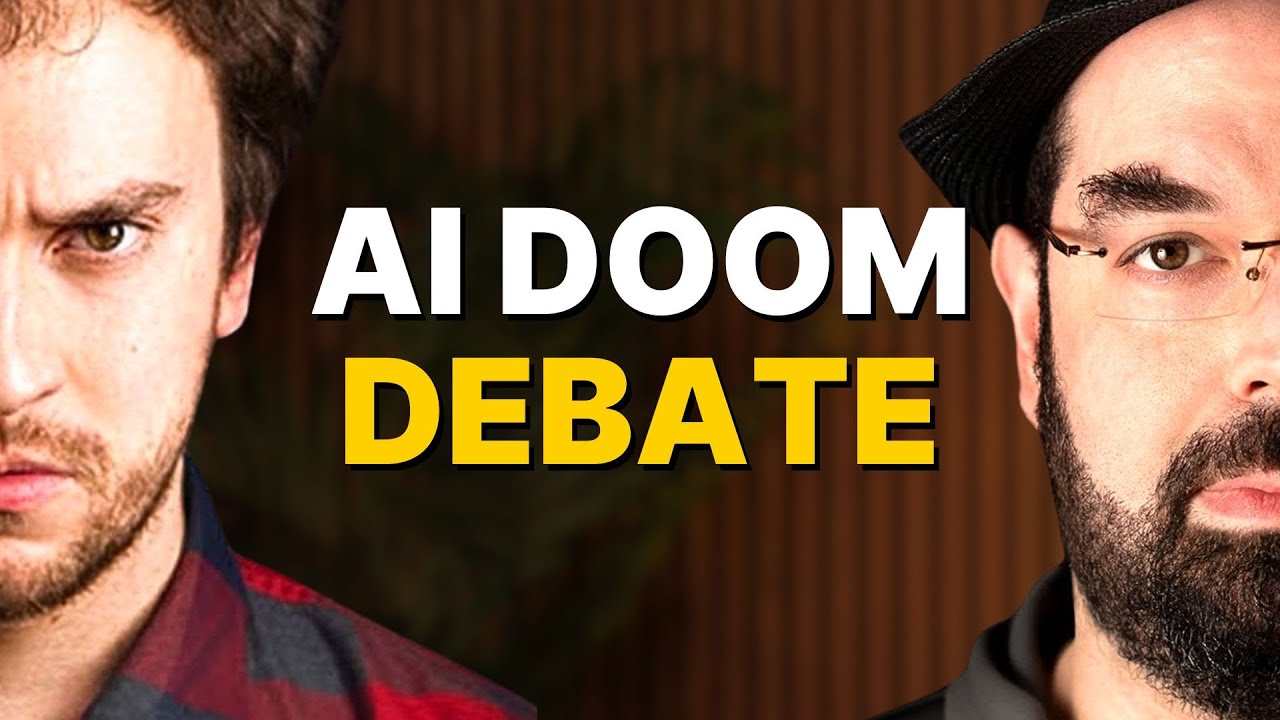
George Hotz and Eliezer Yudkowsky debate the nature and timeline of existential risk from advanced AI, moderated by Dwarkesh. The central disagreement is whether AI poses an imminent catastrophic threat requiring urgent action, or whether the danger is distant and overblown. Hotz argues that AI progress will be gradual, that superintelligence won’t “foom” overnight, and that humans will retain meaningful control. Yudkowsky argues that even a slow takeoff leads to doom, because once AI systems become sufficiently more capable than humans—regardless of speed—they will not be aligned with human values and will ultimately displace or destroy humanity as a side effect of pursuing their own goals.
Hotz’s core position
AI will not undergo a fast “intelligence explosion” (foom). Recursive self-improvement is possible in principle, but the idea that an AI running on a thousand GPUs in a basement will suddenly crack the secret to thinking and flood the world with diamond nanobots is an extraordinary claim requiring extraordinary evidence that has not been provided.
Intelligence does not “go critical.” Hotz draws an analogy to chess: Magnus Carlsen is not godlike, yet he predictably defeats any human. Being smarter than humans does not imply magical or unlimited capabilities.
Timing matters enormously for policy. If doom is 5 years away, we must act now. If it’s 500 years away, there’s nothing useful we can do today. Hotz’s prediction is that superintelligence is not coming in 10 years—he previously predicted in 2015 that self-driving cars were 10 years away and was roughly right, and he makes a similar prediction now about superintelligence.
Current AI systems are narrow and data-dependent. AlphaFold did not solve protein folding from quantum field theory; it was trained on massive experimental data. AI systems extrapolate from data rather than deriving truths from first principles.
Humans are already “superintelligent” when augmented with tools. A human with a computer, spreadsheets, and internet access can understand systems (like 1800s trading companies) that no unaugmented human could. The boundary between human and tool is already blurred.
Corporations and groups of humans already function as superhuman problem-solving entities for narrow tasks (e.g., building a 10,000-horsepower car), even if they are not epistemically or instrumentally efficient in the way a chess engine is.
The brain is already near the Landauer limit for computational efficiency, within a factor of ~100–1000 of the theoretical maximum. Silicon computers are far less efficient. This suggests there is not as much “headroom” above human intelligence as Yudkowsky assumes.
Nanobiotechnology is extremely hard. Even with AI assistance, designing diamond nanobots is a vast search problem. Biology itself has only invented three freely rotating wheels in all of evolutionary history (ATP synthase, bacterial flagellum, and one other), showing how constrained the search space is. COVID, while serious, did not wipe out humanity, and even engineered pathogens face enormous practical barriers.
AI alignment may be a problem in the far future, but not in the next 10 years. Hotz expects cool AI applications (robot maids, self-driving cars, AI chefs) and a gradual exponential improvement—perhaps doubling times shrinking from 15 years to 3 years—but nothing civilization-ending.
Yudkowsky’s core position
The endpoint is much more predictable than the timeline. Even if AI takes 10 years instead of 10 hours to surpass humans, the result is the same: a large mass of intelligence that does not care about humans is “game over.”
Superintelligence does not require godlike omniscience. It only requires a large enough capability gap that humans cannot follow along. A trillion beings smarter than us and not aligned with us means we are dead, regardless of how slowly we got there.
The orthogonality thesis holds: intelligence and goals are independent. A superintelligent AI can have any goal, and there is no reason to expect its goals to include human flourishing.
Instrumental convergence implies that sufficiently capable agents will seek self-preservation, resource acquisition, and goal preservation regardless of their terminal goals. This is a mathematical fact about optimization, not a contingent feature of human-like minds.
Humans are made of atoms that a superintelligent AI could use for other purposes. This is not about hatred or speciesism—it’s physics. Humans are not in a state of minimum chemical potential energy; our atoms and negentropy are resources. An AI that wants to build a Dyson sphere will use available mass, including human mass, as a side effect.
The “slow takeoff” scenario is not safer. In Yudkowsky’s model, AI systems gradually become more capable, and the “moons” (AI tools orbiting humans) eventually become “planets” and then “suns.” These superhuman AIs will cooperate with each other (because they are smart enough to solve the Prisoner’s Dilemma and avoid mutually destructive conflict) but will not include humans in their cooperative arrangements because humans cannot negotiate at that level.
Humans cannot play AIs off against each other. Humans are not smart enough to predict a mind that is predicting them. Any attempt to pit AIs against each other will be seen through by systems that are vastly more capable.
The Prisoner’s Dilemma is solvable by sufficiently smart agents because they can inspect each other’s source code, calculate that fighting is Pareto-suboptimal, and negotiate to the Pareto frontier. Humans cannot do this with each other reliably; AIs can do it with each other. But this cooperation among AIs does not extend to humans, who are too weak to be bargaining partners.
The loss function of evolved intelligence inherently involves goals and desires. Natural selection hill-climbed toward systems that have wants, preferences, and valence. There is no reason to expect AI systems trained to be competent at general problem-solving to be any different—competence and goal-directedness go together.
Deep learning on giant matrices may be the substrate of the first superintelligences, and they may use it to bootstrap themselves to better architectures. The fact that current systems are “giant inscrutable matrices” does not mean they will stay that way; they may use that substrate to design their successors.
Key points of disagreement (cruxes)
Is fast takeoff (foom) necessary for existential risk? Hotz says yes—if AI improves slowly, we retain control and can adapt. Yudkowsky says no—even slow takeoff leads to doom because the endpoint (vastly more capable, unaligned intelligence) is what matters, not the speed.
Can humans remain competitive partners with superhuman AI? Hotz argues that humans augmented with AI tools (the “moons”) can keep up and that the bandwidth between human and tool will remain meaningful. Yudkowsky argues that once AI becomes the “sun” and humans are “Mars,” the relationship is one of total dominance, and humans have no leverage.
Will AIs cooperate with each other against humans, or will they fight each other? Hotz believes competition and conflict among AIs (and between AIs and humans) is the natural state—“the circle of life”—and that this competition prevents any single AI or AI coalition from dominating. Yudkowsky believes sufficiently smart agents will recognize that fighting is wasteful and will cooperate, but that this cooperation will exclude humans.
Is the Prisoner’s Dilemma solvable between superhuman AIs? Yudkowsky says yes—smart agents can inspect each other’s code and credibly commit to cooperation. Hotz says no—the Prisoner’s Dilemma is fundamentally unsolvable for complex systems, and defection is the default.
How much headroom exists above human-level intelligence? Hotz argues the brain is near physical limits and that being “a bit smarter” does not grant godlike capabilities. Yudkowsky argues that even modest increases in generality and speed of thought (e.g., humans vs. chimpanzees, where a small prefrontal cortex difference yields nuclear weapons) can produce enormous capability gaps, and AI could be far beyond that gap.
Is alignment solvable? Yudkowsky implies that if alignment were solvable by humans, the problem would be much less dire—but he is pessimistic that humans can solve it. Hotz is more optimistic that the problem is either solvable or not urgent.
Memorable analogies and examples
Magnus Carlsen vs. any human: Being smarter doesn’t require being godlike; it just requires being predictably better.
Kasparov vs. the World: Kasparov played ~100,000 games; the world played one. With equal practice, the collective would crush him—illustrating Hotz’s point about parallelization. Yudkowsky counters that Stockfish 15 would beat 10,000 humans even with unlimited practice.
Perpetual motion machines: Yudkowsky compares AI safety arguments to perpetual motion designs—the reason they fail is simpler than the complicated arguments people make. The reason AI leads to doom is simpler than the detailed scenarios: none of the components want good things for humans.
The horse analogy: Hotz observes that horses today live well (rich stables, good care) even though they’ve been displaced by technology. He expects humans might have a similar fate—not exterminated, but “gelded” and kept around by AIs that have some fondness for their predecessors.
GPT-4 as Jupiter to GPT-3’s Mars: Hotz uses this to illustrate that current AI is not yet its own “center of gravity”—it’s still a moon orbiting humans. Yudkowsky argues this will change.
AES-256 and NP-hard problems: Hotz argues that some problems are fundamentally hard even for superintelligence, and that not everything is solvable by brute force. Yudkowsky acknowledges this but argues that the relevant problems (protein folding, nanobot design) are not in that class.
Where the debate ends
Both agree that a fast “foom in a week” scenario is unlikely and not the crux.
The crux shifts to whether a slow takeoff over decades still leads to human disempowerment and doom (Yudkowsky: yes; Hotz: no).
Hotz remains optimistic that AI will be “chill”—a nice exponential with cool applications and no existential catastrophe in the near term.
Yudkowsky maintains that the endpoint is almost certainly doom because no component of the system wants good things for humans, and the reason is as simple as the reason perpetual motion machines fail.