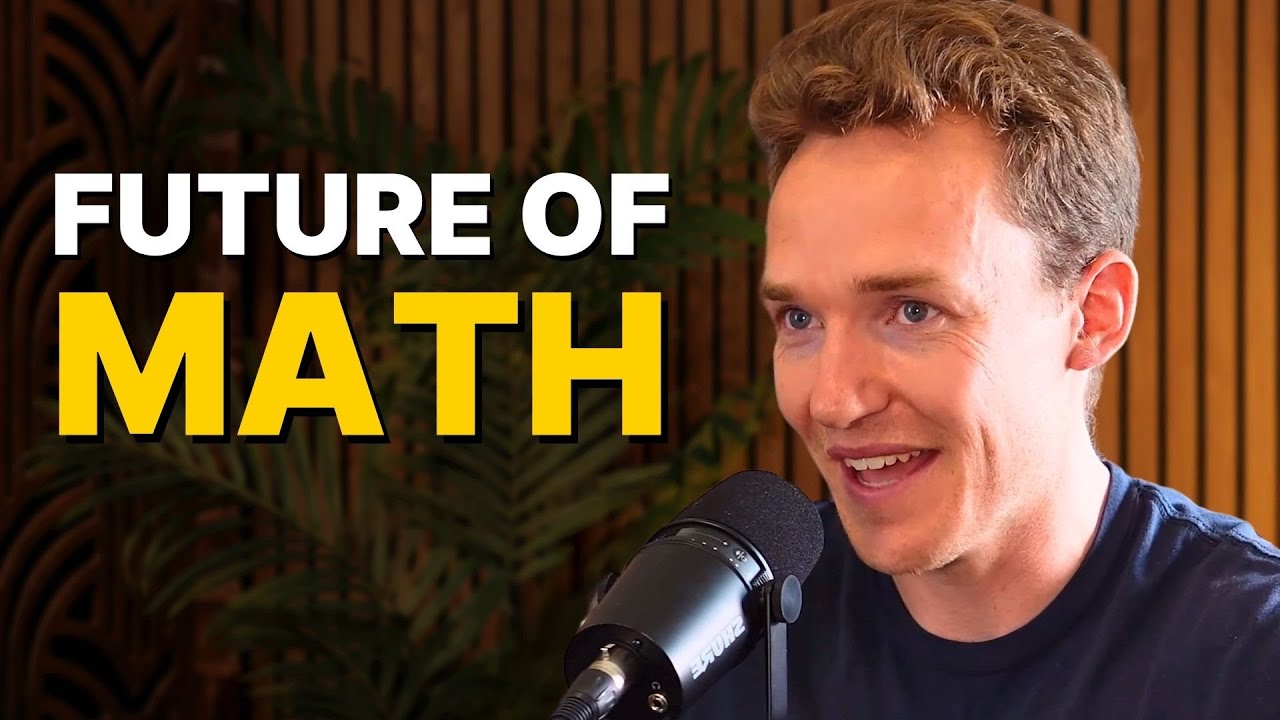
Grant Sanderson (3Blue1Brown) discusses the nature of mathematical intelligence, education, and creativity with host Dwarkesh Patel, covering topics ranging from AI and math competitions to the future of pedagogy and the scarcity of good explanations.
Does winning math competitions require AGI?
Grant is skeptical of the concept of AGI as a discrete threshold, arguing that intelligence is more continuous than people assume, and that GPT-4 already qualifies as “general” in a meaningful sense.
He thinks an AI winning a gold medal at the International Math Olympiad (IMO) would be analogous to AlphaGo beating humans at Go — impressive and creative, but not necessarily a sign that AI can replace most jobs.
The real barriers to AI replacing jobs are more about long-context reasoning, relationship-building, and understanding human motivations than raw problem-solving ability.
Math is unusually amenable to synthetic training data (e.g., generating proofs in Lean and verifying them), which could accelerate AI progress in this domain specifically.
Even if an AI solves IMO problems, the proofs might feel “unmotivated” — technically correct but lacking the moral intuition of why a result should be true, which is what mathematicians actually value.
Where to allocate mathematical talent?
Grant reflects on whether the traditional pipeline funnels too many talented mathematicians into academia, finance, and computer science, when their abstract problem-solving abilities might have higher impact in areas like logistics, manufacturing, transportation, or public policy.
He wonders if there should be structural incentives (e.g., NSF grant requirements) for pure mathematicians to spend a fraction of their time collaborating outside their field.
He’s cautious about overgeneralizing — mathematicians sometimes doubt their usefulness outside pure math — but believes math talent is genuinely more generalizable than most specialized skills.
He’s inspired by examples like Lars Doucet, a game designer who applied algorithmic thinking to land valuation for Georgist tax policy, showing how technical skills can contribute to unexpected domains.
The best advice for young mathematicians may not be universal but rather to think critically about where their specific circumstances and interests connect them to real-world problems.
Grant’s miracle year and the origin of 3Blue1Brown
Grant discusses the phenomenon of “miracle years” in science (Newton, Einstein, Gauss), where a single year produces a disproportionate share of someone’s life work.
He explains that a miracle year is often the “exhalation” after many years of “inhalation” — building up potential energy through learning and experience before releasing it.
He started 3Blue1Brown as a personal programming project during his senior year at Stanford, building his own animation tool (Manim) without any intention of becoming a YouTuber.
He initially saw the channel as a niche portfolio for math exposition, not expecting it to grow beyond a small audience of math enthusiasts.
He believes starting with low stakes and an unreasonably niche focus was key to the channel’s success, because it allowed him to make the best possible content for a specific audience rather than diluting quality for mass appeal.
He chose to build Manim from scratch rather than use existing tools, which was inefficient but gave him creative freedom — a trade-off he sees other math visualization creators make as well.
Prehistoric humans and numeracy
Grant finds it fascinating that prehistoric humans and some isolated modern tribes lack basic numeracy, despite how fundamental numbers seem to us.
He notes that some tribes think logarithmically about quantities (e.g., saying three is halfway between one and nine), which may reflect the natural way humans perceive social complexity scaling with group size.
Formal numeracy may have replaced or obscured more intuitive forms of quantitative thinking, which is why concepts like logarithms feel unnatural to modern students despite being “deep in our bones.”
The abstract concept of a number is so embedded in modern thought that it’s hard to appreciate how transformative it was — like asking how the alphabet is useful.
What limits mathematicians?
Grant speculates that the key constraint for mathematicians is not working memory or processing speed but the number of available analogies — the ability to draw connections between disparate fields.
He points out that modern math is far more collaborative than the “lone genius” stereotype suggests, with mathematicians traveling to conferences and working together because progress requires exposure to diverse problem-solving approaches.
The increasing number of authors on math papers over the past 200 years reflects this collaborative reality.
Why is so much math so new?
Grant explains that even high school-level math (like linear algebra or information theory) is relatively recent because pure mathematics as a profession is itself new.
For most of history, mathematicians were also physicists, astronomers, or natural philosophers — pure math as a dedicated field only became common in the past few centuries.
The explosion of mathematical output correlates with population growth and the increasing number of people with economic freedom to pursue academia.
Some fields like chaos theory required computers to even discover the phenomena (e.g., sensitivity to initial conditions in the Lorenz equations), showing that tools shape what questions get asked.
The space of possible mathematical questions is unfathomably vast, so what gets explored is heavily shaped by practical needs, historical accidents, and motivating problems (e.g., knot theory arose from Lord Kelvin’s incorrect atomic theory).
Future of education and online explanations
Grant distinguishes between “explanation” (which can be online) and “education” (which derives from the Latin “educe,” meaning to bring out), arguing that the latter requires in-person mentorship, inspiration, and social connection.
He strongly values classroom teaching because a single teacher’s small gesture — pulling a student aside to say “you’re good at math” — can permanently alter that student’s trajectory in ways a YouTube video cannot.
He shares a personal story of a substitute teacher who told him “sometimes music people just aren’t math people,” which was hurtful even though he was confident in his abilities, illustrating how sensitive students are to educators’ comments.
He references the George Dantzig anecdote (mistakenly given unsolved problems as homework) as another example of how small, random events can redirect a mathematician’s entire career.
He encourages top educators to put content online but warns against removing them from classrooms, because direct contact with students maintains the empathy needed to create good explanations.
He plans to become a high school math teacher himself at some point, both to stay connected to learners and to model the idea that STEM professionals should spend time teaching.
Why are good explanations so scarce?
Grant identifies two main reasons: (1) it’s cognitively difficult to remember what it’s like not to understand something you know well, and (2) the best explanation varies heavily depending on the individual learner’s background and context.
Most explanations are targeted at specific audiences (e.g., third-year math majors), making them ineffective for cold-start learners.
Creating explanations that are broadly useful across diverse backgrounds is a much harder problem, and until recently there was little economic incentive to do so.
How Grant makes videos
Grant works entirely alone on his videos, including animation, scripting, and editing, because the seemingly mundane production details are actually how he thinks through the creative process.
He finds it difficult to articulate what he wants in words — the code he writes to create animations is itself the medium of his thought, making it hard to delegate to collaborators or AI tools like Copilot.
He tried using LLMs for Manim code generation but found they couldn’t understand the visual output well enough to be useful, unlike the Microsoft Research example where GPT-4 successfully modified LaTeX to change rendered output.
Grant’s Summer of Math Exposition competition
The Summer of Math Exposition (SoME) started accidentally in 2021 as a consolation for rejected intern applicants — Grant offered to feature five submissions in a video and gave people a deadline to motivate them to create math exposition content.
The cash prizes ($1,000 per winner, later expanded) are less important than the deadline and the promise of exposure; Grant believes a larger prize pool might actually be counterproductive by attracting delusional entrants.
A peer review system was created to handle the volume of submissions (1,200+), which inadvertently created a co-watching network that helped good videos get recommended by the YouTube algorithm.
Over 100 videos from SoME received more than 10,000 views within the first two weeks, demonstrating that the real value was not the prizes but the guarantee that good content would reach an audience.
Grant emphasizes that the competition was never meant to be about winners — it was about motivating people to create, and many of the best contributions came from experienced educators sharing their intuition more broadly.
Self-teaching and who benefits from online resources
Grant warns self-learners against skipping calculations, because doing the reps is where intuition solidifies — you learn why a result is true, not just that it is.
He recommends always having a notebook and pencil while reading, treating active problem-solving as part of the reading process.
He references the book Failure to Disrupt to argue that educational technology tends to benefit already-motivated learners the most, widening rather than narrowing gaps.
The most important factors in learning are social: having friends who are also interested, having a personal project that requires the knowledge, or having a respected figure who encourages you.
He speculates (half-jokingly) that the most effective possible “school” would socially engineer students’ environments so that people they admire express interest in learning the same things — approximating this through peer groups and respected teachers is more impactful than any improvement in online explanations.
Grant’s plans to teach high school
Grant has no concrete timeline but plans to teach high school math when he has young children, both to stay connected to learners and to practice what he preaches about STEM professionals contributing to education.
He sees classroom teaching as one of the highest-leverage ways to get more people engaged with math and wants to encourage others to do the same, even if only for a few years.