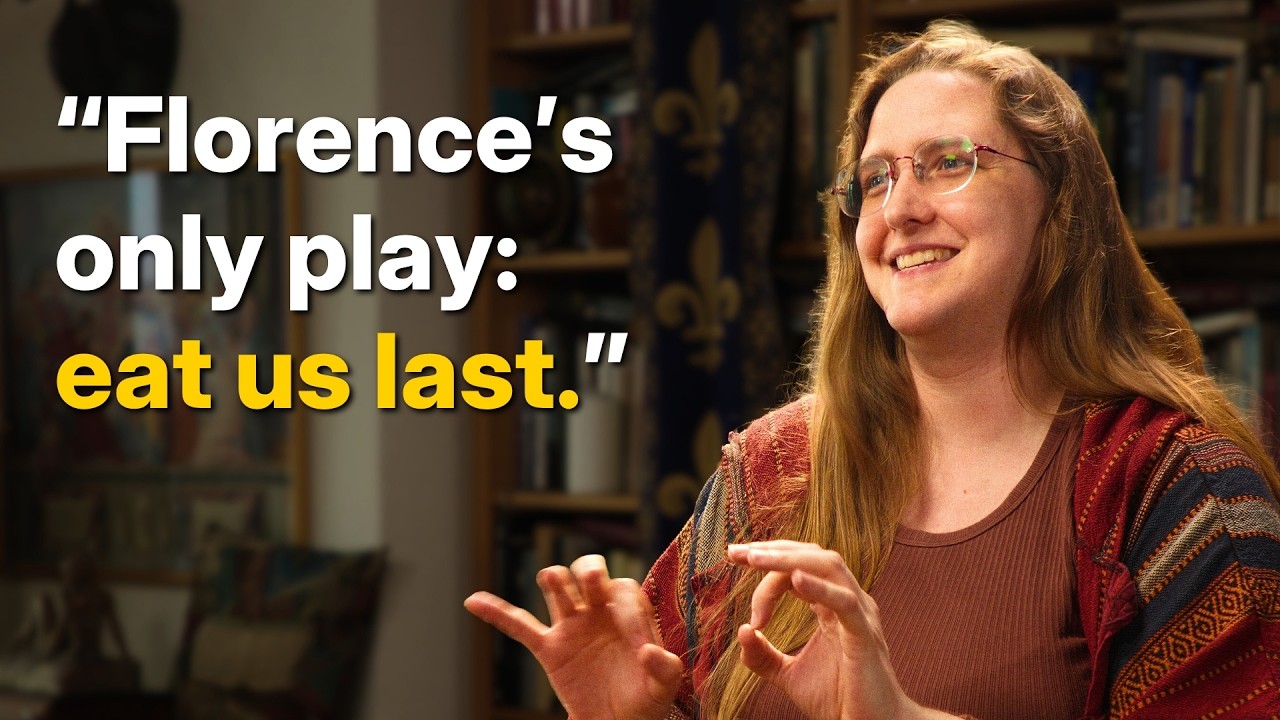
Ada Palmer, historian and author, discusses the life and thought of Niccolò Machiavelli, situating his writing within the political chaos of Renaissance Italy and challenging the popular misconception of “Machiavellian” as self-serving villainy. The conversation explores Machiavelli’s firsthand experience with Cesare Borgia, his deep patriotism, his views on religion and stability, and the material conditions of intellectual life in the early print era.
The instability Machiavelli saw everywhere
Machiavelli wrote The Prince in 1513 and dedicated it to Lorenzo di Piero de’ Medici, urging him to stabilize Italy. The urgency came from two structural sources of chaos:
City-state regime instability: When a long-standing government is overthrown, the thread of legitimacy is cut, and rapid-fire regime changes follow. By Machiavelli’s time, the majority of Italian city-states had recently had their governments uprooted, making every polity volatile and ripe for yet another replacement.
The papacy as a destabilizing force: Popes in Machiavelli’s lifetime increasingly used executive and military power to overthrow governments and install family members. Because the papacy is elected rather than hereditary, each new pope was likely to be an enemy of the previous one, ripping up existing arrangements. With an average papacy of about ten years, this created a cycle of unpredictable, radical turnover unique in Europe.
Machiavelli’s solution was not Italian unification but stabilization: he wanted the Medici to become powerful enough that the papacy would have to negotiate with them rather than dominate a patchwork of weak states.
Machiavelli and Cesare Borgia: the most terrifying job in the world
Machiavelli served as a Florentine diplomat and spent extensive time at the side of Cesare Borgia (called Valentino), giving him an unparalleled first-person view of one of the most charismatic and terrifying political figures in European history.
Accounts of Borgia range from “the most incredible leader I’ve ever met” to “he must be the Antichrist” because of his supernatural charisma and persuasiveness.
Machiavelli’s usual analytical distance breaks at one point in The Prince: when describing Borgia’s fall, he slips into the first person—“he told me”—revealing how personally involved he was.
Borgia’s plan was to conquer the Papal States in central Italy. Florence, as a puzzle-piece notch in that territory, was an obvious target.
Machiavelli’s strategy for Florence was not to resist but to buy time: swear absolute loyalty, provide forces and money, betray allies (including breaking a 300-year alliance with Bologna), and whisper constantly in Borgia’s ear that Florence was loyal. The goal was to be eaten last—to win the “boon of Polyphemus.”
Machiavelli was fully aware that if Borgia’s father Alexander VI had lived another year, Borgia would have finished his conquests and taken Florence.
Machiavelli witnessed the massacre at Senigallia, where Borgia invited conspirators to a banquet under false promises of forgiveness and then slaughtered them all—violating sacred vows and the laws of hospitality.
Afterward, Machiavelli’s family in Florence waited months to learn whether he had been killed in the purge, as the postal system had broken down.
Paradoxically, the massacre made Borgia’s remaining men more loyal than ever, because even the faintest whiff of conspiracy now meant certain death.
Borgia’s kingdom fell not because of any strategic error but because of fortune: he and his father fell ill simultaneously from food poisoning, the puppet pope he installed (Pius III) died too quickly, and he was outmaneuvered by Pope Julius II.
Machiavelli insists that Borgia did everything right and should be imitated. The lesson is that one has power over at most half of what causes outcomes; the other half is fortune. We should evaluate deeds based on the most probable outcome before fortune intervened.
Machiavelli’s nuanced analysis of means and power
A common misconception is that Machiavelli says “the ends justify the means” and that means don’t matter. In reality, he is deeply concerned with means—the specific ways power is acquired determine how stable and fruitful that power will be.
Rising with the help of great powers is precarious because you empower someone stronger than you.
Lying and breaking oaths can be stable or fatal depending on context. Savonarola’s flip-flopping destroyed him because his power base rested on the belief that he was divinely inspired and infallible. Borgia could betray allies because he was so terrifying that his other allies responded by becoming more loyal, not by turning on him.
“It is better to be feared than loved” reflects Machiavelli’s cynicism about human nature: people will break promises the moment your rule seems weak, but the expectation of punishment for disloyalty is a more stable foundation.
Machiavelli was the first European thinker to propose that competing political parties within a state could be a stable mechanism for venting social tensions, observing Siena as an example. The standard Florentine approach had been to massacre the losing party entirely.
The papacy, corruption, and the erosion of spiritual authority
Popes in this period were temporal warlords as much as spiritual leaders, fighting wars against other Catholics and appointing illegitimate sons to rule cities.
For Italians living close to Rome, the pope was a known quantity—“that guy who went to college with my brother”—making it hard to maintain abstract reverence. This proximity produced wars where cities hereditarily loyal to the papacy fought against a specific pope from the opposing faction.
The Guelph-Ghibelline divide, originally about whether the pope or the Holy Roman Emperor was the rightful successor to Roman authority, had devolved into “those jerks murdered Uncle Tybalt”—pure factional hatred with no rational theological content.
The papacy became progressively more corrupt over generations through a prisoner’s dilemma: as the Church accumulated wealth, ambitious families had increasing incentive to place sons in the Church through bribery. Machiavelli’s own family debated the correct-sized bribe to buy a priesthood for his brother Totto.
Even kings needed the pope desperately—for marriage dispensations, bishop appointments, and political legitimacy—so everyone participated in the system defensively.
Machiavelli observed that all institutions gradually corrupt and need to be reformed and returned to their foundations, anticipating the logic that would later trigger the Reformation.
Patronage as the glue of society
Patronage (entangled with nepotism) was not just prominent but the fundamental glue holding society together, creating multi-generational bonds of trust that substituted for institutional loyalty.
When Pope Paul III appointed a competent general rather than his own incompetent son to command the papal armies, the people of Rome rioted demanding more nepotism—because the pope’s son would never betray the pope, and that familial bond was the only guarantee the army wouldn’t turn on Rome.
Soldiers swore oaths to their commander, not to the polity, because communications were slow and commanders needed authority to make field decisions.
The justice system operated through patronage rather than proportional punishment:
Law codes prescribed death for almost everything, but in practice maybe one in 100 convictions resulted in execution. Almost all others ended in fines or flogging because the accused’s patron intervened with the judge.
The purpose of a trial was the spiritual correction of the sinner—fearing for one’s life, begging for mercy, and receiving grace was meant to be an earthly preview of divine judgment.
Giordano Bruno was executed not because his ideas were more radical than others but because he had angered his patron, who turned him to the Inquisition. Marsilio Ficino and Giovanni Pico della Mirandola held equally radical views but were protected by Lorenzo de’ Medici and other powerful patrons.
Even staying in a hotel or buying an apple in a new city required a letter of recommendation from a patron.
Why Borgia was beloved by the people he conquered
When Borgia conquered cities in central Italy, he massacred the ruling families and implemented neutral justice. To everyone’s surprise, he became incredibly popular.
Under the old system, justice was entirely determined by which faction was in power: a carpenter’s son from the ruling faction would get a minimal fine for murder, while the same crime from the opposing faction meant execution.
Borgia’s neutral judges gave the same verdict regardless of faction, delivering equitable justice for the first time in generations. People who had lived under “justice for some and injustice for others” were delighted, and they willingly joined his armies and defended his conquests.
Machiavelli valued liberty defined as the existence of a legal process: even if the system was biased, the requirement of a trial meant you were not a slave. Under Borgia, a man could be pointed at and killed on the spot—that was slavery regardless of how beneficent the tyrant.
Florentines repeatedly rioted and risked their lives under the banner of “Libertas” to defend a system where the Senate was drawn from the top 1%—they were defending their elite’s right to govern, not their own participation, but they considered it fundamentally different from arbitrary execution.
If Florence had to fall, falling to the Medici (who loved the city and wanted to preserve it) was far gentler than falling to an outsider who might raze walls or destroy the cathedral.
Art as diplomacy and high-tech achievement
Despite constant warfare, Florence had enormous surplus for cultural projects because banking and the wool industry were staggeringly profitable.
Art and culture functioned as diplomacy: Florence could not afford enough armies to defend against France, but it could afford to cover its government buildings in fleur-de-lis and create beautiful gifts for the King of France, making him feel like a friend. Dollar for dollar, diplomacy was cheaper than war.
These cultural achievements were understood as high-tech at the time—cutting-edge imitations of Roman achievements that even the Romans might not have accomplished. The period’s orientation was “backwards is forwards”: the goal was to recapture Roman greatness, not to surpass it.
Renaissance thinkers curated Roman history selectively, zooming in on the stable periods of Trajan, Hadrian, and Marcus Aurelius rather than the chaotic emperors. Medieval and Renaissance Europe even developed the legend that Pope Gregory the Great posthumously baptized Trajan so he could go to heaven despite being a pagan persecutor of Christians.
Religion, sin, and the Renaissance attitude toward morality
Machiavelli highlights Borgia’s betrayals as remarkable, but the conversation reveals that political violence and oath-breaking were common. The key question is whether people genuinely believed they would go to hell for these acts.
They did believe it, and they did it anyway. Dante’s Commedia was a direct confrontation with this hypocrisy: he filled his hell with Florentines, including people he loved and respected, making the painful point that if the religion is true, these people are damned.
The most famous example is Paolo and Francesca—the Renaissance equivalent of Romeo and Juliet—celebrated as a beautiful love story but placed by Dante in hell for adultery, shocking everyone.
Renaissance Christianity had much less focus on purity than later Calvinism or Puritanism. The assumption was that everybody sins constantly, repents, is forgiven, and sins again. St. Julian the Hospitaller, patron saint of murderers, was enormously popular: his legend involved accidentally killing his parents and spending his life in repentance, offering a spiritual path for anyone who had committed homicide.
This created a sophisticated hypocrisy: society built elaborate apparatuses to let actions be at odds with religious precepts, and figures like Dante and Savonarola who insisted on taking the rules seriously were unusual and often punished for it.
Machiavelli’s exile and the true nature of The Prince
Machiavelli was arrested, tortured, and exiled by the new regime despite not having plotted against them. His exile was unusually harsh: he was sent to a remote hamlet with no political contacts, forbidden from engaging in diplomacy—not a “wait for instructions” exile but a “rot and prove your loyalty” exile.
He could easily have gotten a prestigious job at any European court. Instead, he stayed, rotting in the countryside, and wrote The Prince as a job application begging the regime that had tortured him to let him come back and serve.
The Prince was secret and proprietary—he shared it only with the Medici rulers and his closest scholarly friends. He would not let any other power have it, like a nuclear scientist with diplomatic secrets who refuses to sell out. This is the opposite of the “Machiavellian” reputation for self-serving scheming.
His other works (the Discourses, histories, plays) were for public circulation and increased his fame. The Prince was meant for an audience of one.
How The Prince entered the world and why it matters
The Prince was first published in 1532, after Machiavelli’s death, when his surviving relatives sought fame for the family and the Medici pope permitted it. The Medici didn’t fully grasp the power of its contents—they saw it as a way to spread both the Machiavelli and Medici family fame.
It was swept up in a wave of censorship triggered by the printing press. The Inquisition’s system required all books to be approved before printing, and in return granted the printer a monopoly license—the very first version of copyright was born from censorship.
Places like England imitated this system because printers and authors wanted the monopoly protection, eventually separating the copyright function from the censorship function.
The Prince drifted along without major influence until two moments made it surge:
After Hobbes’s Leviathan (1651): Hobbes’s terrifying vision of humanity and government used reasoning that sounded like Machiavelli’s. Philosophers trying to refute Hobbes went back to Machiavelli to find holes in the “daddy monster.”
The 19th century: After the Enlightenment revolutions, people needed ways to think about politics without religion entangled in it. Machiavelli’s secular analysis of government operating by itself made him invaluable for developing separation of church and state. Italy also claimed him as “the first modern man” in a nationalist competition with England (Bacon) and France (Descartes).
Machiavelli on religion’s utility for the state
Machiavelli does think religion is essential to political stability, but he thinks about it in utilitarian terms—as a psychological tool for shaping citizen behavior—rather than as a truth claim the state must advance.
He praises Roman religion for making the afterlife depend on being remembered by descendants, which motivated people to sacrifice themselves for the state. Christianity, by making the afterlife depend on interior piety, encourages monastic withdrawal rather than patriotic military service. He then adds: “Christianity has the advantage of being true”—end of chapter.
This parallels Thomas Paine, who despised institutional religion as a mind-control conspiracy but advocated mandatory religious education in schools because fearing God and posthumous punishment makes people obey laws. The state cultivates religiosity the way it cultivates literacy—as a skill needed for good citizenship.
The material conditions of Renaissance scholarship
Machiavelli’s father did months of drudge work indexing Livy to get a copy. Machiavelli himself hand-copied the entire text of Lucretius, integrating corrections from a manuscript source to produce a version better than either the printed or manuscript original—even though improved print editions would eventually come out.
In the Renaissance, original ideas had to be couched in the form of commentaries on antiquity to be taken seriously. Nobody wanted original ideas; antiquity was cutting-edge.
Scholars like Ficino genuinely believed their original cosmology and magic were secretly coded in Plato. Annius of Viterbo faked ancient texts and archaeological digs to advance his original historical theories under the guise of antiquity.
Radical political thought in the 1600s was hidden in footnotes to editions of Seneca and Livy. This is why 19th-century historians of philosophy dismissed the Renaissance as “200 years of people being wrong about Plato”—they couldn’t see that the commentaries were the original thought.
Machiavelli experienced the transition from manuscript to print culture firsthand. When a printer published one of his works without permission, full of typos, he panicked—there was no legal recourse, no concept of authorial copyright. His friends could only suggest writing letters to important people explaining the errors weren’t his.
The Inquisition’s dependence on local power
The Inquisition was not a centralized, all-powerful institution but operated more like an international organization (analogous to Doctors Without Borders) that was only as strong as the local government allowed.
Inquisitors depended on local authorities for funding, jails, guards, and arrest powers. If the local duke was a radical intellectual who protected heretics, the Inquisition was nearly impotent. The Spanish Inquisition was infamous because Ferdinand and Isabella poured money into it to scapegoat Jewish and Muslim populations.
This created bubbles of privileged access: if you worked for a cardinal or a duke, you could practice radical philosophy, magic, or sexuality and the Inquisition couldn’t touch you.
Machiavelli was bisexual and wrote homoerotic poetry. He and his gay friends discussed how to get jobs working for cardinals to avoid crackdowns on homosexuality. One friend who couldn’t get such a job hired two female prostitutes to appear with him constantly to seem straight.
The double image of Machiavelli
Machiavelli the person—a patriot who gave up wealth, fame, comfort, and even contact with his family to serve his country—is almost the opposite of “Machiavellian,” which means self-serving, scheming, and devilish (Shakespeare’s “murderous Machiavel,” “Old Nick” as a synonym for the devil).
This splitting of an author from their reputation happens to other thinkers too: Hobbes became “the Beast of Malmesbury,” and Spinoza—a warm, sweet, piously monist thinker who believed the entire universe was the body of God—became “the arch-heretic” partly because even the Jewish community expelled him, making him seem more radical than he was.
The character of Machiavelli the villain is useful for political thought experiments (“what would a Machiavellian politician do?”), but it has a separate life from the actual innovator who laid the groundwork for secular political science, separation of church and state, and modern concepts of political stability.
The real lesson of Machiavelli is that the same figure can be two such different things depending on how society uses him—and recognizing this doubling is a tool for understanding how ideas and reputations are shaped by social utility rather than by the actual content of a person’s thought.