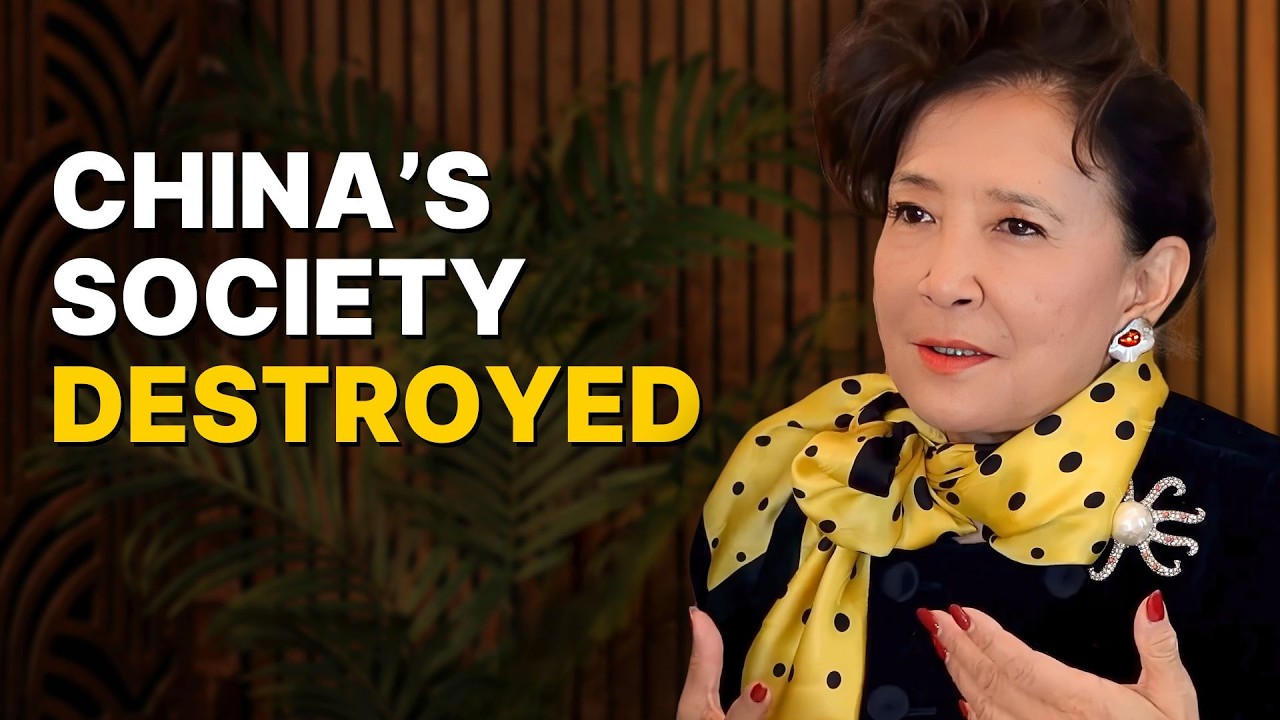
Jung Chang grew up as the daughter of high-ranking Communist officials in Mao’s China, survived the Cultural Revolution that destroyed her family, eventually escaped to Britain, and became the author of Wild Swans—a memoir of her grandmother, mother, and herself that has sold over 15 million copies worldwide—and Mao: The Unknown Story, a biography co-written with her husband Jon Halliday that draws on decades of archival research to argue Mao was responsible for the deaths of over 70 million people, making him the greatest mass murderer in history.
Growing up under Mao
Chang was born in 1952 in Sichuan province and lived a privileged childhood in a Communist compound with servants, cooks, and drivers, taking class hierarchy for granted until she arrived in Britain and found it comparatively classless.
In 1966, when she was 14, Mao launched the Cultural Revolution—a Great Purge targeting his own party colleagues—and her father, a senior Sichuan official, was arrested, tortured, driven insane, exiled to a labor camp, and died prematurely after speaking out against Mao’s policies.
Her mother refused to denounce her father and was subjected to over 100 denunciation meetings where victims had their arms twisted behind their backs, heads pushed down, and were kicked and beaten; she was once forced to kneel on broken glass and was paraded through streets where children spat at her and threw stones.
Chang was exiled to the edge of the Himalayas and worked as a peasant, then as a “barefoot doctor” (a doctor with no training, since Mao had closed schools and burned books), then as an untrained electrician who suffered five electric shocks in one month.
China was a cultural desert for a decade—no books, cinemas, theaters, or museums—and the only foreigners she had spoken to were sailors at a southern port where English students were sent to practice with a textbook whose first lesson was “Long Live Chairman Mao” and second was “Greetings” (translated from the Chinese habit of asking “Where are you going?” and “Have you eaten?”).
After Mao died in 1976, universities reopened in 1973 (partly due to Nixon’s visit, partly internal politics), and Chang studied English at Sichuan University; in 1978 she passed a national exam and became one of the first 14 people sent abroad under Communist rule, eventually earning the first doctorate from a British university by someone from Communist China at the University of York in 1982.
The psychology of totalitarianism
Chang describes Mao as having achieved a Godlike status through two mechanisms: complete isolation from alternative information (parents wouldn’t tell children anything contrary to the party line for fear of endangering them) and intense terror that scared people into suppressing unorthodox thoughts.
Even after witnessing her family’s destruction, it took Chang eight years—from age 16, when she first doubted the society, to reading a Newsweek article in 1976 that spelled out Mao’s name in connection with Madame Mao—before she dared hold Mao personally responsible; she had spent years blaming Madame Mao and the “Gang of Four” instead.
She wrote her first poem at 16 in 1968 and had to tear it up and flush it down the toilet when Red Guards came to raid the flat; she spent years afterward composing writing in her head “with an imaginary pen” while working as a peasant, doctor, steel worker, and electrician.
The desire to write never left her, but she avoided it for ten years in Britain because the past was too painful; when her mother visited in 1988 and told her life story and her grandmother’s story, Chang recorded 60 hours of tapes and transcribed them into Wild Swans, published in 1991.
How Mao maintained total control
Chang argues the key difference between 20th-century totalitarianism and earlier authoritarianism was the thoroughness of organizational control: the Communist Party organized Chinese society down to the grassroots through layers of party cells, making rebellion unthinkable in a way it never was under emperors or the Nationalists.
Mao’s genius was not economics—which he understood poorly—but psychology and organization: he knew how to identify and elevate petty, sadistic, arrogant, and cowardly people and use them so that no corner of society could harbor a dissenting voice or independent life.
During the Cultural Revolution, Mao unleashed young people’s worst instincts—violence, destructiveness, sadism—giving them license to attack teachers and other “class enemies,” then reined them in by using the army to disperse the most militant Red Guards to villages and mountains, and purged the disobedient ones in a second round of campaigns.
Mao always ensured “the barrel of the gun was in his hand” through his control of the army, first via Lin Bao (a completely cynical enforcer who rescued Mao when other colleagues dissented) until Lin’s death in 1971 while trying to flee China, after which things improved because Mao had to rely on Deng Xiaoping to control the army.
Chang notes that when a tyrant dies, things generally improve because no one else is as extreme—Mao’s death in 1976 led immediately to the arrest of the Gang of Four and the end of the Cultural Revolution—but she declines to predict what would happen if Kim Jong-un died, noting only that the Kim dynasty has arranged succession in a way Stalin and Mao did not.
Why officials couldn’t overthrow Mao
Chang’s father, despite being a high-ranking official, had no option but to write a letter to Mao to voice dissent because the Communist Party charter theoretically permitted it, and only Mao could stop the violence; any other attempt to speak out meant instant denunciation and likely public execution.
Liu Shaoqi, Mao’s number two, did try to build a power base after the 1962 7,000-cadre Congress where party officials rallied against Mao’s famine-producing policies, and by 1965 he was powerful enough to resist a purge; Mao then spent years creating the Cultural Revolution’s atmosphere of terror—first targeting school teachers and other groups he didn’t even care about—before the climate was ripe to move against Liu.
Chang argues Mao’s colleagues couldn’t organize a coup because they couldn’t get organized (necessary to topple a tyrant) and couldn’t lay hands on the army, which was controlled by Lin Bao; even when Liu knew he would be purged, the mechanisms for resistance were systematically destroyed.
The Great Leap Forward and the famine
Mao’s ambition after taking power was to build a superpower to dominate the world, requiring him to import military-industrial technology from the Soviet Union and Eastern Europe; since China was not rich, he exported food—even though China had traditionally been a food importer for centuries, with emperors banning food exports.
The Great Leap Forward (1958–1962) was Mao’s attempt to industrialize rapidly; Chang describes how, as a six-year-old, her main occupation was searching for nails and cogs to feed backyard furnaces that had to run 24 hours a day, consuming all available fuel until mountains that had been covered with great trees were laid bare.
Most of what the backyard furnaces produced was completely useless, but the effort consumed labor that should have been harvesting grain; peasants were not allowed to leave their villages, and the regime issued stiff orders to stop them from fleeing to cities to beg for food.
Chang personally witnessed starvation: a child snatched a steamed bun from her mouth; her family’s maid returned from visiting her village in floods of tears after her landlord-classified family members died; her grandmother said, “The Communists are good except all these people are dead”; her father, after volunteering to live in a village, saw a man walking unsteadily on a paddy ridge simply collapse and die, and returned suffering from edema caused by starvation.
Her family collected urine to grow a seed believed to have nutritional value, which Chang remembers as revolting; the adults starved themselves to feed the children.
Mao also ordered the entire population to kill sparrows because they ate grain; Chang as a child beat pots and pans to prevent sparrows from landing until they dropped dead, but the ecological catastrophe that followed—insect pests flourishing without natural predators—worsened crop failures.
Liu Shaoqi decided to stop Mao’s policies after visiting his own village and finding his brother-in-law dead from starvation and his sister near death; he opened a pot and found only water with a few drops of grain, bowed to the peasants, and apologized—an unusual act that led to the 1962 Congress where officials rallied against Mao, which Mao called “the ambush” and which motivated the Cultural Revolution as revenge.
Chang estimates around 40 million deaths from the famine and notes that Mao died in 1976 thinking of himself as a failure because China was still poverty-stricken, partly defeated by his own economic ignorance.
Deng Xiaoping’s refusal to denounce Mao
Deng Xiaoping was purged during the Cultural Revolution; his son Deng Pufang was chased out of a window by Red Guards, and doctors refused to operate on him because he was Deng’s son, leaving him paralyzed for life; Deng himself was forced to do manual labor in the countryside.
Despite this personal devastation, Deng refused to denounce Mao after returning to power, saying “we must not overemphasize the crimes of Mao”; Chang argues this was a mistake—Khrushchev had denounced Stalin without endangering Communist rule in Russia in 1956, but Deng believed (perhaps correctly) that denouncing Mao would cause the Communist Party to collapse in China.
Chang speculates that Deng’s devotion to the party and its one-party dictatorship outweighed personal grievances, and that many children of old Communists, despite their parents’ suffering, still support the regime because they are its beneficiaries—corruption and privilege are associated with party membership, and ending one-party rule would end their advantages.
She contrasts China with Germany, where no one yearns for Hitler, and notes that Mao’s portrait still hangs in Tiananmen Square—his victims and their children are expected to bow to the image of the man who killed them.
Why some in the West defend Mao
Chang argues that Western defenders of Mao either don’t know the facts or don’t care to know them; some academics who criticized her Mao biography used explicitly Maoist language, calling him “a great Marxist-Leninist” and asking “Was Mao really a monster?”
She notes that Western radicals of the 1960s, disillusioned with capitalism, wanted so badly to believe in an alternative that they accepted fantasy as reality; Edgar Snow’s book about Mao gave many their illusions, and some Western visitors to China were told by victims in labor camps that they “enjoyed” being reformed, and the visitors believed them—Deng Xiaoping himself said “they were lying” when confronted with such accounts.
She draws a parallel to Walter Duranty, the New York Times Moscow bureau chief who denied the Ukrainian famine, writing headlines like “Russians are hungry but not starving.”
Chang acknowledges that some Westerners may think “China has always been awful” and assume “Orientals must feel differently,” a form of condescension that excuses atrocities.
The opening of China
Chang disputes the claim that Nixon and Kissinger “opened up China”; she lived there at the time and says the liberalization after 1971–72 was mainly due to Lin Bao’s collapse, which deprived Mao of his army controller; real opening only happened after Mao died in 1976 and Deng came to power.
She is critical of Kissinger for being “too fascinated with power,” saying nice things about Mao, and attending rallies to eulogize Mao alongside figures like Bo Xilai—lending his status to the Chinese regime’s effort to preserve Mao’s legacy, which she calls “unforgivable.”
Chang believes opening up was unequivocally good: it ended Mao’s economic lunacy, lifted hundreds of millions out of poverty, and made a return to Maoist isolation impossible because people now know what the outside world is like; the challenge of a rising China as a potential threat to the world is a separate matter that does not argue against having opened up.
The mechanics of Communist control
Chang describes life in the communes as a form of chattel slavery: the commune controlled everything—food, fuel, travel (requiring a pass), marriage (requiring permission)—and peasants were not individual farmers but units in a highly concentrated organization of a few tens of thousands of communes governing 500 million people.
The commune system prevented peasants from rising up during the famine by controlling movement and issuing orders to drag back those who fled to cities; this mirrors what happened in Soviet Ukraine, where roadblocks prevented starving peasants from leaving.
Chang argues that Communist ideology was not the driving force behind Mao’s actions but a tool he used pragmatically: collectivization was not about abstract ideology but about making it easier to seize food from peasants by organizing them into controllable units rather than dealing with hundreds of millions of individual farmers.
She notes that the ideology attracts and enables opportunists like Mao, Stalin, and the Kim family, and that its claim to be a “science” necessitates purges—if it fails, there must be internal saboteurs to blame.
The psychology of self-criticism and mutual destruction
Chang explains that Mao required victims to incriminate themselves and confess because it broke them psychologically—even sincere self-criticism stirs up deep discomfort and unsettlement, and forcing people to criticize each other created animosities that prevented opposition from organizing.
The system of quotas—Mao declared that 5% of any group were “capitalist roaders”—meant that if you didn’t produce names, you would be denounced as a rightist yourself; this forced good people to sacrifice colleagues and family, creating an impossible dilemma that served as a psychological weapon.
Even family love was criminalized as “warm-feelingism”—Deng Xiaoping had to preface his plea to let his crippled son join him with “I’m afraid I’m committing warm-feelingism”—a device that separated people from each other and made everyone guard against everyone else.
Chang draws no comparison between the Cultural Revolution and recent Western movements like statue toppling, noting that the Cultural Revolution involved a decade with no books, cinemas, theaters, or museums; antiquities in private hands were wiped out; cinemas and theaters were turned into prisons and torture chambers; and the fear and destruction were on a scale incomprehensible to Western observers.
Legacy and reception of Chang’s books
Wild Swans has sold over 15 million copies and Mao: The Unknown Story was also a bestseller; in the 1990s and 2000s, pirated editions circulated widely in China via Hong Kong and Taiwan, but since Xi Jinping came to power around 2012–13, there has been a total clampdown—possessing banned books including Chang’s can lead to jail, and officials face severe punishment.
Warnings screens at Chinese borders now alert travelers not to bring in “bad literature” about revolutionary leaders or martyrs; research on history is forbidden, creating another generation of brainwashed people.
Chang notes that Chinese people are pragmatic and avoid trouble; parents who suffered under Mao tend not to tell their children, so many grow up with no alternative information beyond the official line.
She observes that some Chinese yearn for Mao not out of genuine ideological commitment but out of nostalgia for a simpler life or disillusionment with the “money is God” society of post-Mao China, where lack of regulation has disadvantaged many people; but the most important factor in Mao’s continued veneration is the regime’s active promotion of his legacy, particularly under Xi Jinping.