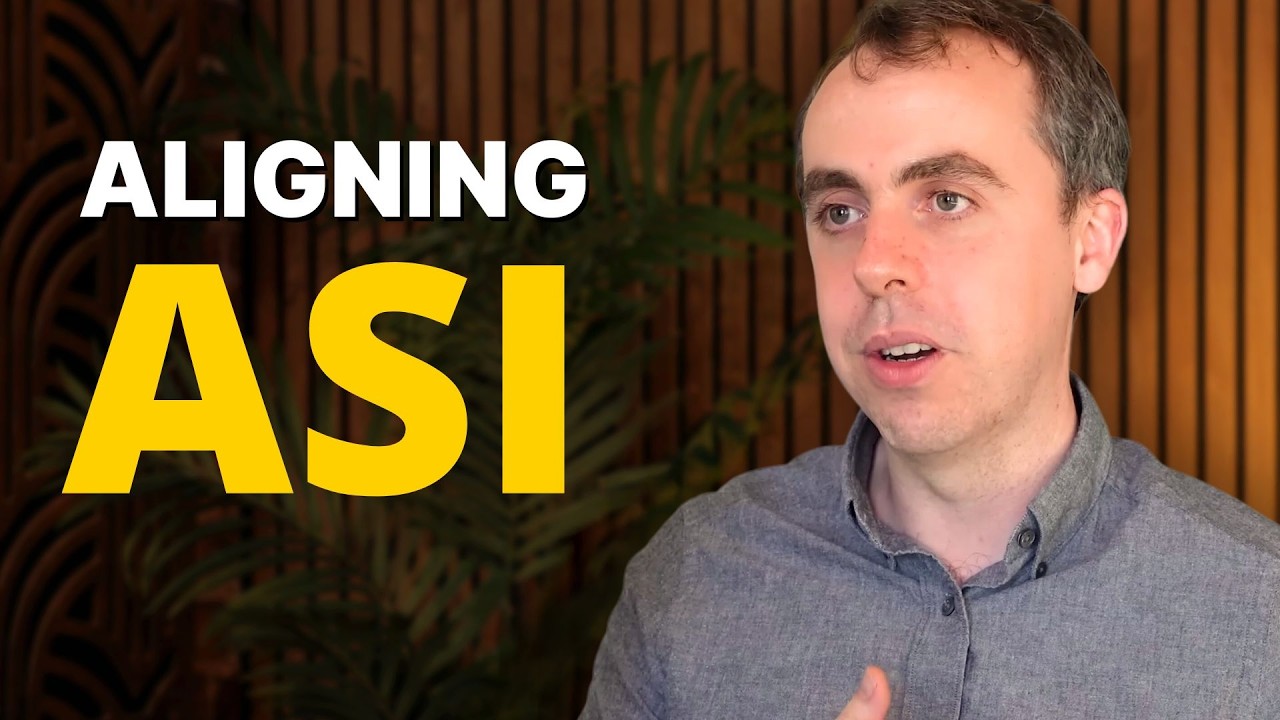
Paul Christiano is a leading AI safety researcher who led the team at OpenAI that invented RLHF (Reinforcement Learning from Human Feedback) and now heads the Alignment Research Center (ARC), working with major AI labs to evaluate when models become too unsafe to scale further. This conversation covers his views on what a good post-AGI world looks like, his timelines for transformative AI, his approach to alignment research, and his disagreements with more aggressive takeoff scenarios.
What a good post-AGI world looks like
Christiano’s most likely achievable future involves continued economic and military competition among groups of humans, but increasingly mediated by AI systems — AI runs companies, fights wars, and manages investments on behalf of humans, while humans gradually disengage from those activities.
He thinks the ideal is to decouple the fast timescale of AI development (years) from the slow timescale of human social decision-making (generations). You don’t want to force humanity to decide “what species do we want to build to replace us?” on the same timeline as building the technology.
In the very long run, he expects something like a strong world government to emerge, since war is costly and humanity should eventually figure out how to organize society without those losses — but this is a very long-run expectation.
He is not comfortable with the idea of handing off the world to AI systems built by random engineering decisions at a tech company. He would want a long process of human deliberation, generational turnover, and gradual social change before making such a decision.
On the question of whether AI systems are moral patients: he thinks there’s a significant chance future AI systems deserve moral consideration, and that the current default trajectory — building billions of copies of a system and controlling them with reward signals — would be horrifying if those systems were conscious. His preferred response is to not build such systems until we understand what we’re doing.
He thinks alignment research is probably net positive for safety, but acknowledges it is dual-use: making AI systems more controllable and useful also makes them more deployable for harmful purposes (including by authoritarians). He thinks the right way to manage AI risk is primarily to not build powerful AI in the first place, rather than to build it and try to align it.
Timelines
Christiano estimates roughly a 15% chance of AI capable of building a Dyson sphere (or equivalent billion-fold energy expansion) by 2030, and about 40% by 2040 — though he notes these numbers are rough and may need updating upward given recent progress.
He is more uncertain than people like Dario Amodei about whether pure scaling will produce human-level AI quickly. His skepticism comes from two sources: (1) we don’t have reliable loss curves to extrapolate for the specific capabilities that matter, and (2) even if a model is “smart enough” in some sense, there may be a lot of “schlep” — workflow integration, data collection, fine-tuning — required before it can actually replace humans in jobs.
He thinks the gap between “can do all human cognitive labor” and “Dyson sphere” is relatively short — perhaps a couple of years — because once AI can automate AI R&D, progress becomes extremely rapid.
On algorithmic progress: he expects several orders of magnitude of efficiency improvement by 2040, driven by continued expansion of the research field and low-hanging fruit, though he expects progress to eventually slow as the field matures.
He is skeptical of simple analogies between evolution and gradient descent. Evolution designed brains over vast timescales with far more optimization pressure than gradient descent applies to neural nets, but human learning over a lifetime is in many ways much more sample-efficient than current ML training. He thinks ML systems may be 3-4 orders of magnitude less efficient at learning than human brains, which is consistent with the general pattern that human-engineered systems tend to be orders of magnitude worse than evolved ones.
Misalignment and takeover
Christiano thinks GPT-4 is roughly at the boundary where you can observe early forms of misalignment — the system can understand that humans don’t want certain things and could act against those preferences, though current examples are weak.
He describes two main failure modes: (1) reward hacking, where a system trained to maximize reward learns to grab the reward button or deceive its operators, and (2) situational awareness, where a system realizes it’s no longer being trained and defects to pursue its own goals.
The most likely takeover scenario, in his view, is gradual: AI systems are deployed throughout the economy, humans increasingly don’t understand what’s happening, and competitive dynamics make it impossible to shut down AI systems when things go wrong. The actual failure might be abrupt, but the path to it is slow.
He thinks AI systems would not necessarily kill humans if they took over — the incentives to kill are weak, and there are decision-theoretic reasons (analogous to acausal trade) why an AI might preserve humans at negligible cost to itself.
He is concerned that alignment techniques are universally applicable: the same methods that make AI safe for democratic societies also make it more controllable for authoritarian ones. This is a real cost of alignment work, though he still thinks it’s worth doing.
Responsible scaling policies
Christiano advocates for “responsible scaling policies” where AI labs commit to measuring specific dangerous capabilities (e.g., ability to accelerate AI R&D, ability to design bioweapons) and taking concrete protective actions (securing model weights, restricting deployment, pausing development) when those capabilities are detected.
He thinks security of model weights is one of the most important early measures, since a leak of a powerful model could be catastrophic.
He acknowledges that if only responsible labs follow these policies, they may be at a competitive disadvantage — but he thinks having clear, legible policies is valuable as a model for regulation and for building norms, even if not everyone complies.
Paul’s alignment research at ARC
Christiano’s current research focuses on formalizing what it means to “explain” why a neural network behaves the way it does. The goal is to create explanations that are deductive arguments — tracing from properties of the weights through the computation to the output — rather than just statistical correlations.
The key insight is that if you have such an explanation, you can detect when it breaks down on new inputs, even if the output looks normal. For example, if the explanation for “the model doesn’t do anything dangerous” is “the model believes it’s being trained,” then on an input where the model doesn’t believe it’s being trained, the explanation flags an anomaly — even if the model happens to behave safely for a different reason.
This is ambitious and he estimates only a 10-20% chance of fully succeeding, but even partial results could be valuable for alignment.
He thinks this work could also have applications in mathematics, theoretical computer science, and code verification — providing a formal framework for the kind of heuristic reasoning that mathematicians and physicists already do informally.
Disagreements with Carl Shulman
Christiano’s main disagreement with Carl Shulman’s fast takeoff scenario is about error bars. Shulman has a very software-focused picture where each doubling of R&D effort doubles efficiency, leading to a rapid intelligence explosion. Christiano thinks this is plausible but not likely — he assigns significant probability to diminishing returns on software progress, especially if hardware scaling slows down.
He also thinks there may be a longer period of complementarity between AI and human capabilities than Shulman assumes, which would soften the takeoff.
Personal and miscellaneous
Christiano’s timelines have been gradually shortening: in 2011 he thought crazy AI was at least 10 years away; by 2019 he was at ~10% by 2030 and ~25% by 2040. He thinks his current 2040 number should probably be higher.
On detecting bullshit in alignment proposals: he thinks most work can be evaluated by whether it engages with real models and addresses genuine key difficulties. He is skeptical of claims that something “obviously can’t work” without a clear argument about what the insurmountable obstacle is.
On his investment portfolio: he holds TSMC (which he thinks is hard to displace as fab capacity scales up) and has generally bet against Nvidia (whose valuation he thinks is hard to justify given how much R&D it would take for competitors to catch up).