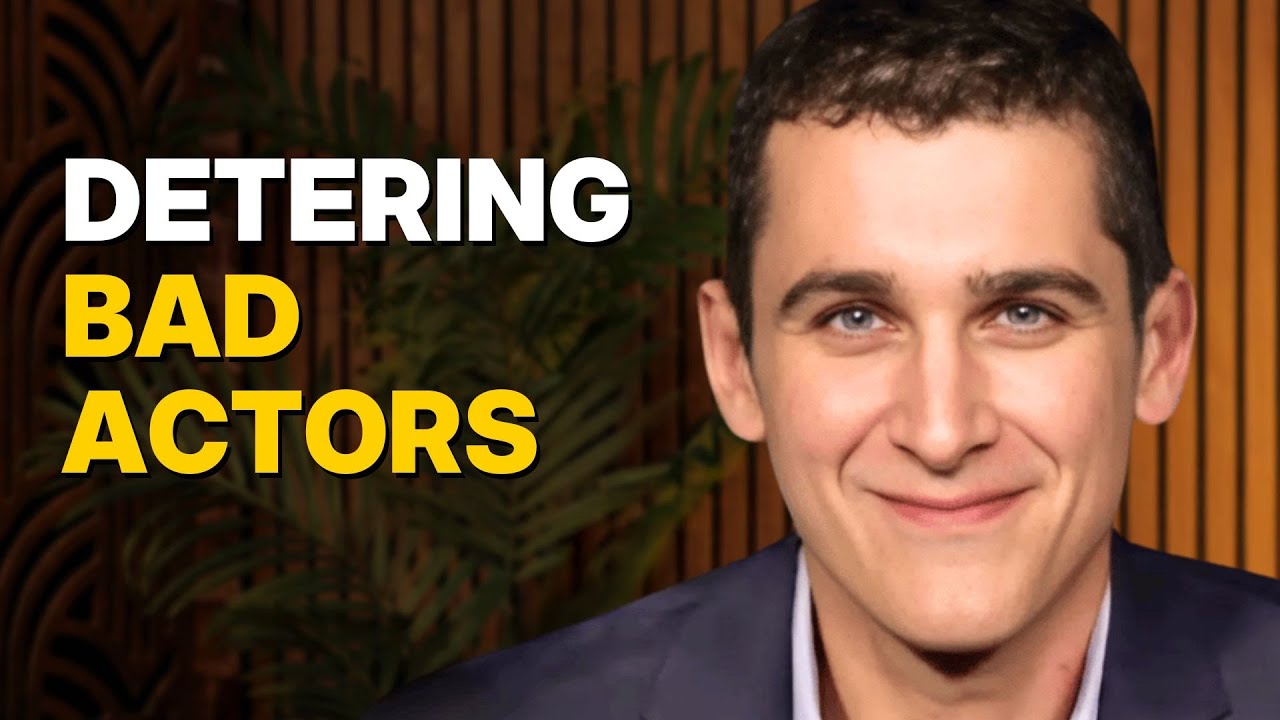
Richard Hanania is president of the Center for the Study of Partisanship and Ideology and author of Public Choice Theory and the Illusion of Grand Strategy, which argues that American foreign policy is not driven by a coherent “grand strategy” but by interest groups, bureaucratic incentives, and domestic political pressures—much like domestic policy. He extends this analysis to topics including the decline of war, China’s foreign policy, the limits of expertise, political polarization, and fertility.
The illusion of grand strategy
The standard academic view in international relations treats states as rational unitary actors pursuing coherent long-term goals across diplomatic, economic, and military domains.
Hanania argues this is a fallacy: we never assume the U.S. government has a coherent “grand strategy” for domestic policy (immigration, health care, taxes), so we shouldn’t assume one exists for foreign policy either.
His alternative model draws from public choice theory: foreign policy outcomes are the product of competing interest groups, bureaucratic self-interest, and political incentives, not top-down strategic design.
He tests this model against cases like U.S. military presence abroad, the timing of wars, and the sanctions regime, and finds public choice explains the patterns better than grand strategy.
Does competition enforce rationality?
One counterargument (associated with Kenneth Waltz) is that international competition selects for rational state behavior over time—states without coherent strategies lose out.
Hanania is skeptical: the U.S. has enormous advantages (human capital, institutions) that let it absorb irrational foreign policy; moreover, the same decentralized, open-society features that promote economic growth may actually undermine coherent grand strategy because interest groups can capture foreign policy.
There may even be a tension between good economic institutions (decentralization, individual freedom) and the ability to pursue a unified foreign policy.
War as political accelerant
War unquestionably accelerates political change: World War I and II dramatically expanded the U.S. federal government and centralized power in Washington.
The Cold War’s existential pressure contributed to the Soviet Union’s collapse; without that pressure, it might have persisted indefinitely.
Hanania does not endorse war as good, but acknowledges it has historically served as a catalyst for institutional change—for better or worse.
China vs. America: coherence without democracy
China’s foreign policy appears more coherent than America’s: it mostly avoids costly overseas interventions and uses targeted economic punishment (e.g., against Lithuania over Taiwan) with clear, limited goals.
America’s foreign policy blunders—Iraq, Afghanistan, Libya, Syria—are far costlier and less strategically coherent than anything China has done.
Hanania attributes China’s relative coherence partly to its authoritarian system, which is less susceptible to domestic interest-group capture.
However, even poor authoritarian states can be highly interventionist (Maoist China gave massive foreign aid to richer countries; Russia overextends relative to its economy), so the advantage is not simply about resources.
China may simply be choosing restraint for now, but has the economic capacity to become far more interventionist.
Presidential power in foreign policy
The public pays far less attention to foreign policy than domestic policy, giving presidents more freedom of action.
This freedom has limits: strategies requiring large troop deployments and casualties (e.g., Iraq) are politically costly and require public support.
But strategies that impose costs primarily on foreign populations—like sanctions and regime-change pressure on Iran and Venezuela—face little domestic backlash and can be pursued relatively freely.
Hanania notes the Trump administration had a de facto regime-change policy toward Iran and an official one toward Venezuela, both achievable without American casualties.
Can the U.S. deter bad actors?
On North Korea: the regime likely seeks nukes defensively, fearing U.S. invasion. The question is whether to accommodate that fear or continue pressure. Hanania notes the U.S. could overthrow the government but at enormous cost.
On Venezuela: U.S. sanctions worsen suffering, but the deeper problem is ideological—the regime adopted central planning voluntarily, not under military pressure. The U.S. also harms Latin America through the drug war, which forces countries to fight cartels in ways that may not suit local conditions.
Hanania is skeptical of U.S. hubris in promoting democratization and human rights norms abroad, arguing that outsiders cannot know the best policies for societies they don’t understand.
Why foreign policy is more interest-driven than domestic policy
In domestic politics, voters’ economic circumstances poorly predict their political orientation; cultural attitudes and demographics matter more. Voters have little individual stake in outcomes.
In both domains, interest groups dominate when public attention is low.
The key difference: public opinion is more easily manipulated in foreign policy because most Americans have no direct knowledge of foreign countries. Leaders can frame threats and alliances through media narratives (e.g., the Bush administration linking Saddam to 9/11 despite no evidence).
This gives leaders more room to maneuver on foreign policy than on salient domestic issues like Social Security.
Fixing foreign policy institutions
Hanania suggests institutional reforms: better regulation of foreign lobbyists, disclosure of financial ties (e.g., noting when a former general on TV sits on corporate boards), and reducing the influence of defense contractors on think tanks.
He is less enthusiastic about broad campaign finance reform, noting that removing money from politics might simply shift influence to government and party insiders.
He emphasizes cultural change over legal fixes—changing how we talk about and evaluate foreign policy expertise.
The track record of expertise
Hanania has argued that many established fields (criminology, psychology, international relations) have poor track records: suicides, crime, and foreign policy outcomes have worsened despite professional expertise in these areas.
He makes an exception for economics, which he considers more rigorous and which correlates with the massive reduction in global poverty since 1990 (driven by market reforms in China and India).
On whether nuclear peace validates international relations expertise: Hanania is skeptical, arguing that nuclear weapons may simply be too horrible to use, and that the decline in war is global and not clearly attributable to U.S. hegemony.
He acknowledges a “Burkean” argument—the international system has worked relatively well, so radical change is risky—but leans toward the view that the U.S. is actually a source of instability, especially in civil conflicts and Latin America.
NATO and alliances
NATO’s original justification (deterring Soviet invasion of Europe) is obsolete. The only plausible threat now is Russia, which lacks the economic capacity to invade Western Europe.
Russia’s aggressive behavior (Georgia, Ukraine) is driven partly by fear of NATO expansion, which it sees as an encroachment.
Hanania argues the deeper issue is ideological: the U.S. treats non-democratic governments like Russia’s as illegitimate, and Russia perceives a regime-change threat beneath the surface.
Why some academic fields work and others don’t
Hanania focuses his critique on the social sciences, acknowledging that fields like economics, particle physics, and computational complexity function better.
Key differences:
Connection to reality: In natural sciences and economics, theories can be tested in markets or experiments. Social sciences lack large-scale randomized experiments on policy.
Social desirability bias: People have strong priors about how society should work, and without market tests, scholars can believe whatever aligns with their values or the preferences of funders (State Department, Pentagon).
Culture of rigor: Economics is more mathematically demanding and has a more aggressive, confrontational culture that weeds out weak arguments. Other social sciences tend to be more protective of feelings and less willing to declare theories wrong.
Even before recent diversity pressures, academia had pathologies: communism and disarmament fads were popular, and the Vietnam War was waged by credentialed experts (Kissinger, McNamara) who privately knew it was unwinnable.
Hanania believes academia has gotten worse—pointing to the low quality of discourse among prominent political scientists on Twitter compared to the 1960s.
Can we get useful expertise in social sciences?
Hanania is deeply skeptical. The problems seem inherent: these fields are disconnected from market feedback and deal with phenomena that resist clean measurement.
He suggests relying more on prediction markets and economic-style mechanisms that reward track records rather than credentials.
On crime specifically, he thinks common sense and basic statistics outperform the field of criminology.
The concept of “expertise” itself can be harmful: politicians and media selectively cite experts to legitimize predetermined policies (e.g., during COVID, the Great Barrington Declaration signatories from Harvard and Stanford were ignored in favor of more hysterical voices).
Why liberals have been winning
Hanania argues liberals care more about politics and have become far more politically engaged since 2016.
Data on protest attendance and petition signing: liberals were 2–3 times more likely than conservatives to engage in 2010, but by 2016–2020 the gap had widened to roughly 10 times.
Trump mobilized low-propensity conservative voters (good for Republicans in elections) but alienated the activist class—lawyers, bureaucrats, journalists—who shape policy day-to-day, pushing them further left.
Why big tech is especially woke
Until 2015–2016, big tech was less willing to censor than the media wanted. Zuckerberg and Dorsey were relatively non-woke by elite standards.
Tech initially attracted non-conformist, libertarian-minded pioneers. As it became an establishment industry, it drew more conformist employees.
Hanania draws an analogy to his foreign policy thesis: like America, Google had an explicit idealistic mission (“Don’t Be Evil”) and then took actions in service of that mission that may have made things worse.
Walmart, by contrast, never claimed to be revolutionizing society—it just moves goods—so it attracts less ideologically motivated workers.
Crypto, as the new cutting edge, is now more right-wing than big tech, following the same cycle.
Authoritarian populism vs. libertarianism
Hanania’s theory can vindicate authoritarian populism: a right-wing government that cares more about politics than the left (even if outnumbered) can push back on the liberal-led establishment.
It can also vindicate libertarianism: shrinking government funding and power starves rent-seeking elites (in universities, media, NGOs) of resources and limits their ability to coerce.
He sees value in both approaches but is unsure which is ideal. Libertarianism struggles with cultural problems (e.g., parents can’t easily shield children from a sexualized culture). Authoritarian populism risks backfiring if pro-natalist or nationalist messaging becomes associated with a polarizing figure like Trump.
Fertility and what governments can do
Fertility is more cultural than economic: as societies get richer, people have fewer children, suggesting income is not the main driver.
Religiosity is a strong correlate of high fertility.
Hanania argues government can influence culture—civil rights law is an example of government shaping norms even without heavy-handed coercion.
China’s COVID lockdowns demonstrate the regime’s capacity for extreme social control. Analogous measures to boost fertility could include banning anti-natalist propaganda, taxing single people heavily, funding pro-natalist education, and giving large cash transfers.
He predicts China’s fertility rate will fall to 1.99 by 2031—a bet he’s willing to make.
On whether pro-natalist propaganda would be dysgenic (disproportionately influencing less intelligent people): Hanania notes that smart people are more susceptible to wokeness, while nationalism historically spread from elites downward. The compositional effects are hard to predict and depend on the type of messaging and incentive structure (cash transfers favor the poor; tax breaks may favor the rich).
Advice for libertarians
Libertarians should embrace polarization: in a highly polarized environment, they can take over the Republican Party and win roughly half the time, then use that power to implement unpopular libertarian policies.
Polarization also explains wokeness’s success: as politics becomes more zero-sum, the more motivated side (currently the left) wins.
Libertarians should clearly communicate to the anti-woke right that conservatives have never actually tried libertarianism—Republicans never repealed the Civil Rights Act or defunded public education. Blaming libertarianism for negative trends is scapegoating.
Hanania’s own work on civil rights law aims to show the right how broad interpretations of civil rights law have empowered bureaucrats and activists, and how libertarian reforms could advance goals the right already holds.