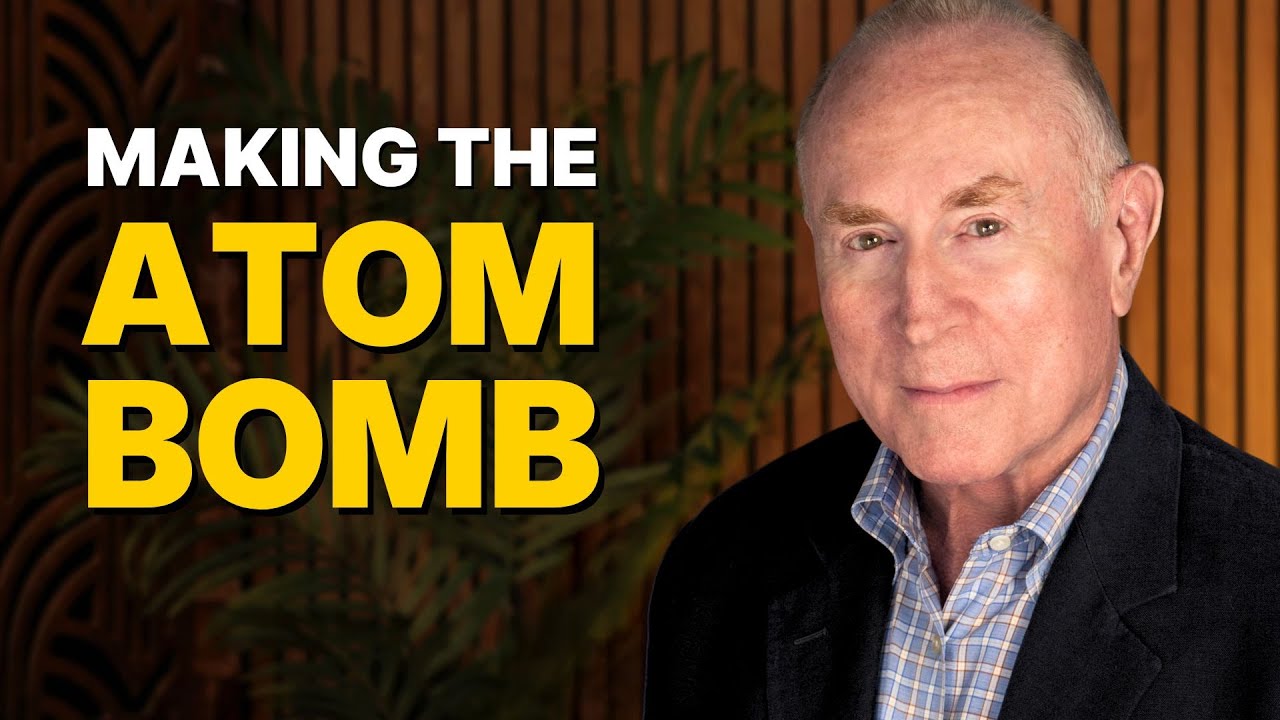
Richard Rhodes, Pulitzer Prize-winning author of The Making of the Atomic Bomb, discusses the history of nuclear weapons, the Oppenheimer film, and the broader implications of nuclear technology. The conversation spans the scientific origins of the bomb, the moral and political dilemmas faced by its creators, the Cold War arms race, and parallels to modern challenges like AI and bioweapons.
The Oppenheimer Film and Oppenheimer’s Legacy
The upcoming Oppenheimer film has a strong physical resemblance in its lead actor, who captures Oppenheimer’s rail-thin frame and intense presence.
Oppenheimer was a communist sympathizer in the 1930s, primarily motivated by helping Jews escape Nazi Germany, not ideological commitment. He found Marx’s writings logically weak.
He lied to security officials during WWII not to hide his own espionage but to protect his brother Frank, a Communist Party member whose involvement would have led to his removal from the war effort.
There is no evidence Oppenheimer leaked information to the Soviets; he was deeply committed to the Allied cause.
Was the Bomb Inevitable?
Even without WWII, the bomb would likely have been developed due to the sheer scale of energy released by nuclear fission and the strategic imperative it created.
The discovery of fission in Nazi Germany in 1938 created urgent fear that Hitler might get the bomb first, accelerating the U.S. and British programs.
Two refugee physicists in England calculated in 1940 that only about 125 pounds of uranium-235 were needed for a bomb—far less than previously assumed—and that building a separation plant would cost no more than a battleship.
They also introduced the concept of deterrence: the only defense against such a bomb would be possessing one yourself.
Multiple countries—including the USSR, France, Japan, and the UK—began exploring nuclear weapons soon after fission was announced, suggesting global development was inevitable.
Why Scientists Continued After the Nazi Threat Faded
By 1944, it was clear Germany was not close to building a bomb, yet almost no scientists quit the Manhattan Project.
Only Joseph Rotblat left upon Germany’s defeat; others stayed because the work had become a “spiritual quest”—pure science with world-historical stakes.
Physicists like Victor Weisskopf saw the bomb as both a dark weapon and a potential path to ending all large-scale war through mutual deterrence.
The sheer intellectual challenge and momentum of the project kept scientists engaged even after the original justification faded.
Firebombing vs. Nuclear Weapons: A Spectrum, Not a Category
Rhodes argues that atomic bombs are part of an escalating gradient of destructive firebombing, not a fundamentally different category—until the hydrogen bomb.
The firebombing of Tokyo, Hamburg, and Dresden killed as many or more people than Hiroshima and Nagasaki, using tens of thousands of small incendiary bombs.
The atomic bomb’s novelty was delivering comparable destruction with a single plane and one bomb, not a new kind of destruction.
Early nuclear weapons were essentially firebombs: their primary effect was igniting mass fires, not blast or radiation.
Military planners after the war underestimated nuclear weapons because they only calculated blast effects, ignoring fire—leading to massive overkill in targeting (e.g., 60 warheads on Moscow).
The Hydrogen Bomb: A Qualitative Leap
The hydrogen bomb represents a true category break: it can be made arbitrarily large, with yields thousands of times greater than fission bombs.
The Soviet Tsar Bomba (56 megatons) had a fireball over five miles wide; Edward Teller calculated a 1,000-megaton bomb would waste energy by blowing into space.
Oppenheimer opposed the H-bomb on moral and strategic grounds, stating he would not have used it on Hiroshima because “the target was too small.”
The U.S. pursuit of the H-bomb was driven by Air Force budget competition and Cold War one-upmanship, not military necessity.
Deterrence, Arms Races, and Bureaucratic Incentives
The U.S. nuclear arsenal ballooned not because of strategic need but because each military branch wanted a share of the budget tied to nuclear delivery systems.
The Air Force cornered 47% of the defense budget by the 1950s by claiming only it could deliver nuclear weapons.
The Army developed tactical nuclear weapons (including a shoulder-fired rifle), and the Navy built nuclear submarines—creating the “triad” more for institutional reasons than security.
One nuclear submarine with MIRVed warheads could destroy all of Europe or the Soviet Union, making much of the arsenal redundant.
Soviet Bomb Development and Espionage
The Soviets developed their bomb faster than expected, partly due to espionage (e.g., Klaus Fuchs), but also because they had first-class physicists.
By 1947, Soviet scientists had designed a bomb half the weight and twice the yield of the U.S. Fat Man.
Lavrentiy Beria, head of the NKVD, demanded they copy the proven American design rather than risk failure with their own.
Despite having spies, the Soviets could have built the bomb independently within a few years.
Secrecy, Proliferation, and the Real Barrier to Bombs
The real bottleneck in nuclear weapons is not design but obtaining fissile material (highly enriched uranium or plutonium).
A crude nuclear explosion can be achieved simply by bringing two subcritical masses together—no precision engineering required.
The U.S. emphasized the complexity of Los Alamos to obscure the fact that the true secret is material production.
Natural reactors existed in Gabon two billion years ago when uranium-235 concentrations were higher—showing how lucky we are that raw ore isn’t weapons-grade today.
Postwar Missed Opportunities and the Failure of International Control
The Acheson-Lilienthal Plan (1946) proposed international control: all nuclear facilities would be open to surprise inspections, and any attempt to build bombs would trigger collective response.
It was undermined when Bernard Baruch added a requirement that the U.S. retain its monopoly until others complied—ensuring Soviet rejection.
The plan’s core idea—an “open world” where secrecy is eliminated—was sound but politically unworkable at the time.
Today, satellite and sensor surveillance make such a system technically feasible, but the world is now awash in weapons.
Non-Proliferation: Success and Fragility
The Nuclear Non-Proliferation Treaty (1968) succeeded in limiting the number of nuclear states to nine.
Many countries (Sweden, Japan, South Korea) had the technical ability but chose not to build bombs, often after realizing nuclear weapons made them bigger targets.
The treaty offered civilian nuclear energy in exchange for forgoing weapons, and nuclear powers promised disarmament—a promise never fulfilled.
The treaty nearly collapsed in 1995 when non-nuclear states considered abrogation due to lack of disarmament progress.
Diplomat Tom Graham spent two years convincing countries to extend it indefinitely, contingent on renewed disarmament efforts.
New Threats: Tactical Nuclear Use and Eroded Taboos
Putin’s doctrine—using nuclear threats to backstop conventional war—is a dangerous new form of deterrence.
Unlike Cold War deterrence (don’t attack or we’ll retaliate), this approach risks escalation during active conflict.
India and Pakistan’s 1999 border war showed that nuclear powers can fight conventional wars under a nuclear umbrella—a model now adopted by Russia.
Rhodes finds this shift terrifying: it lowers the threshold for nuclear use and increases the risk of miscalculation.
Bioweapons and Other Hidden Threats
Rhodes is less worried about bioweapons because nature has already evolved the most lethal pathogens; lab-engineered improvements are unlikely to surpass them.
However, the Soviet Union secretly maintained a bioweapons program even after agreeing to eradicate smallpox, planning to use the disease as a weapon while keeping its own population vaccinated.
This underscores the danger of hidden state programs, even in areas where natural threats dominate.
Oppenheimer as Lab Director
Despite personal flaws—condescension, insecurity, superficiality—Oppenheimer was an exceptional lab director during the war.
He understood all aspects of the project (physics, chemistry, metallurgy) and could explain them clearly to General Groves.
He insisted on ending compartmentalization among scientists, arguing that progress required open exchange—a principle he called “gift exchange.”
Hans Bethe noted that Oppenheimer was cruel before and after the war but wise and restrained during it, focusing collective genius on the task.
The Unintended Consequence: War Becomes Obsolete
The bomb was expected to aggrandize national power but instead placed limits on it.
Since 1945, annual war deaths have dropped from millions to 1–2 million, despite population growth.
Large-scale war between nuclear powers has become historically impossible—not because of morality, but because of mutual vulnerability.
This shift was driven not by politicians but by scientists exploring fundamental physics.
The dark side: peace is maintained only under a “sword of Damocles”—the constant threat of annihilation.
AI and the Manhattan Project Analogy
Rhodes sees parallels between the Manhattan Project and AI: both involve small groups recognizing transformative potential early, followed by rapid scaling.
Key figures like Ilya Sutskever (OpenAI) resemble Leo Szilard—seeing the chain reaction before others.
However, the Manhattan Project was mostly engineering with known physics; AI involves more fundamental uncertainty.
The analogy is useful but imperfect: AI lacks the clear endpoint of a working bomb.
Secrecy and What Remains Hidden
Most nuclear secrets have emerged over time; Rhodes learned recently that early H-bombs were dumbbell-shaped, a fact confirmed by North Korea’s public display.
He obtained classified dimensions of the Fat Man bomb from a KGB-published journal but chose not to publish them, respecting non-proliferation norms.
The biggest secret that remains is not how to build a bomb, but how difficult it is to produce the material—and that barrier is eroding.
The Future: Will a Nuclear Weapon Be Used in Anger?
Rhodes estimates a greater than 10% chance of a nuclear weapon being used in anger within the next 500 years.
Even a “small” regional war (e.g., India-Pakistan exchanging 50 Hiroshima-sized bombs) could cause nuclear winter, killing up to two billion people through global crop failure.
As long as any country possesses nuclear weapons, the risk remains.
The solution is not better weapons governance but elimination—returning the ore to the ground.
Humanity is in a long transition; solving global warming may teach the cooperation needed to abolish nuclear weapons.