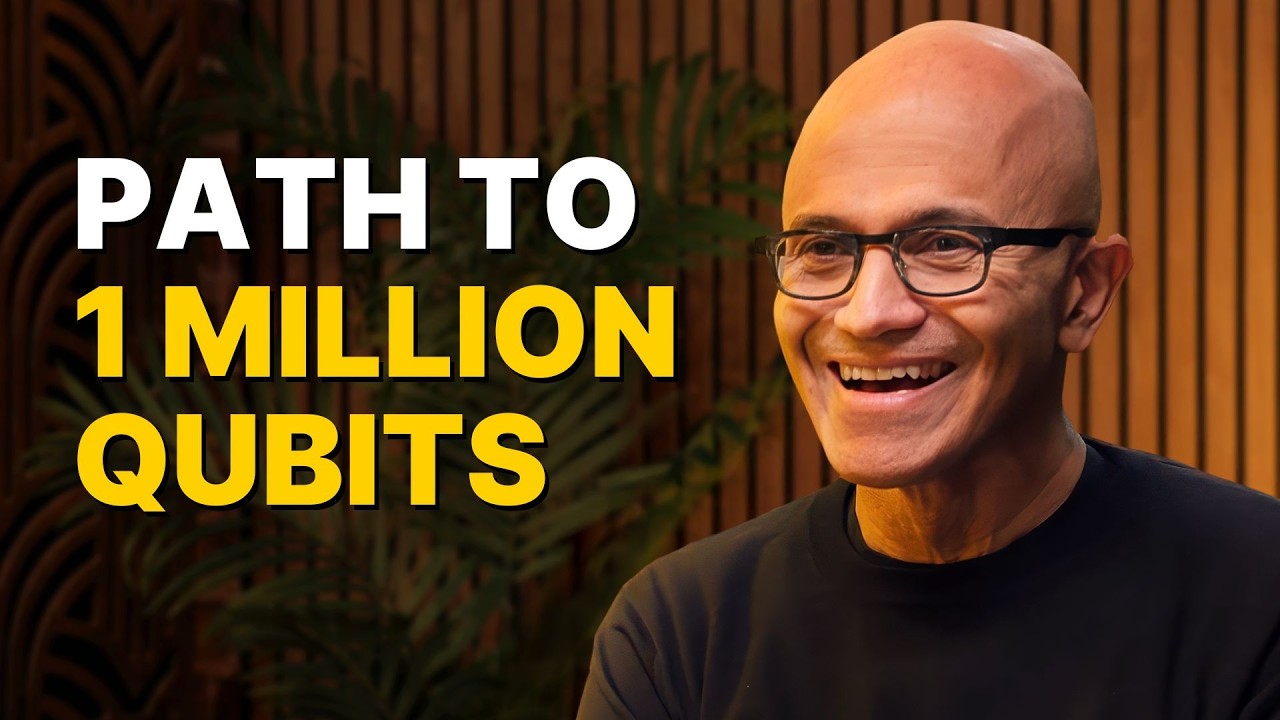
Satya Nadella on Microsoft’s full-stack AI and quantum bets, the future of economic growth, and why he doesn’t believe in AGI
In this conversation, Microsoft CEO Satya Nadella discusses two breakthroughs announced the same day in Nature: a topological qubit based on Majorana zero modes and Muse, a world-action model for game generation. He explains why he frames AI’s success in terms of GDP growth rather than AGI milestones, how Microsoft thinks about hyperscale compute, quantum timelines, the future of knowledge work, and the legal and social constraints on deploying powerful AI. He also reflects on his 34 years at Microsoft, the company’s ability to stay relevant, and what domains he would tackle if he were starting a company today.
AI won’t be winner-take-all
Hyperscalers are the most structurally advantaged layer
If intelligence scales with compute, whoever can deploy the most compute wins. AI workloads are uniquely hungry for infrastructure, not just for training but increasingly for test-time compute and agentic inference, where one human invokes programs that invoke many more programs.
This creates exponential demand for compute infrastructure, making the hyperscale cloud business (Azure and peers) a major beneficiary.
Buyers in enterprise and IT departments will always demand multiple suppliers. Nadella learned this competing against Oracle and IBM in client-server, and again when investors told him Azure could never catch Amazon.
Consumer markets can exhibit winner-take-all dynamics (ChatGPT’s app store position is an example), but enterprise will have multiple winners by category.
Open source acts as a governor on model concentration
Just as Linux complemented Windows, open-source models will ensure that closed-source model providers cannot fully monopolize the market.
States and governments will also not sit idle if AI becomes as powerful as expected, adding another check on private monopoly.
Models are not commodities at scale
Nadella pushes back on the analogy that models will become like cloud compute, a low-margin commodity. At scale, the know-how of running a global fleet across 60+ regions, with storage, compute, and AI accelerators co-located, is extremely hard to duplicate.
The nexus of model plus state (storage, compute, agent environments) means a single model running away with everything is unlikely.
Hyperscaler advantage in training and inference
A hyperscaler can amortize GPUs and data centers across both training and inference. As inference-time scaling becomes part of training future models, this dual-use advantage grows.
Microsoft designs its fleet for high utilization across large training jobs, test-time compute, RL-specialized distillation, and globally distributed inference serving.
World economy growing by 10%
Nadella’s real benchmark: 10% global GDP growth
He is skeptical of AGI milestone claims, calling them “benchmark hacking.” The real test of AI’s impact is whether the developed world, which has been growing at roughly 2% (near zero inflation-adjusted), can sustain 5–7% real growth, with the world economy growing at 10%.
The biggest winners will not be tech companies but the broader industries whose productivity increases because intelligence becomes an abundant commodity.
Supply must map to demand
Nadella tracks inference revenue as a governor: capital invested in training must translate into real customer demand for inference. Without that, the supply-side build-out risks going “off the rails.”
He expects overbuild in compute, especially as countries and companies race to deploy capital, which he sees as beneficial because it will drive prices down.
Jevons’ Paradox and the price of intelligence
When the cost of intelligence drops, demand expands. Nadella cites the example of cloud in India: SQL Server sold modestly on-premises, but cloud adoption was far larger because it was cheaper and metered.
He argues that making tokens cheap enough for use cases in healthcare and the Global South would be transformative, even if consumer use in rich countries already feels cheap.
Deployment speed and change management
The bottleneck is not just technical capability but process change. Nadella compares AI’s introduction to knowledge work with the shift from fax-and-memo forecasting to shared Excel spreadsheets via email: the work artifact and workflow changed entirely.
He frames AI as “Lean for knowledge work,” a methodology of continuous improvement that reduces waste and increases value, but one that requires time for management teams and individuals to adopt.
Decreasing price of intelligence
New workflows and the agent manager
Nadella describes his own workflow: he uses Copilot to prep for meetings, asking it to summarize relevant documents, even requesting the output in podcast format, then shares the artifact with his team.
He anticipates a new scaffolding he calls the “agent manager,” a layer above chat interfaces that handles exceptions, notifications, and instructions across millions of agents.
Each knowledge worker will manage many agents, and the UI for that management is a critical product surface.
Microsoft’s quantum breakthrough
30-year journey to a physics-first qubit
Microsoft’s quantum effort, spanning three CEOs, bet on a physics breakthrough rather than incremental improvements to existing qubit types. The approach centers on Majorana zero modes, theorized in the 1930s, which allow quantum information to be stored in a topologically protected phase of matter, making it inherently less noisy.
The breakthrough, published in Nature, is the reliable fabrication of Majorana zero modes in a new topological phase. Nadella compares it to the transistor moment for quantum computing.
Majorana One: from one gate to a million-qubit chip
The first chip, Majorana One, is designed to scale to one million physical qubits on a single chip, enabling thousands of error-corrected logical qubits.
Other companies (Google, IBM) have announced ~100 physical qubits using different approaches. Microsoft’s topological qubit is at an earlier stage (one gate demonstrated) but is designed for far greater scalability.
Timeline: fault-tolerant quantum computer by 2027–2029
With the fabrication technique now demonstrated, the next step is integrating gates into circuits and building a fault-tolerant quantum computer. Nadella estimates this could happen around 2027–2029.
The first use of a quantum computer would be to accelerate the design of better quantum computers, by simulating atom-by-atom construction of quantum gates.
Quantum plus AI: a combined stack
Microsoft’s software stack is already being built for neutral atom and ion trap quantum computers (24 logical qubits demonstrated), alongside HPC and AI.
Quantum excels at data-light, exploration-heavy problems with exponential state spaces: chemistry, physics, biology. AI can serve as an emulator trained on quantum-generated synthetic data, creating a feedback loop between the two.
Quantum will not replace classical computing but will augment it for simulation-heavy tasks.
Microsoft’s gaming world model
Muse: a world-action model for games
Muse, published in Nature, is trained on gameplay data and can generate game environments that are consistent, diverse, and responsive to user input in real time. A demo showed an Xbox controller input generating coherent game output.
Nadella compares the moment to the first time ChatGPT completed sentences or Dall-E drew images: a qualitative leap that signals a new capability.
Gaming data as a general world model
Microsoft Gaming’s catalog of studios and IP represents a massive dataset of human action in virtual worlds. Nadella likens gaming data’s role for Microsoft to YouTube’s role for Google.
The model is not just useful for games but as a general action and world model, with potential applications beyond gaming.
Gaming as an end, not a means
Nadella emphasizes that Microsoft invests in gaming for gaming’s sake, not merely as a data source. Flight Simulator predates Windows at the company. Cloud gaming and AI are natural extensions that expand the total addressable market.
He sees AI’s role in gaming as analogous to CGI: a transformative tool, but one that still requires great games as the foundation.
Three bets: AI, quantum, and mixed reality
Nadella’s three foundational bets
He identified AI, quantum, and mixed reality as the three big bets several years ago, and still believes in all three.
Mixed reality aims to create true presence. It has proven harder than expected, partly due to social factors (wearing headsets). Microsoft is pursuing it through the Anduril partnership and the IVAS military program, as well as through 2D surfaces like Teams.
AI represents the business logic breakthrough (learning systems instead of imperative code), quantum the systems breakthrough, and mixed reality the UI breakthrough (presence).
Why these three converged now
Nadella frames them as answering three fundamental questions: Can we build a new kind of system (quantum)? Can we reason about business logic differently (AI)? Can we create real presence (mixed reality)?
Legal and social barriers to AI
Trust and legal infrastructure as the binding constraint
Nadella argues that the biggest rate limiter on AI deployment is not technical capability but the evolution of legal infrastructure. The world is built on humans owning property, having rights, and being liable. Until legal frameworks address delegation of authority to AI, deployment will be constrained.
He believes no society will tolerate harm caused by an AI without a human being liable. Deployment will require someone to indemnify the system.
Rogue actors and global governance
He acknowledges rogue actors and states exist but argues the world order already has mechanisms for dealing with them, and societies broadly will not tolerate uncontrolled AI.
Return on labor as a social precondition
Drawing on economists like David Autor, Nadella notes that democracies require a return on labor, not just capital. If 60% of the economy is labor income, the social structure requires that labor be revalued, not eliminated.
He expects new forms of valued human labor to emerge, even as today’s high-value cognitive tasks become commoditized.
Alignment and observability in deployment
Microsoft allocates compute specifically to alignment research and builds runtime environments with strong observability, drawing on classical software engineering practices like monitoring for cyber attacks and fault injections.
Nadella emphasizes sandboxing and controlling the action space: ensuring code generated by agents is ephemeral and does not “spring out into the world.”
He is cautious about physical embodiment and about agents operating for extended periods without human oversight.
AI and the future of Microsoft’s product suite
Office as the UI layer for knowledge work
Nadella sees Office not as today’s applications but as the evolving UI layer for knowledge work. As workflows change, the canvases (documents, spreadsheets, presentations) will be populated and orchestrated by LLMs.
A doctor preparing for a tumor board uses Copilot to create an agenda from SharePoint cases, has Copilot transcribe the meeting into a structured database entry, and then generates a PowerPoint deck from the meeting for teaching. The workflow is fundamentally reshaped.
SaaS industry transformation
He argues that today’s CRUD-based SaaS applications will be fundamentally changed as business logic moves into the agentic tier. Code generation plus agents interrogating SaaS applications will create an explosion of vertical-specific agents.
SaaS companies that survive will “up-stack” from narrow browser-based processes to participating as agents in a multi-agent world.
Will LLMs commoditize Office?
Nadella’s view is that LLMs will make Office more valuable by using its canvases and data (via Microsoft Graph, CRM systems) as the scaffolding for agent-mediated workflows, rather than replacing them.
34 years at Microsoft and the sixth CEO
Longevity through relevance, not franchise value
In Microsoft’s 50th year, Nadella frames the goal as relevance, not longevity. In tech, there is no franchise value; the entire R&D budget is a bet on what will matter in five years.
He emphasizes a culture of “refounding,” borrowing Reed Hoffman’s term: the ability to see the company’s core assumptions fresh every day and give oneself permission to change them.
Retaining future leaders
He thinks about creating an environment where people can use Microsoft as a platform for economic return and mission-driven purpose, so that future leaders emerge organically from within.
If he left Microsoft
Nadella says he will never leave, but if he were to start something, he would focus on domains where AI’s abundance could serve the underserved: healthcare, education, and the public sector.
Does Satya Nadella believe in AGI?
He rejects the framing of AGI as a static target
Nadella argues that cognitive labor is not a fixed category. Automating today’s cognitive labor (like email triage) will create new, higher-level cognitive tasks. There is always a “next thing.”
He distinguishes between knowledge work (which can be automated) and knowledge workers (who will shift to new abstractions).
Humans and cognitive machines coexisting
He questions the assumption that all cognitive labor will disappear, pointing out that “cognitive labor” as a category is only about 200 years old. Powerful cognitive machines can exist alongside human cognitive agency.
AI on the board of directors
He is open to AI as a facilitator agent in board meetings, using long-term memory and context to keep discussions focused, effectively amplifying the bounded rationality of human board members.
250 years of chemistry in 25 years
Nadella has said he wants the next 250 years of progress in chemistry and materials science to happen in the next 25 years, enabled by quantum computing and AI. This would mean reinventing the carbon-based industrial system, discovering new materials, and addressing planetary challenges, with interplanetary travel as a longer-term aspiration.