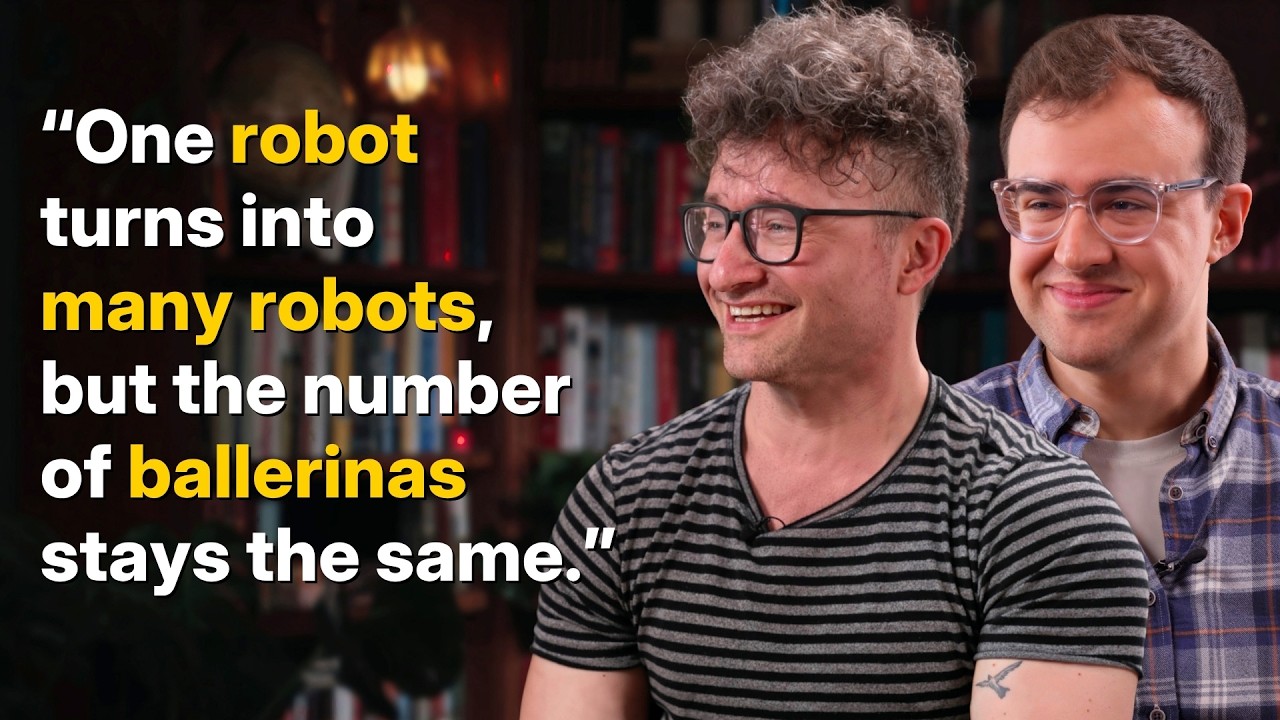
- This episode features a conversation between Alex Imas (Director of AGI Economics at Google DeepMind, Professor at University of Chicago) and Phil Trammell (Head of Economics at Epoch, Stanford research scholar) about what economics can tell us in a world of increasing AI automation. The central questions are: what happens to wages and labor share, how to tax and redistribute AI-generated wealth, and—most fundamentally—what will remain scarce, since scarcity determines where value accrues.
What will be scarce after AGI?
-
The relational sector is one candidate: goods and services where the fact that a human is in the loop is itself part of the value. Examples include a ballerina’s performance or a barista making coffee—people derive value specifically from the human involvement, not just the output.
- This only works if humans are not like horses—i.e., if the human is not merely an input into an output where you only care about the output. If you can replace the human without the value dropping, the relational sector doesn’t hold.
- Experimental evidence (from Imas’s research) suggests people do pay more for human-made art prints than AI-made ones, but only when the item is unique (suggesting a connection with the artist). When 500 copies are produced, the premium disappears for human-made prints but not for AI ones, which are already viewed as commodities.
- The critical unknown is how strong and widespread this preference is across jobs and sectors. There is essentially no data on willingness-to-pay for human involvement in different tasks. Conjoint analyses are needed to measure demand elasticity for human-in-the-loop services.
-
The human economy may shrink relative to the machine economy. If robots can do everything physically and intellectually, the “machine-only economy” becomes a closed loop—machines building factories, doing research, producing goods—while humans participate in a separate “human economy” of services for each other. But humans also want goods from the machine economy, so wealth flows out of the human loop. Unless human-intrinsic demand is extremely strong, the human economy could become a vanishingly small share.
-
Historical analogy (Mongolian economist in 1400): If you asked someone in 1400 what would be scarce after more automation, they might have predicted that spending would shift entirely to intrinsically human goods like singers. Instead, as wealth grew, the variety of non-human goods expanded enormously, and the share spent on singers stayed negligible. The lesson: increasing variety in capital-produced goods can prevent satiation and keep labor share low.
-
Moore’s law as diminishing marginal value of compute: One way to interpret Moore’s law is that the value of the marginal transistor halves every 18 months—we run out of uses for computation so fast that prices fall even as supply explodes. But this may be changing: H100 rental costs are higher now than three years ago despite better technology, because smarter models raise the opportunity cost of compute. If demand for new AI-driven varieties keeps growing fast enough, compute’s share of the economy could keep increasing.
The lump-of-labor fallacy and why forecasting is hard
-
David Ricardo’s mistake: During the Industrial Revolution, Ricardo correctly predicted that specific jobs would be automated, but incorrectly predicted mass unemployment. He missed structural change: automation made goods cheaper, people spent more on services, and new jobs were created. The prime-age employment rate in 2026 is near its highest ever.
- This doesn’t guarantee the same outcome with AI—it’s used to illustrate how hard forecasting is, not to make a prediction.
-
Economists should map scenarios, not make point forecasts. There is enormous disagreement among economists about AI’s labor market effects. Instead of individual forecasts, the speakers advocate prediction markets for aggregate forecasts. The useful exercise is to write down models of what could make labor share go to zero, stay constant, or collapse—and then identify what data would distinguish these scenarios.
-
We lack essential data. Consumer demand elasticities are poorly measured. Job creation/destruction tracking is weak (the O*NET database is rarely updated and low quality). Without this data, any forecast is largely speculation.
Labor share and capital share: the Kaldor fact and its potential breakdown
-
Labor share is the portion of total economic output paid out as wages; capital share goes to owners of machines, land, and company equity. For centuries, roughly 60% has gone to labor and 30-40% to capital—a remarkably stable “Kaldor fact.”
- Some argue labor share has fallen in recent decades, but accounting changes (e.g., how intellectual property is counted) may explain much of this. If accounting methods are held constant, labor share may not have fallen at all.
-
Why has labor share been so stable? Labor and capital are often complements—you need both to produce anything. Even when a final step is automated, labor adds significant value down the supply chain (e.g., in producing the machines that do the automating). Computer and electronic products have a network-adjusted capital share of only about 50%, not 100%.
-
A qualitative shift may be coming. For the first time, some goods could have a network-adjusted capital share approaching 1—the entire supply chain automated with no part where humans are intrinsically valued. The implications for overall labor share are ambiguous:
- If we satiate quickly in automated goods (marginal utility falls faster than quantity rises), spending shifts to human-intrinsic goods and labor share stays high.
- If variety in capital-produced goods keeps expanding (new drugs, new software, new products), we may never satiate, and labor share could go to zero even though relational goods are available.
The “Messy Middle” scenario
-
The scenario: AI automates many jobs, causing unemployment and political disruption, but doesn’t create enough wealth during the transition to make everyone better off—no Pareto improvement. This is the “Messy Middle” described by Molly Kinder.
-
Why it seems unlikely (narrow window of conditions required):
- AI would need to automate jobs only piecemeal (e.g., software engineers but not accountants), which is implausible if the underlying intelligence is general.
- AI would need to be only slightly cheaper than the humans it replaces, generating minimal savings. More likely, AI is substantially cheaper, creating large potential savings.
- The technological frontier would need to barely expand. Historically, major automation has always expanded the frontier significantly.
- Even if the pie doesn’t grow much, the savings from automation are real resources that can be redistributed. The problem is allocative inefficiency and political feasibility, not literal impossibility.
-
The political economy concern: A slow “drip” of job losses (like phone operators between 1920-1940, who were reabsorbed at lower wages over 20 years) may be worse than a sudden shock. A sudden 2-3% unemployment spike triggers emergency fiscal response (as with COVID). A slow drip doesn’t trigger the same urgency, and people gradually move into lower-paying, underemployed roles.
How to tax and redistribute AI wealth
-
Negative income tax: Immediately provides a floor—everyone gets a baseline, taxed more if they earn more. Pro: immediate insurance. Con: politically vulnerable (a future government could eliminate it when people can’t fall back on labor income).
-
Universal basic income (UBI): Similar to negative income tax but flat. Con: creates dependency on government checks; whoever controls power controls people’s basic needs—a dangerous power-sharing arrangement.
-
Universal basic capital: Give everyone an ownership share in AI companies (e.g., government buys shares of Anthropic and distributes them). Pro: property rights, not dependency. Con: indexing problem—which companies do you buy? If Anthropic goes to zero and a robotics company takes over, the portfolio fails. This is the central challenge.
-
Wealth tax: Risk of escalation (like the income tax, which started low and rose to 40-50%). Could distort investment if people expect ever-higher taxes on capital.
-
Consumption tax (VAT-style): Government taxes consumption, uses revenue to buy stocks, distributes them. Similar to universal basic capital but with a different revenue mechanism. David Autor has proposed something related.
-
Key insight: Separate the question of how revenue is raised (what’s taxed) from how it’s distributed. The distribution mechanism (shares vs. checks) matters as much as the tax instrument.
Why demand collapse and negative growth are unlikely
-
The Citrini scenario: White-collar workers get automated, their spending disappears, and the economy enters recession due to demand collapse.
-
Why this requires implausible conditions:
- Demand would need to be hard-bounded—the rich would need to eventually say “I’ve had enough” and stop spending or investing.
- Even with AGI, the economy would need to stop investing in data centers, fabs, etc.—which is absurd when the technological frontier is expanding rapidly.
- Historically, depressions involved no frontier expansion. Here, there would be abundance. For abundance to produce negative growth is extremely difficult.
-
Jevons paradox and elasticity of demand: When something gets cheaper, total spending on it only increases if demand is highly elastic. This was true for coal in Britain. It’s not true for everything (oil, insulin). The question for software/AI is whether demand is elastic enough that cheaper AI leads to massively more spending on AI-driven goods and services.
-
Current evidence: There is no sign of a white-collar bloodbath. The Yale Budget Lab finds essentially nothing happening across the economy. Junior developer hiring may be slightly below trend, but senior software engineer demand is up. Anecdotal claims of AI-driven unemployment may reflect normal layoffs being reframed as AI narratives, or firms laying off workers to signal AI adoption (a dangerous coordination cascade).
Why there isn’t more automation already—and why that will flip
-
O-ring theory (reliability): The Challenger shuttle exploded because one component failed. Similarly, production requires every task to be reliable. Current AI may automate 9/10 tasks in a job but can’t guarantee the reliability needed for the final product. This limits automation today.
-
The flip side: Once AI is advanced enough, integrating humans into AI-organized production flows becomes the problem. AIs may think thousands of times faster, communicate in “neuralese,” and operate at quality/speed levels humans can’t match. Even if a human has comparative advantage in some task, the transaction costs and reliability concerns of integrating them may make it not worth it.
-
Regulatory and institutional frictions keep humans in the loop: Licensing, liability, the need for someone to fire/hire, legal accountability—these currently require humans. But these are transitional. Throughout history, what we expect from humans politically has changed repeatedly (hunter-gatherer bands to empires). If AI-run systems are more efficient, they may out-compete.
Non-human preferences and the future of demand
-
AIs and firms as future preference-holders: Evolution selected humans for specific drives (empathy, social connection). Future AIs or AI-integrated firms will be selected for different traits—likely growth and resource accumulation. An AI with its own welfare would have no intrinsic reason to prefer human interaction.
-
Selection for non-satiation: Agents that don’t satiate in capital (that always want more—to explore the universe, build more data centers, accumulate influence) will have higher savings rates and, over time, accumulate most of the wealth. Even a few such agents could dominate the economy’s direction because their wealth grows faster than everyone else’s.
-
Current examples: Elon Musk invests in mass drivers on the moon. The wealthiest humans already behave as if they don’t satiate—they reinvest rather than consume. Mark Zuckerberg could liquidate Meta stock to consume, but instead lets it compound.
-
Dissipation shocks: Historically, wealth dissipates because heirs squander it or foundations spend it. But if people live forever or align trusts to accumulation, this changes. A small number of immortal, non-satiating agents could dominate.
-
-
Instrumental reasons for accumulation: Even without intrinsic greed, people accumulate wealth for political, philosophical, or religious influence (an arms race over what society believes). Total utilitarian philanthropy also motivates accumulation—creating new happy beings (e.g., via Dyson spheres and simulations) is a form of consumption that doesn’t satiate.
-
Von Neumann probes as pure capital accumulation: A self-replicating probe that colonizes star systems has high marginal value for each new solar system (it becomes more probes). If such entities exist and we count them in GDP, labor share could be low. But GDP only counts final consumption and investment goods—it’s unclear how such probes would be accounted for.
-
Will returns to capital stay high? If growth is explosive, returns to capital stay high (investing in data centers earns 30%+), and non-satiating agents keep accumulating. If growth slows, returns fall, the rich consume more, and labor share could rise. The price of capital goods relative to consumption goods is falling (investment-specific technical change), which complicates the picture—one robot now becomes many robots next year, but robots are also getting cheaper.
What should developing countries do?
-
The core dilemma: Developing countries (India, Nigeria, etc.) are not in the AI production chain (not making models, hardware, chips, or lithography equipment). There are two scenarios:
- AI technology diffuses quickly (open models are only 6-9 months behind frontier), leveling the playing field.
- AI concentrates in a few countries/companies, and developing countries get left behind—especially since automation means developed countries can produce commodities domestically, reducing the need for developing-country labor and markets.
-
Indexing is the priority, not retraining. The best strategy for a developing country is to buy the index of AI—invest broadly in AI companies so the population shares in the gains. Retraining programs are secondary and may not work for countries with weak education systems.
-
The indexing problem is real: Most wealth in the global economy is already public (under 20% of US market cap is in private companies). But returns are increasingly concentrated in private companies. Nigeria doesn’t own much SK Hynix or Anthropic. Index funds only became widely available recently, and the window for easy indexing may be narrowing.
-
Open models are crucial: If open models stay close to the frontier, every company can leverage AI, and buying the S&P 500 effectively indexes AI gains. If frontier models stay proprietary and concentrated, indexing is much harder.
-
-
AI as electricity vs. AI as social media:
- Electricity transformed every industry but the rents went to users, not the utility companies. ConEd isn’t politically powerful.
- Social media is everywhere but the rents went to the platforms (Meta, Google).
- If AI is like electricity (broad transformation, diffuse gains), prosperity is widely shared. If it’s like social media (concentrated rents), inequality worsens.
-
Leapfrogging is possible: Developing countries have leapfrogged before (mobile banking is more prevalent in Nigeria than Germany). AI could enable similar jumps.
-
Safety trade-off with commodification: Commodified frontier AI diffuses benefits broadly but also diffuses harmful capabilities and creates competitive race dynamics that may reduce safety. Concentrated labs are safer (fewer actors to coordinate) but create wealth concentration and become political targets (e.g., the Defense Production Act threat against Anthropic). The speakers increasingly think the benefits of commodification outweigh the risks.
The relational sector and human preferences—will they persist?
-
Evolutionary argument for persistence: People with strong preferences for human connection (empathy, trust, moral emotions against offloading social interaction to AI) may have reproductive advantages. Even if AI therapists seem superior now, selection could strengthen human-to-human preferences over time.
-
Counter-argument: Preferences may shift as technology normalizes. Future generations may see AI therapists as superior products and not need human empathy in the same way. This is an open empirical question.
-
The relational sector’s size depends on data we don’t have: We need conjoint analyses measuring willingness-to-pay for human involvement across different tasks and sectors. Without this, we can’t predict whether the relational sector will be economically significant or negligible.