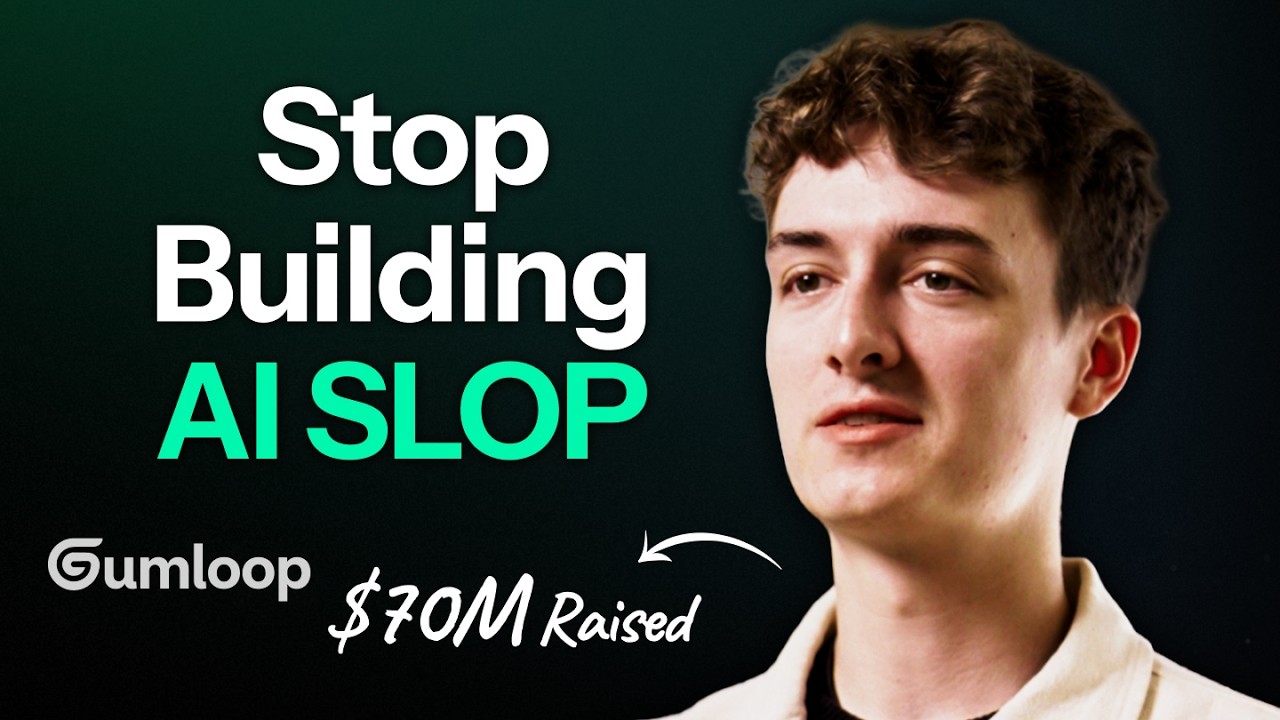
Max Brodeur is the founder and CEO of Gumloop, an automation platform that runs about 4 million workflows daily for companies like Instacart, Shopify, DoorDash, and Gusto. The company has a team of 15 and is growing fast. Gumloop lets non-technical people inside businesses, like marketers, salespeople, and ops staff, automate their own work without needing to hand specs to engineers. Max shares the unconventional path that led him to build Gumloop and the principles that guide how he runs the company.
Throw yourself into the ether
Max studied software engineering at McGill in Montreal, always aiming for a good job in big tech. He got one at Microsoft but hated it quickly and left after a short time.
He doesn’t think he learned anything at Microsoft that he uses now. The only real value was the resume credibility, a kind of default respect from people who see a big-tech logo.
Most of how he runs Gumloop is deliberately the opposite of how big tech works.
After quitting Microsoft, he moved back to Vancouver planning to build things in his bedroom for a year. Then he got deported from the US and banned for 5 years at the Canadian border, suspected of trying to overstay a 2-day visit to Seattle.
That moment forced him to take building a company seriously because he had no fallback plan. He spent the next six months working as hard as he could.
Prove yourself wrong
Max tried building many things in rapid succession: VR video game moderation software, trust and safety tooling, bot detection, an anti-scam platform. He’d get to MVP, try to sell it, and learn quickly it was a bad idea.
He learned that in startups you should be hunting for someone to tell you why your idea won’t work, not hoping someone tells you it will. Finding a strong reason it won’t work saves weeks or months.
If you can’t find a reason it won’t work, that’s when you might have something real.
The origin of Gumloop came from AutoGPT, a popular open-source agent framework. Max joined its Discord and saw people constantly asking basic questions: what is GitHub, how do I use the terminal, how do I install something locally.
He built a simple UI called AgentHub to solve the onboarding problem, thinking of it as a way to learn front-end development. He imagined it could become a GitHub for agents.
Within days he realized the agents themselves were unreliable, which was the real problem. People wanted predictability and reliability, not just agent frameworks.
He built a framework that let people chain simple automated steps together. It started for developers but the audience that went crazy for it was non-technical: business admins, ops people, HR people.
That realization, that 80% of the audience was non-technical, became the motivation to build something approachable and fun rather than complex.
During YC, Max was stuck in Canada (due to the US ban) working alone in a small studio apartment. The product was free for five months before the batch started.
They turned on pricing in the first week of YC at $20/month because they couldn’t imagine charging more than ChatGPT. Their first paying customer was a guy named Kai who paid $20. They freaked out over the Stripe notification. Kai is still a user.
Real networks aren’t built at cocktail parties
Max stayed in Vancouver during YC, coding in his room with none of the distractions of in-person events. He thinks the people building something amazing aren’t at networking events and random tech parties.
His co-founder almost never goes to events, to the point where most people haven’t met him because he’s always working.
The biggest lesson: stay focused, talk to users constantly, and your network emerges naturally.
Fundraising isn’t about going out to meet investors. If you build something exceptional, they come to you. You just have to show them you’ll succeed without them.
Great products aren’t built in one click
Max is critical of the anti-pattern he sees on Twitter where people claim to have 50 AI agents running their company or a C-suite of AI telling them what to do. He calls this a slot machine approach.
Most of those claims are marketing. People are lying about automating everything, working one hour a week, and making millions on weekends. It’s selling hope and skipping the hard work, which never actually works.
He calls these people “course Bros” who shill productivity dreams without offering anything novel. The people selling the course are the ones making money.
The right approach is keeping the human touch in important parts and automating repetitive things. The best users are super AI-enabled but not replacing their entire job with AI.
Max only automates things he deeply understands. If you automate something you don’t understand, you’re creating uncertainty and poor results.
He uses AI to speed himself up on things he already understands, so he can learn more and grow. He never uses AI to shortcut understanding.
He worries about a split forming: a smaller group of people who use AI as a learning tool, pausing to understand fundamentals and having AI teach them, will become exceptional. Everyone else will fall into what he calls “slop,” producing low-quality work without understanding why it works or what the knock-on effects are.
Hiring is like dating
Almost everyone at Gumloop was hired through their network. Many were customers first: someone from Instacart, someone from Webflow, someone from Shopify all quit their jobs to join.
These people already had conviction because they loved the platform enough to bet their careers on it. They’re already bought in, already see the vision, so onboarding is fast.
You can’t beg someone to join your company any more than you can beg someone to date you. You have to build something amazing with real traction so that the best people want to join you.
Max’s co-founder only joined because Max had a working early version of the product that excited him enough to come on board.
Max’s hiring filter is simple: does he want to spend all his time with this person, 24/7? This has compounded over time into a team that’s well-adjusted, fun, ambitious, and intelligent. The momentum builds because everyone is equally excited about the mission.
Nobody is told to stay late. There are no fixed hours. People just love what they’re doing.
The core mindset
Max thinks there are a million reasons not to start a startup. People who obsess over moats and why big companies will crush them never build anything. They end up as pawns at big players.
The people who try, who take risks and prove others wrong, end up somewhere surprising. When people ask how he got there, the answer is just that he tried, and when it didn’t work, he tried again.
He could have talked himself out of Gumloop on day one by listing reasons Zapier or OpenAI would crush them. Instead, they built something new that millions of people use.
The biggest quality that makes a founder start founding is blind confidence, the belief that you’re the person who can do it. Without that, you never start.