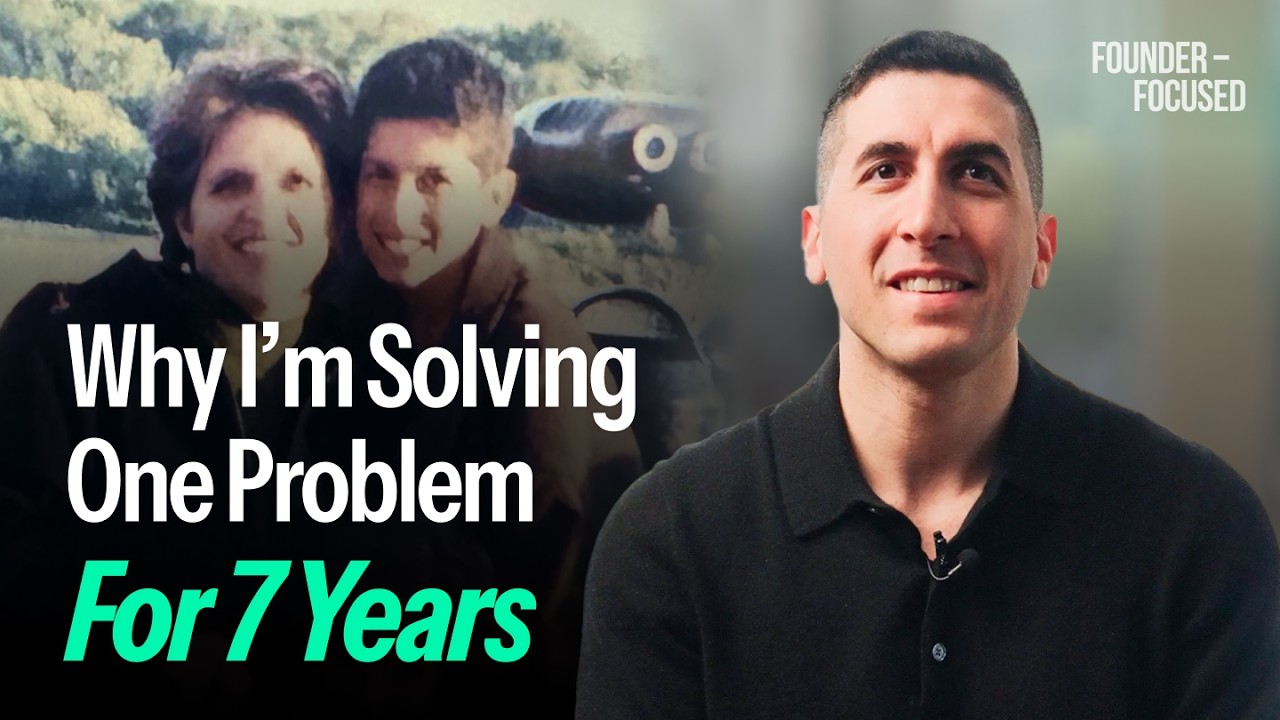
Purya Sarmadi, co-founder and CEO of MedMe Health, built a platform that powers operations, integrations, and automations for over 4,500 pharmacies across North America, transforming them from drug dispensaries into community healthcare hubs; his conviction for the market grew through four pivots, and the company’s breakthrough came when COVID forced pharmacies to become primary clinical care sites, scaling from ~100 to nearly 1,200 pharmacies in ten weeks.
Personal origin: a surgeon’s ripple effect and a child’s helplessness
At age 6–7, Sarmadi’s mother suffered heart valve failure; most surgeons were hesitant, but Dr. Tyrone David operated successfully, saving her life and creating a ripple effect on the entire family.
As a child, Sarmadi felt the helplessness of understanding the stakes but being unable to act; meeting Dr. David later cemented the realization that healthcare impact scales far beyond the individual patient.
He initially wanted to become a cardiovascular surgeon but realized his unsteady hand and sleep issues made that path impractical; he redirected his drive for scalable impact toward technology and data science.
The insight: pharmacies are underutilized, trusted, and everywhere
Growing up, Sarmadi noticed his mother always said the pharmacist knew her holistic treatment best, yet she couldn’t get basic diagnostic services (like INR monitoring for blood thinners) at the pharmacy.
95% of North Americans live within 5 miles of a pharmacy, making them the most accessible healthcare touchpoint, yet they were treated only as drug dispensaries.
This conviction — that pharmacies could be far more — became the fixed market thesis that survived every pivot.
Four pivots, same market: learning the difference between wrong wedge and wrong market
Pivot 1 (2018): Prescription scanning and automated data entry — real problem, but pre-LLM technology couldn’t deliver viable accuracy.
Pivot 2: Hardware device for drug adherence — high capital costs and hardware complexity forced a retreat.
Pivot 3: Software to give pharmacies capacity and tools for consultative clinical care — closest to today’s MedMe.
Pivot 4 (implicit): Narrowing to one problem, one solution, one ideal customer profile (ICP); the signal was when an Alberta pharmacist canceled four other subscriptions and said, “I’m just using MedMe.”
Key lesson: every pivot deepened understanding of pharmacies, pharmacists, and patients; the market was right, the wedge was wrong — don’t confuse the two.
COVID as proof and accelerant
When the pandemic hit, the continent-wide pharmacy network instantly had to deliver vaccines, point-of-care testing, and clinical services.
In 2.5 months, MedMe grew from ~100 to almost 1,200 pharmacies because the product already solved the exact workflow problem COVID created.
The crisis validated the thesis: pharmacies are the logical site for accessible clinical care, and software that unlocks their capacity is essential infrastructure.
The future of pharmacy: clinical services create enduring value
Online pharmacies have better unit economics and logistics for pure dispensing; drug margins are shrinking.
Simultaneously, primary care shortages and rising chronic illness drive demand for proactive, personalized, consumer-driven care.
Pharmacies investing in clinical services (flu shots, A1C checks, device consultations, INR monitoring) build lifetime patient relationships that pure logistics cannot replicate.
The human element — a trusted practitioner who knows your longitudinal history, preferences, and family — is irreplicable and makes pharmacies indispensable.
In Nova Scotia and expanding jurisdictions, patients like Sarmadi’s mother now get INR monitoring at the pharmacy via MedMe, avoiding ERs and diagnostic centers.
AI changes the toolkit, not the customer’s job to be done
AI lets founders solve a broader class of problems, but the customer’s jobs to be done remain the same.
Old industry playbooks may be obsolete, but the fundamental problems pharmacies and patients face persist; AI is an enabler, not a replacement for understanding the wedge.
Co-founder partnership: the candle principle
Sarmadi met Nick through the Next 36 accelerator; complementary skills, mutual respect, and shared interest in the problem space led to a 7-year partnership.
A critical failure: Sarmadi became overly critical, framing feedback as “you’re not capable” — nearly breaking Nick’s confidence and the partnership.
Blame is counterintuitive and destructive; it works against the organization and costs you your number one ally.
The candle principle: a co-founder’s motivation is a flame that burns bright in ups and dwindles in downs; your job is to keep both flames alight, because once extinguished, it’s nearly impossible to reignite.
Only your co-founder truly empathizes with the C-suite/founder experience; leaning on each other through trials is a core strength.
The 72-hour prototype that won the first enterprise customer
During COVID, an enterprise customer demanded a solution at scale; Nick pulled two all-nighters (72 hours non-stop) with Sarmadi to build a prototype.
Leadership loved the demo and asked when they could go live; the team had 6–8 weeks to make it production-ready.
That first enterprise customer built the trust and credibility to win subsequent ones.
The crucible confirmed Nick as the right partner: no matter the constraints, they survive and thrive together.
Final admonition: don’t contribute to your co-founder’s candle dwindling — you’re only working against yourself and your startup.