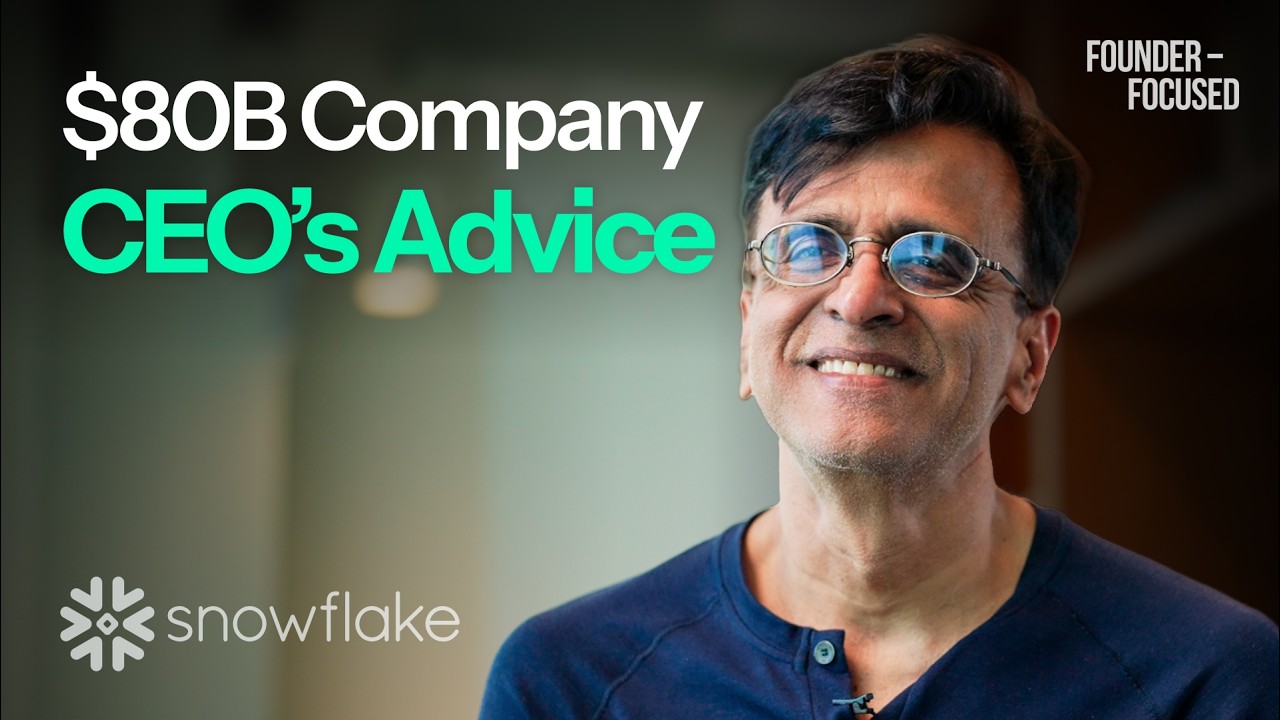
Sridhar Ramaswamy, CEO of Snowflake and former Google ads leader, shares his career journey from a PhD in the US to founding the search startup Neeva (which failed) and leading Snowflake, framing the conversation around finding resonant work, leading through rapid AI-driven change, and building resilience through failure.
Finding Work That Makes Time Stand Still
Ramaswamy grew up in South India and came to the US for a PhD, but realized he wasn’t passionate about research itself.
He advises people to work on something that “makes time stand still” — where you’re happy to spend more and more time doing it.
After 10 years in research, he deliberately reinvented himself as a software engineer because he loved the act of creation and building tangible systems.
His success at Google came from combining software craft with business impact, particularly on the search ads team where technology directly drove enormous revenue.
Reinventing Himself as a Software Engineer
He views career growth as a combination of being at the right place at the right time and finding work that is truly resonant.
Mentors like Google’s founders and Bill Campbell (“the coach”) shaped his approach.
A key lesson: every job has its own definition of excellence; figure out what that is, learn from people who know, and aspire to match the best.
As a first-time public-company CEO at Snowflake, he had to learn new skills like working with financial analysts — and he embraced that learning.
Leadership Principles for the AI Era
Ramaswamy calls himself a “reluctant leader” who didn’t start his career aiming for leadership but saw its organizational impact.
Leadership is not just people management; leaders are cultural icons who set the tone for what is valued.
He emphasizes being hands-on and knowing the details, treating software engineering as a craft that makes a difference to customers.
Great products are the best defense, especially when everything is changing — leaders must obsess over product quality and understand what “great” looks like today and tomorrow.
Why Great Leaders Stay Close to the Product
High-quality, competitively priced products are the ultimate defensibility; taking care of customers when things go wrong builds lasting loyalty.
The most important job of a leader is bringing people in, helping them grow, and helping them thrive.
He hires for “driven and malleable” — people who will go the extra mile to learn and adapt, because skills that were valuable yesterday may be automated by AI today.
Leaders must nurture talent, give opportunity, protect teams when things go wrong, and share credit generously when things go well.
Credit is never diluted by sharing; good leaders stand in front during failures and say “this is my responsibility.”
Hiring People Who Can Adapt
He sets a very high bar and is a demanding boss, but always in service of making the team and company better.
Transparency and direct feedback — giving and receiving — create an environment where things get done quickly and improvement accelerates.
An open culture where feedback is treated as a gift enables rapid organizational learning.
From Google’s $100B Plan to Founder Failure
In 2007-08, Eric Schmidt tasked Ramaswamy and others with writing a $100B revenue plan, which seemed preposterous at the time.
The real crisis came when desktop query growth flatlined as PC sales stopped; mobile search grew but monetized at a fraction of desktop.
It took 5 years to bring mobile monetization to parity with desktop, which powered Google’s growth through 2015 and beyond.
The journey looked smooth from outside but was “an ocean full of big turbulence”; they improved query monetization ~5% per quarter to compound growth.
When Mobile Almost Broke Google’s Business
Big achievements like hitting $100B revenue and becoming SVP of Ads & Commerce eventually prompted Ramaswamy to seek a different challenge.
The success gave him both pressure and freedom to start something new.
Why He Left Google to Build Neeva
He founded Neeva on the thesis that a free search engine could be better than Google’s ad-supported model.
In retrospect, the biggest mistake was not setting the bar at 10x better than Google — the product was only “a little bit better.”
Google’s massive distribution (paying browsers, default positions) meant a 10x product was necessary for adoption; AI hadn’t yet arrived to enable that leap.
Why Neeva Failed and What He Learned
He considers ChatGPT the true successor to Google for information retrieval, citing its ability to solve nuanced problems (e.g., diagnosing a broken coffee grinder from a photo).
His message to founders: believe you can do something better, but ensure there’s a compelling reason for users to switch.
At Snowflake, he tells PMs and engineers the bar is “faster, cheaper, better” — ideally all three.
Core principles remain: create value for customers, and leverage the best available models to disrupt how value is created.
How to Keep Building After Failure
His aspiration: in 10 years, Snowflake becomes an iconic company like Google or AWS, using data and AI to help every enterprise realize its full potential.
The Neeva team that built search and AI features now builds Cortex and Snowflake Intelligence — the seeds of failure became the foundation for Snowflake’s AI future.
You Are More Than Your Failures (and Successes)
Failure is hard, like a deep gash — you can deal with it, but it still hurts. Dealing with it makes you try harder and appreciate success more.
Every failure carries important lessons, but you must accept failure, accept your humanity, and internalize that you are more than your failures.
He tells his children and himself: “We are more than our successes and we simultaneously are also more than our failures.”
That conviction lets you believe in life, act with purpose, and cherish successes precisely because you understand how amazing and unusual they are.