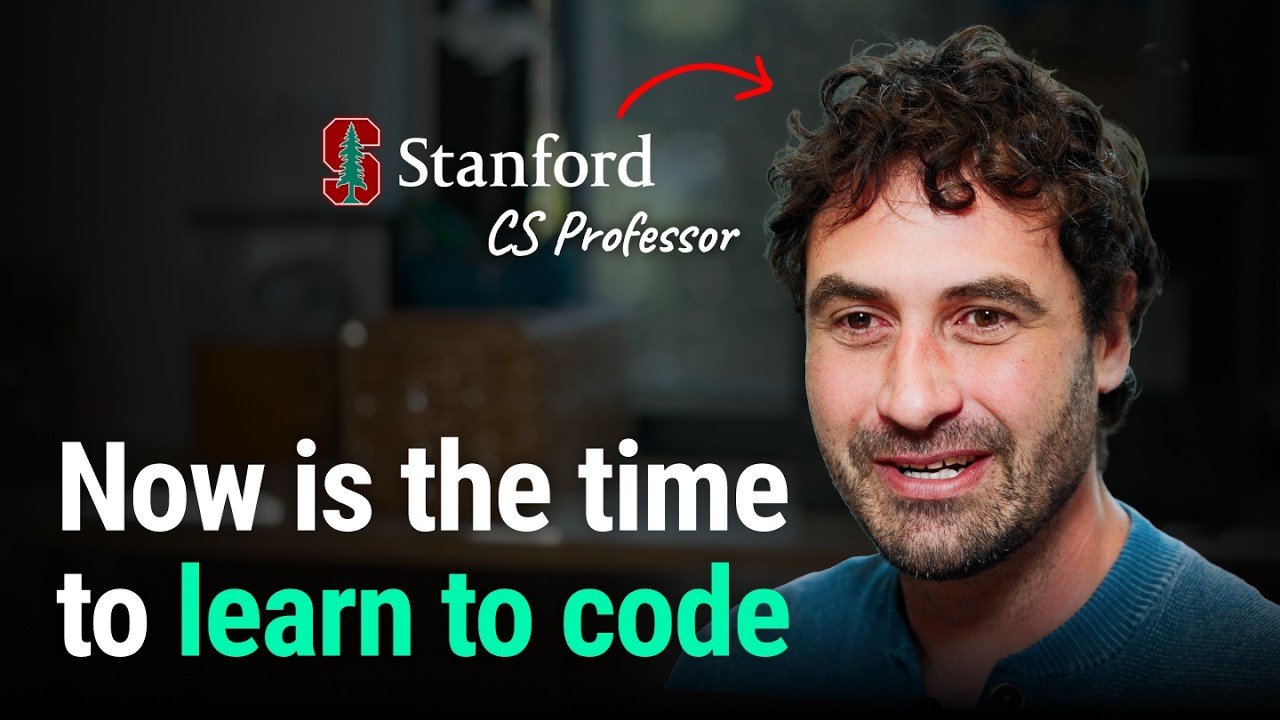
Chris Piech, a Stanford computer science professor who teaches large introductory programming and math-for-AI courses, argues that despite AI’s growing ability to write code, learning to program remains essential because it builds problem-solving ability and foundational thinking that AI amplifies rather than replaces. He draws on six years of running Code in Place — a free online course with ~17,000 students and 1,000+ volunteer teachers — to show that human connection, not just information delivery, drives learning, and that students who outsource too much thinking to AI risk losing the architectural judgment they need to debug, iterate, and design systems.
The motivational crisis facing students today
Students are experiencing a motivational crisis because they must plan four-year degrees for a 2030 job market shaped by AI that is four years more advanced than today’s, creating deep uncertainty about which skills will remain valuable.
Piech empathizes with this uncertainty but notes that predictions about future jobs have always been wrong; he cites the 2011–2012 self-driving car milestones that led many to predict the rapid demise of truck driving, yet the profession has grown steadily because of long-tail edge cases and the need for human responsibility over valuable cargo.
The core fear: if you outsource too much thinking to AI — writing essays, coding, reasoning — you may lose the ability to do that thinking yourself, and the inflection point where you can no longer reclaim it is invisible until it’s too late.
Piech advises self-awareness: use AI tools, but constantly ask whether you are growing alongside them or merely offloading the cognitive work that builds expertise.
Code in Place: human teachers outperform AI tutors on motivation
Code in Place was born during the pandemic when Piech asked whether Stanford’s “special sauce” — section leaders (near-peer mentors who guide small groups) — could be scaled globally; the program now runs with a 10:1 student-to-teacher ratio.
Experiments over six years showed that simply giving learners an AI chatbot for help increased dropout rates; the AI was factually correct but demotivating, while a human teacher popping up for a 10-minute session raised a student’s completion probability by 10 percentage points.
The human advantage is not accuracy — the AI rarely hallucinated on intro programming — but motivation: a human signals “I care about you becoming a smart person,” which ignites the curiosity and effort that drive learning.
Piech’s current model: build foundations first with human support, then teach students how to code with AI; this sequence works far better than throwing AI at beginners immediately.
Learning to code in the AI era: problem-solving over syntax
Programming teaches two things: syntax (how to instruct computers) and problem-solving (decomposing problems, structuring data for algorithms, algorithmic thinking); AI is rapidly mastering syntax, so the durable value is problem-solving.
Code provides immediate, falsifiable feedback — if your logic is wrong, the program fails — creating a tight iteration loop that accelerates skill development far more than life decisions with slow, noisy feedback cycles.
Becoming a high-contribution engineer still requires “time on task” — actual hours creating things, not just prompting Claude Code; Piech suggests using AI to prototype rapidly and asking it to teach you the key concepts behind each prototype, turning AI into a tutor for the architecture you’re building.
Barriers to entry have collapsed: an 18-year-old with a friend can now build a production-quality startup; the high-leverage skill is identifying valuable problems — what users actually need — and translating human problems into software, data, or research solutions, a skill junior engineers should cultivate immediately.
Axiom: the next generation will be smarter than us
Piech adopts as a working axiom that the next generation will be smarter than the current one; from that premise, skipping foundations (in CS, probability, writing) makes no sense — just as calculators didn’t eliminate the need to understand multiplication.
Foundations can be taught more artfully (less rote memorization, more conceptual depth), but they cannot be skipped if the goal is to produce people who can reason, architect, and judge AI output.
A student who thrived in the AI era told Piech he simply doesn’t think about the future of AI — he stays curious and learns; Piech now starts each day with the axiom: “I’m not giving up on the next generation being smart,” and urges students to adopt the same stance for themselves.
The best engineers of the future may not be those who know the most syntax, but those who can bridge real-world human problems into computational solutions; the path there is to “go make stuff” that people use and love, iterating toward excellence in both coding and problem-solving.