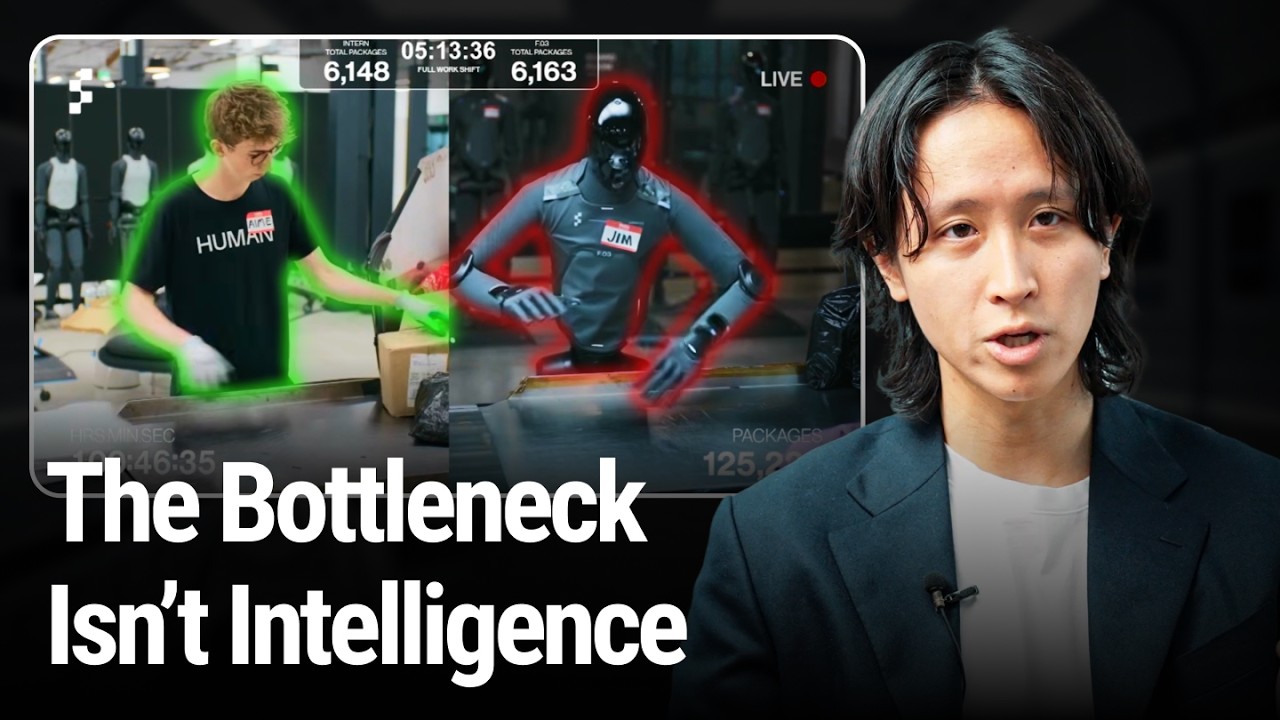
Andrew Kang, CEO of Robo Strategy (a NASDAQ-listed venture fund focused exclusively on robotics and physical AI), explains why humanoid robotics is approaching an inflection point, what the real bottlenecks are, and where the investment opportunities lie.
The Figure AI live stream proved humanoid robots are real and durable
The 8–10 hour live stream (eventually running 8 days) was not a cherry-picked demo; it showed sustained operation in real time.
The human competitor won by a small margin but ended with blistered hands and exhaustion — highlighting that robots can already match or exceed human endurance on repetitive physical tasks.
Kang estimates humanoid intelligence will be “good enough for most daily tasks” in roughly 2–3 years.
Robo Strategy’s investment thesis centers on vertically integrated companies
Portfolio includes Figure AI, Apptronik, Sanctuary Robotics, Center Bots (industrial arms/cobots), and Path Robotics (welding).
The Figure AI investment was non-consensus: other frontier-tech VCs doubted humanoid robotics could produce venture-scale outcomes soon.
Kang’s conviction came from assessing the team’s rare combination of hardware engineering, robot learning, hand engineering, controls, and fleet management — a full-stack capability set few competitors possess.
The fund operates with “high conviction, strong beliefs loosely held,” continuously re-evaluating against the pace of development across the entire field.
Co-optimizing hardware and models makes training more efficient: e.g., better joint torque sensing improves simulation fidelity and model performance.
Owning manufacturing eliminates supply-chain bottlenecks — critical when demand for robots scales like GPUs did.
Figure, Tesla Optimus, and Apptronik earmark their own factory output for data collection, avoiding dependence on external suppliers who cannot ramp fast enough.
Embodiment-specific data is the primary data bottleneck for robot learning
Models trained on data from one body morphology (e.g., a 7-foot frame) transfer poorly to another; the robot needs data from its own physical form.
Collecting that data at scale requires large fleets of the exact same robot — hence the strategic value of in-house manufacturing.
Teleoperation and autonomous task execution both generate this data, but fleet size is the limiting factor.
Market sizing: tens of trillions in revenue and market cap
Top-down: global physical labor market ~$50 trillion.
Bottom-up: a humanoid leased at ~$50,000/year (comparable to all-in cost of a US worker) × 100,000 units = $5B/year; × 1M units = $50B/year.
Reference points: billions of smartphones, hundreds of millions of cars/PCs produced annually — humanoid volumes could exceed both.
Cheap, abundant labor expands the market further: space construction, data-center buildout (currently constrained by skilled trades), personal assistants for every household.
Intelligence timeline (2–3 years) decouples from manufacturing timeline (longer)
AI research accelerates recursively: better models automate more research, which produces better models faster.
LLM techniques (data annotation pipelines, mid-training, RL) transfer directly to physical AI models.
However, “I can spin up a million chatbot instances instantly; I cannot do that for robots” — factories, supply chains, and component production take years to scale.
Open-source physical AI models will commoditize the intelligence layer in 3–5 years
Open-source LLMs now generate ~25–30% of all tokens; gap to frontier models has shrunk from ~2 years to ~6 months.
For many physical tasks (restocking shelves, assembling a mouse), “Einstein-level” intelligence is unnecessary — good-enough open models will suffice.
Nvidia is a major driver: Nemotron (LLMs), autonomous-vehicle models, and physical AI models (Root, Cosmos, Dream Zero) are open-sourced to protect Nvidia’s hardware moat — if closed labs switch to TPUs or other accelerators, Nvidia loses.
Kang expects the model layer to commoditize; value will shift to deployment, hardware production, and component innovation.
US and China will develop massive, largely independent humanoid industries
Geopolitical drive for self-sufficiency: each bloc wants domestic robot supply chains.
China has deployed billions in direct/indirect government funding; US has precedent (rare earths, Intel CHIPS funding) and will likely follow.
US currently leads on physical intelligence models, but Chinese groups (e.g., Alibaba-affiliated) are near the frontier.
Open-source research circulates across borders; in 5–10 years both ecosystems will be mature and largely self-sustaining.
Application-layer white space is enormous — the “smartphone app” model for robotics
Hardware platforms (Figure, Tesla, Unitree, etc.) enable developers to build skills without building robots: cooking, elder care, agriculture, specialized manufacturing.
Any domain involving physical labor is a potential robot application.
Unitree’s platform strategy (selling robots as research/entertainment platforms now, not perfect products) seeds a developer ecosystem, creates Unitree-specific data flywheels, and locks in downstream model optimization — a strategy US firms have largely avoided.
Portfolio company Dexma pursues a similar platform approach.
The industry is still early; opportunities exist for joining, founding, or investing
Robots today are nowhere near the ubiquity and utility of LLMs like GPT-4 or Opus — the adoption curve is just starting.
First step: deep research, talking to people already in the field.
Building a robotics company is severely underappreciated in difficulty
Not a software startup: requires decades-deep expertise across mechanical design, electrical engineering, high-rate manufacturing, real-world deployment, and fleet operations.
Influx of capital and founders will produce many failures; successful teams need veterans from established manufacturing and robotics environments.
Kang cautions against underestimating the multidisciplinary execution burden.