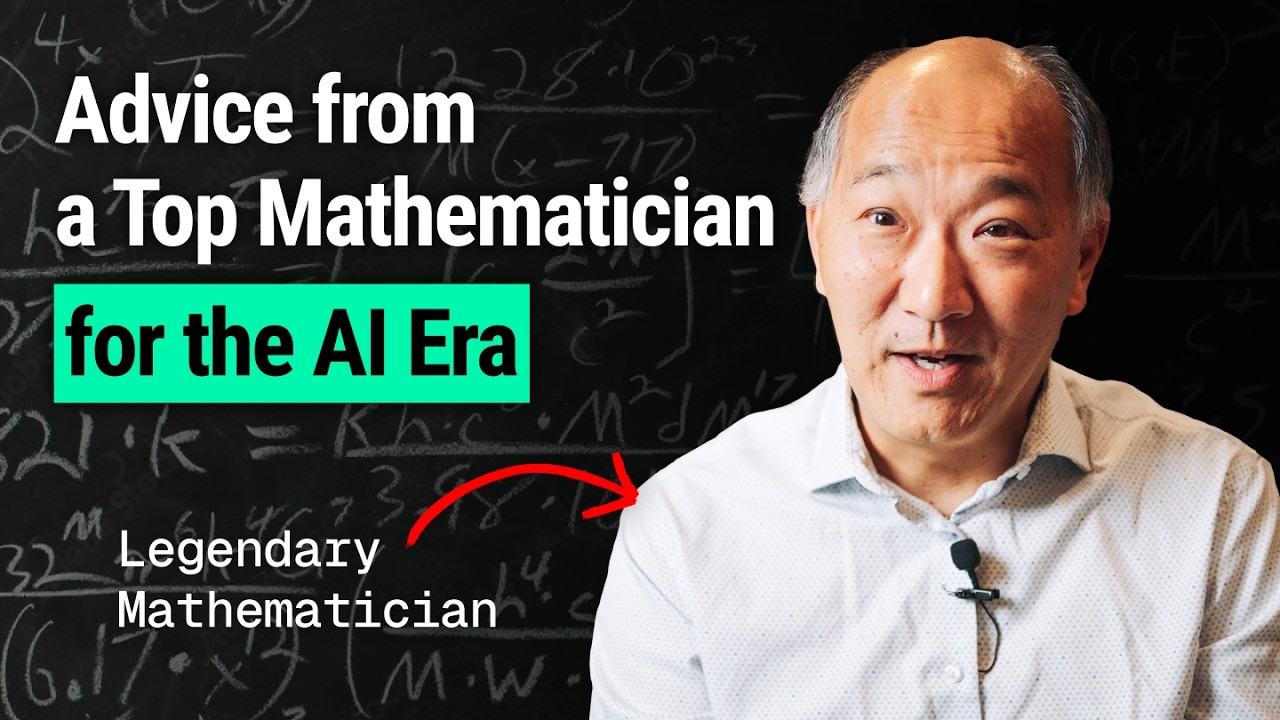
Ken Ono is a mathematician and founder of Axiom Math who has spent his career studying creativity, genius, and how humans think. A year ago, his world shifted when he encountered frontier large language models (LLMs) through the FrontierMath program run by Epoch AI in Berkeley, which hired professional mathematicians worldwide to build extremely hard math questions to benchmark LLM capabilities. For the first time, he struggled to write problems that ChatGPT would get wrong. This shook him: these models know more facts than any human alive. But he now believes the question “How do I stay ahead of AI?” is the wrong one.
What AI Changes About Knowledge and Education
Knowledge is becoming cheap, but knowing how to use and verify it is becoming expensive. LLMs should be thought of as the world’s most extraordinary librarians — if something has been written, posted on YouTube, or published in a newspaper, the model has likely already seen it. Competing with that breadth of information is futile.
What remains uniquely human is not recall but reasoning, creativity, and the ability to forge new concepts. Can you generate ideas? Can you connect concepts at a deep level? Can you build something from scratch — a gadget, a computer program, an entirely new field of science? That deeper intelligence is not the same as factual knowledge, and schools at any level are not good at recognizing it.
The real value of education is shifting. A year at an American university can cost $80,000. Almost everything taught academically — book by book — can be learned from an LLM, at your own pace, possibly faster. What you cannot get from a machine is the human element: how to ask the right questions, what the next important questions in a field might be. That is why colleges and professors still matter, but almost everything else — tutoring, precise learning with AI assistance — suggests we are not yet educating our children as well as we could.
The current education system is broken in a specific way. Students in middle school and high school are stressed about getting into the right schools, the right test scores. They carry enormous debt — $150,000 from college, then $200,000 more from professional school — and three years later discover they cannot even look at blood, but cannot change careers because of the debt. That cycle is a kind of hell. Education should begin with inspiring people to learn about the world they live in — its cultures, its wonders — not with checkbox credentials.
Ramanujan and the Genius the System Misses
Ken Ono’s personal story is deeply tied to Srinivasa Ramanujan, the self-taught Indian mathematical genius. Ono is the son of a Japanese mathematician who grew up during World War II and saw Ramanujan as a symbol of hope — proof that someone who failed college twice could still change mathematics forever. When Ono was a rebellious teenager who had dropped out of high school and wanted nothing to do with his parents’ expectations, a letter arrived at his home in April 1984 from Ramanujan’s widow, thanking Ono’s father for a small contribution toward a memorial statue. His father, who almost never showed emotion, was moved to tears. That letter changed Ono’s trajectory.
Ramanujan was a mystic, largely self-taught, who failed college twice because he neglected all subjects except mathematics. He believed a goddess gave him formulas, which he recorded in three notebooks. He died at 32, nearly forgotten. Yet his notebooks contained mathematics that would take the world decades to understand, and the proof of Fermat’s Last Theorem — the biggest mathematical news of the late 20th century — ultimately depended on the very area of mathematics (Galois representations) that grew out of Ramanujan’s work.
Ono’s PhD thesis was based on Ramanujan’s work, specifically Galois representations, and he considers following Ramanujan the best decision of his life. He has spent years running a program called “The Spirit of Ramanujan” to find overlooked talent — people like Karina Hong, his former student and one of the program’s first fellows, who might never have been discovered without it.
There are almost certainly more Ramanujans alive today who never get the chance — perhaps because they lack privilege, not ability. The capacity for genius, or at least deep creativity, exists in all of us. The challenge is giving students of all ages the courage to follow their curiosity and building systems that recognize and nurture it.
What Intelligence Really Is
Ono’s view of intelligence has fundamentally changed. It is not about speed of reasoning or drawing correct conclusions. It is about whether you can forge new concepts, generate ideas, and make deep connections across fields. Pattern recognition that transfers from one domain to another to push a frontier forward — that is intelligence.
Persistence and dedication are also forms of intelligence and talent. The student or employee who becomes an expert in their field through relentless daily learning, who is deeply committed — that too deserves recognition. Ono does not use the word “genius” lightly.
The best scientists should still see the world as marvelous. The best doctors should see their work as service, not as a side project to academic publishing. If we focus too much on metrics, speed, and standardized tests, we cannot train the next Einstein — or the next unknown thinker who, like Ramanujan, is quietly wondering in a laboratory whether something might be true.
Why This Is the Most Exciting Time to Be Human
Ono’s identity has shifted from a carefree professor to someone grappling with what it means to be human in the age of AI. But he has come through the other side: the goal should not be to outrun AI in a race we will lose, like Usain Bolt against a motorcycle. The goal is to do what machines cannot — ask the right questions, feel wonder, connect ideas across domains, and care about the world.
If you are passionate about the world you live in, you will care about climate change, about conflicts between cultures, about injustice. That passion is what makes us human. The challenge now is to preserve the sense of wonder that children have — when everything around them is new — and to build educational and social systems that recognize many forms of intelligence, not just the ones that fit on a test.