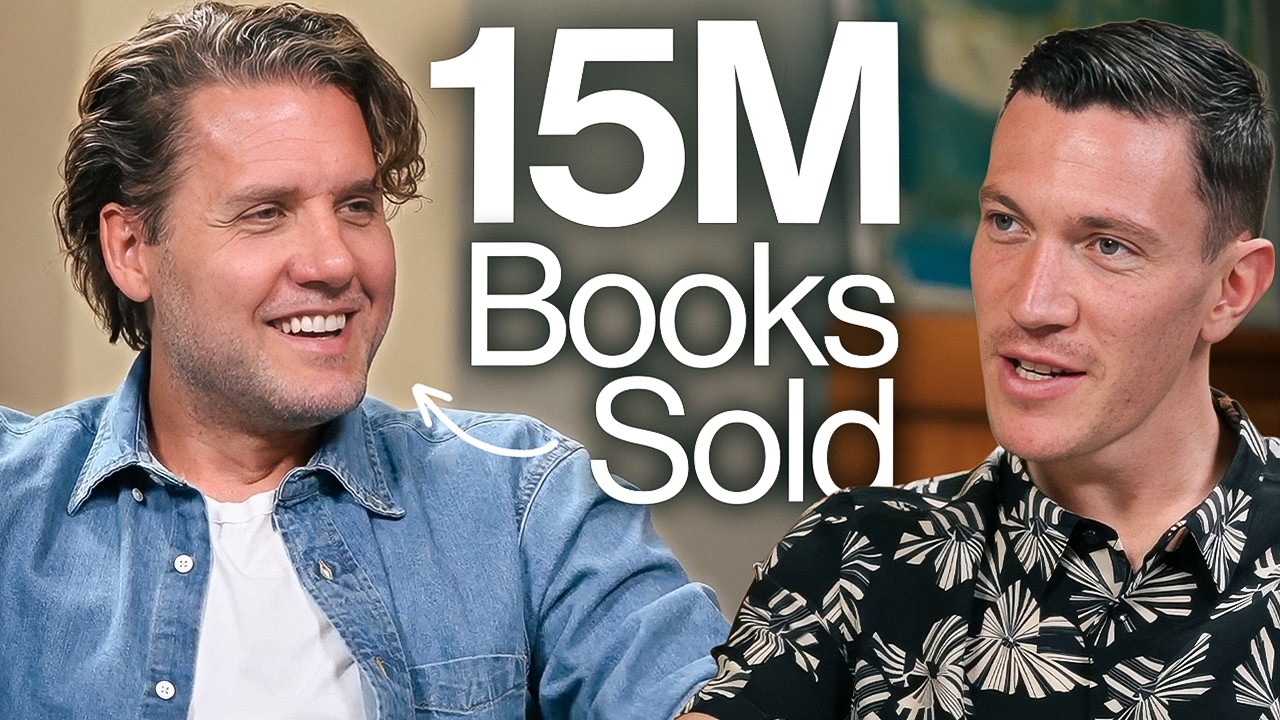
Mark Manson is a writer and blogger whose career evolved from dating advice to personal development and bestselling books like The Subtle Art of Not Giving a F*ck. This episode is a deep dive into his writing philosophy, process, and the lessons he’s learned across two decades of online and mainstream publishing. He emphasizes writing that feels like conversation, prioritizing resonance over rigid truth, and building a brand through authenticity and iteration. His journey—from early internet fame to co-authoring Will Smith’s memoir—illustrates how practical implementation, emotional honesty, and relentless experimentation can turn writing into both an art and a sustainable career.
Early Influences and the Shift to Writing
Manson grew up in a conservative, emotionally repressed environment, which made him introspective and curious about human behavior.
He turned to philosophy in high school, reading Nietzsche, Ayn Rand, and Anton LaVey, seeking intellectual challenge and alternative worldviews.
Stephen King’s It was the first book that showed him reading could be deeply enjoyable and immersive.
He started writing on internet forums as a teenager, treating argumentative essays as entertainment.
Blogging began as a marketing tool for his online businesses, but he soon realized writing was his natural strength while sales and strategy felt like forced labor.
The turning point came when he read David Foster Wallace’s essay “A Supposedly Fun Thing I’ll Never Do Again.”
Wallace’s extreme descriptiveness, observational depth, and ability to find profound meaning in mundane details (like cruise ship room cleaning protocols) blew Manson’s mind.
That essay made him want to become a writer—not just a blogger—but someone who could give readers that same visceral, insightful experience.
From Blogger to Brand
Manson’s blog exploded between 2012 and 2015, growing from 100,000 to 2.5 million monthly readers by mastering Facebook’s algorithm.
He studied copywriting principles and applied them to social media headlines and images, treating each post like a sales pitch.
Titles became half the work—he’d often start with a compelling headline, then reverse-engineer the content to justify it.
His brand evolved organically: dating advice → self-help → stoicism-infused personal development.
He noticed readers’ “dating problems” were really about self-esteem, identity, and life structure—so he shifted focus to root causes.
Articles like “Stop Trying to Be Happy” and “Choose Your Struggles” resonated because they voiced unspoken frustrations of his generation.
Brand decisions were often accidental but intentional in hindsight.
The iconic red asterisk/splat on Subtle Art’s cover was a Photoshop experiment he created on a plane; it stuck because it felt uniquely his.
He tests ideas in concentric circles: first himself (must excite him), then trusted inner circle, then audience feedback.
Writing Philosophy and Process
Voice: Manson writes as if talking to a friend at a bar—conversational, unfiltered, sometimes tipsy-sounding.
He imagines explaining ideas aloud and transcribes that tone directly.
Criticism comparing him to “a drunk guy lecturing at 2 a.m.” is wear as a compliment—it means he’s achieved his desired voice.
Structure: He uses Scrivener for early drafting because it allows easy reorganization of chapters and ideas.
Once the structure is solid, he moves to Word for polishing and formatting.
Introductions are often written last; he frequently cuts opening paragraphs after realizing they’re unnecessary.
Editing: The first three chapters of any book expose flaws in the original outline.
He expects to rewrite or restructure heavily around chapter 3–4, discarding early drafts and reworking the entire arc.
Writer’s block usually stems from self-imposed expectations—he advises writing “for fun, as if no one will read it.”
Ideas: Strong ideas write themselves; weak ideas can’t be saved by beautiful prose.
He looks for ideas that surprise people at dinner tables—“I’ve never heard that before” signals a winner.
Creativity thrives when judgment is suspended; working on unrelated projects often sparks usable insights.
Medium-Specific Lessons
Audiobooks: The Subtle Art succeeded on Audible almost by accident.
He chose narrator Roger Wayne based solely on voice (dry, deadpan, barfly-like), unaware Wayne specialized in romance novels.
The audiobook’s success drove hardcover sales, proving audio’s growing influence.
YouTube & New Mediums: He underestimates new formats consistently.
For his Audible Original Love Is Not Enough, he assumed raw coaching conversations would carry the book—but realized even great moments need narrative structure and thematic cohesion.
“Having 100 great ideas doesn’t mean you have a book.”
SEO: He was bad at SEO but benefited indirectly—viral social media posts generated backlinks that boosted search rankings.
Collaboration and Biography: Working with Will Smith
Will Smith reached out because he wanted a memoir with life lessons, not just stories.
Smith excels at micro-stories (e.g., auditioning for Fresh Prince) but struggles with macro-themes and structure.
Manson’s role was to organize Smith’s experiences into a coherent emotional arc: fear → anger → pride → guilt → love.
Their process:
Manson shadowed Smith for two years, conducting interviews, visiting his childhood home in West Philly, meeting family, and reviewing archives.
He took videos and photos to capture sensory details (e.g., gospel music echoing off wooden church beams).
Smith drew floor plans of his childhood home to help Manson visualize scenes.
Division of labor:
Manson wrote the first draft; Smith revised it in his own voice, adding flair and exaggeration; Manson did a final polish.
Smith was deeply involved—unlike many celebrity authors—spending months refining his sections.
Key insight: Charisma and emotional intelligence are Smith’s superpowers; Manson’s job was to channel them into written form without imitation.
On Style, Taste, and Originality
Developing a authentic voice takes time—like Miles Davis said, “It takes a long time to play like yourself.”
Early on, writers imitate others; only by trying on different “masks” do they discover what feels genuinely theirs.
Manson embraces being criticized for being himself rather than praised for being someone else.
He prioritizes resonance over strict truth when storytelling.
Example: In Subtle Art, he simplified a Japanese man’s complex relocation history to “left Japan forever” because it was more impactful—even though it wasn’t literally true.
To avoid echo-chamber thinking, he reads widely outside self-help: fiction, economics, history.
Cross-disciplinary analogies spark original ideas (e.g., applying market dynamics to internal identity conflicts).
Practical Advice for Writers
Write 100 posts before asking for advice—most beginners haven’t written enough to know their voice or audience.
Content first, brand second—figure out what you’re great at making before worrying about image.
Read books, not blogs—blogs reflect the zeitgeist; books offer deeper, more original thinking.
Optimize for quality traffic, not vanity metrics—build a small, engaged audience before scaling.
Remove expectations to beat writer’s block—write freely, without judgment, and let relevance emerge naturally.
Final Thought
Great writing feels like eavesdropping on a smart, honest friend. It’s not about perfection—it’s about presence, clarity, and the courage to say what others are thinking but won’t voice.