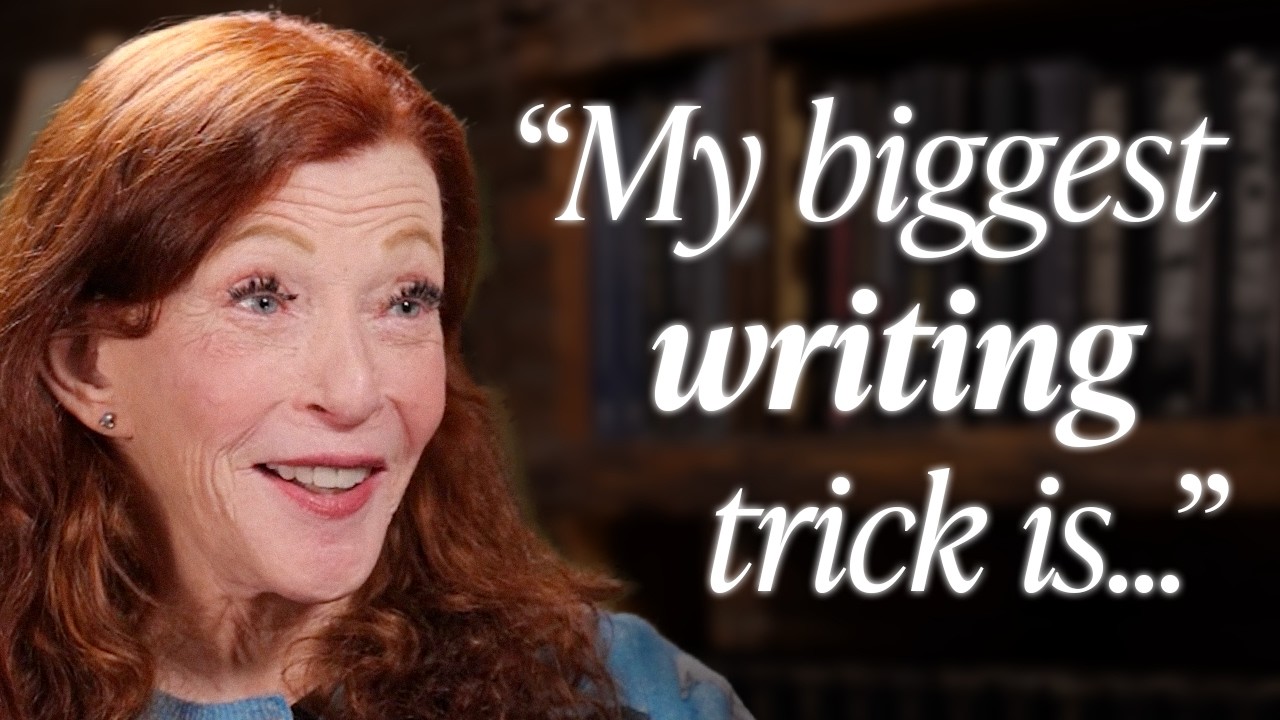
- Susan Orlean is an award-winning nonfiction writer known for books like The Orchid Thief and The Library Book, who writes narrative nonfiction that reads like fiction, in the tradition of Joan Didion and Tom Wolfe. What sets her apart is how intentional and methodical she is about every phase of her writing process, from research to structure to editing. This episode is a deep dive into how she chooses stories, structures them, writes them, and ruthlessly edits them, along with the lessons she’s learned over decades.
How Susan Structures a Story Using Index Cards
- For her last several books, Orlean has used a system of 5x8 index cards to organize all her research material before writing a single word of the narrative.
- For The Library Book and Rin Tin Tin, she had roughly 700 index cards.
- Each card holds a “chunk of thought”—this can be as small as a single detail (a dog’s name, a specific fact) or as large as a reference to an entire legal document or source file.
- The physical act of moving the cards around on a large open surface is central to her process. It forces her to reacquaint herself with the material, see connections, and identify themes.
- She organizes thematically first (e.g., all the fire/arson cards together, all the library history cards together), then builds connective tissue between those thematic chunks to create a narrative arc.
- The key insight: organizing information thematically reveals the story within it, rather than forcing a strictly chronological approach.
The Art of the Lead: Hooking the Reader
- Orlean considers the lead—the opening of a story—the most important element, especially now when attention spans are short and readers have endless alternatives.
- Most of the time, she’s writing about subjects readers don’t think they need to know about (orchid poaching, library fires, a 1950s TV dog). Her job is to overcome the reader’s initial indifference.
- She uses the opening of The Orchid Thief as a model: a vivid, slightly jarring physical description of John Laroche that ends with the unexpected detail that he’s missing all his front teeth. The goal is to make the reader say “Wait, what?”—which means they’ll keep reading.
- Her philosophy: people are interested in people. Even if the subject seems obscure, anchoring it in a compelling character pulls readers in.
- She sees herself as being in the same position as the reader—slightly ahead, discovering the story in real time, then turning back to say, “Keep going, you won’t believe what I found.”
How She Chooses What Stories to Tell
- Orlean deliberately chooses subjects that haven’t had a spotlight on them—not celebrities, elections, or wars that already have built-in audiences. This means she has to be “extremely seductive” as a writer.
- The essential criterion: she must be genuinely, intensely fascinated by the subject. She doesn’t write about things she already has a hobbyist interest in; she discovers her fascination through the reporting process.
- A good book subject needs dimensionality and depth—it must function like a prism that can be turned in many directions, revealing connections to bigger themes (war, Hollywood history, animal breeding, American culture).
- Rin Tin Tin seemed like a trivial subject (a 1950s TV show), but it opened into World War I, the German Shepherd breed’s cultural history, the founding of Warner Brothers, silent film, vaudeville, and the evolution of modern Hollywood.
- She’s skeptical of prescriptive rules about what makes a good book idea, but emphasizes that the writer must be in love with the subject to sustain the effort over what can be six to eight years.
The Challenge of Writing a Memoir
- Writing her memoir, Joyride, was fundamentally different from her other books because she couldn’t experience the discovery process that normally drives her work.
- In her other books, she stumbles into a new world and experiences it alongside the reader. With a memoir, she already knew the story—she was the story.
- To recreate that sense of discovery, she hired a journalist friend to interview her, with no predetermined questions. Hearing herself tell her story to someone else helped her see her own life as if she were meeting a stranger.
- The interviews also helped her identify which parts of her life might interest others, pushing beyond the “abbreviated life history” everyone carries in their head.
How She Got Her First Book Deal
- Orlean’s path to her first book contract illustrates the importance of authentic passion over marketable ideas.
- Early in her career, she approached an agent with 12 book ideas, most of them weak. She didn’t yet understand what made a good book idea.
- One publisher encouraged a marketable idea about following people training for an Ironman triathlon. She wrote a proposal and got enthusiastic rejections—publishers liked her but didn’t bite on the idea.
- One editor, Joanie Evans at Simon & Schuster, asked her directly: “Is this the book you really want to do?” Orlean admitted it wasn’t, then blurted out her real idea: a book about traveling around America and spending Saturday night in different places.
- Evans immediately said yes. Orlean believes Evans sensed the inauthenticity in the triathlon proposal—the spark of “I’m dying to do this” was missing. With the Saturday night idea, the enthusiasm was unmistakable.
- The lesson: publishers can smell when a writer isn’t fully invested, and a young writer who has never written a book needs to be “literally burning with the desire” to do the specific project.
Becoming a Brutal Self-Editor
- Orlean’s evolution as a writer involved learning to edit herself ruthlessly, moving from a young writer who treasured every sentence to one who could cut freely.
- Switching from a typewriter to a computer was transformative. On a typewriter, editing is messy and inconvenient, so you leave things as they are. On a computer, you can experiment fluidly—move a sentence, try it without, put it back.
- Her single biggest editing trick: reading her work out loud. This is an almost foolproof way to catch sentences that don’t work, repetition, and rhythm problems. If she gets bored reading aloud, the reader will be bored too.
- She edits intensely the day before continuing—reading what she wrote the previous day with fresh eyes after sleeping on it.
- She’s developed a genuine love for editing, comparing it to Enzo Ferrari’s philosophy of making every part of a car incrementally better. With her memoir, she read the entire book countless times, each time finding ways to improve it.
- She identifies and removes bad writing habits, such as:
- Overusing “would” as a grammatical crutch (“I would go to the store” instead of “I went to the store”), which makes writing feel passive.
- Using too many adjectives, which dilutes their impact. She prefers one strong, vivid image over a string of mushy descriptors.
- Her broader principle: consolidate power into fewer, stronger punches rather than flooding the reader with information. This applies to both adjectives and examples—one vivid example is more memorable than six.
Her Writing Method: Three Phases
-
Orlean breaks her writing process into three distinct phases:
-
Research and reporting (can last years)
- No writing at all. She’s on the phone, traveling, in libraries, digging through archives.
- Task-based rather than time-based: her goal is to complete specific research tasks (interview the arson investigator, read the legal files), not to work 9-to-5.
- For The Library Book, this phase lasted three to four years. Learning just how arson investigations work took six to eight weeks—and that’s just one piece of one section.
-
Thinking and processing
- Typing up notes, transferring them to index cards, moving cards around, identifying structure.
- No words of the narrative on the page, but she’s digesting what the research means and asking: What’s the lead? What’s the tone? Where does the story start?
-
Writing
- She sets a daily word quota of 1,000 words, five days a week (six if behind). She treats it as a task: “My job today is to tell you 1,000 words of the story.”
- This structure doesn’t kill creativity—it liberates it. Instead of staring into the void of an unfinished book, she has a manageable daily goal.
- She compares it to training for a marathon: you can’t look at the finish line or you’ll panic, but if you run mile by mile at a sustainable pace, you get there.
- The daily quota was suggested by her New Yorker editor when she was overwhelmed by her first book. It removed the mystery and made the process practical.
-
On Structure vs. Spontaneity
- Orlean acknowledges the counterexample of writers like Jack Kerouac, who wrote with wild, passionate spontaneity. She doesn’t believe her method would prevent that kind of energy—it simply provides a framework that works for her temperament.
- She notes that even famously spontaneous artists like Eminem work structured hours (9-to-5), suggesting that discipline and creativity aren’t opposed.
- The quota is like a budget: for some people it’s suffocating, but for many it’s oddly liberating to have clear parameters.
Why Libraries Matter
- Writing The Library Book—about the largest library fire in American history (400,000 books burned, 700,000 damaged)—gave Orlean a deep appreciation for books as humanity’s system of permanent memory.
- Individual memory dies with us. Books preserve the output of minds—technical knowledge, fiction, ideas—across time.
- Libraries have an outsized emotional presence because they safeguard this shared knowledge. They function as a kind of immortal collective memory.
- Orlean pushes back against the narrative that libraries are in decline. While they face the same challenges as cities (homelessness, funding, social friction due to their radical openness), they have adapted admirably—lending ebooks, audiobooks, videos, and computers, and serving as community knowledge centers.
- She encourages people to get a library card and borrow ebooks for free rather than buying Kindle books, noting that popular titles may have waiting lists but are ultimately available.