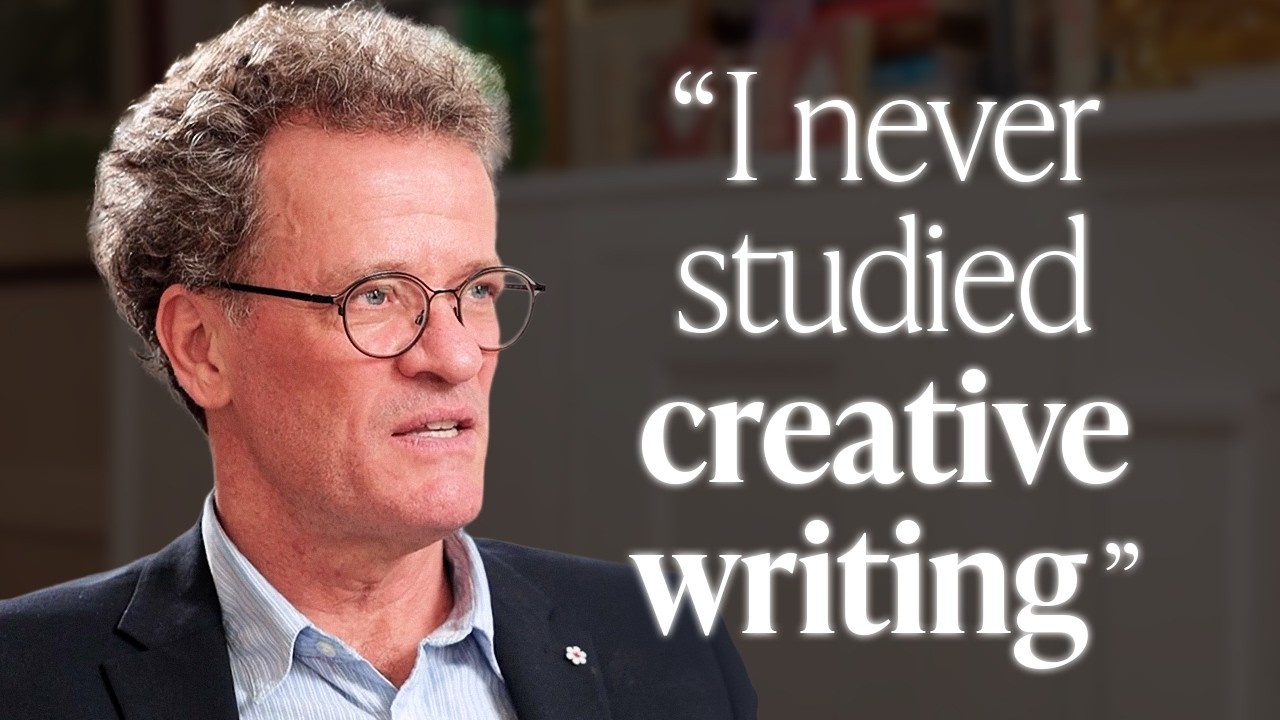
Yann Martel, Booker Prize–winning author of Life of Pi, discusses his unconventional approach to writing, storytelling, and the creative process. He is strikingly well read, deeply interested in religion and philosophy, and has developed a unique analog system for structuring novels. Rather than obsessing over character, he prioritizes ideas, scenes, and especially endings. His method emphasizes co-creation with the reader, leaving space for mystery and imagination.
Martel’s writing process: an analog architecture
Martel uses a physical, envelope-based system to organize his research and scenes before writing.
For Life of Pi, he spent two to two and a half years researching animal behavior, survival at sea, and the religious traditions of Hinduism, Islam, and Christianity.
He took notes in the form of quotes, single words (like “bamboozle”), facts (e.g., types of Pacific turtles), and spontaneous scene ideas.
After accumulating around 400 pages of material, he printed it all out, cut it into fragments, and sorted them into labeled envelopes representing chronological or thematic units—essentially building blocks for chapters.
When writing, he opens an envelope, lays out its contents near his computer, and begins drafting from those snippets, rearranging, discarding, or expanding as needed.
He always knows the ending before he starts: for Life of Pi, he knew from the first sentence that the book would have 100 chapters and that Chapter 100 would be an investigator’s report on a shipwreck.
The envelopes can shift position—some scenes, like when Pi sees a whale, are movable—but key structural elements, like the final chapter, are fixed from the outset.
This system gives him direction while leaving room for spontaneity, likening the process to planning a trip with reservations but allowing for unexpected discoveries along the way.
Scenes as the unit of story
Martel thinks of stories as composed of discrete scenes—“little bits of unity of time, action, and place.”
Each envelope typically contains one or more scenes.
Chapters may contain multiple scenes or, in simpler cases like the author’s note in Life of Pi, just one.
He compares arranging scenes to playing with cards, reordering them for maximum effect.
He values concision in scenes, echoing Hollywood’s advice to “get in as late as possible and leave as early as possible,” so the reader’s imagination is engaged rather than overwhelmed.
Books vs. movies: co-creation and subjectivity
Martel sees reading as an act of co-creation between writer and reader, unlike film, which supplies everything visually and emotionally.
When reading, the reader mentally constructs characters, settings, and emotions, making the experience deeply personal.
Two people can read the same book and have entirely different reactions—one loving it, the other hating it—because each brings their own subjectivity.
Movies, by contrast, limit subjectivity; most viewers experience the same visuals and emotional cues (e.g., music signaling danger).
He cites The Great Gatsby as a book he feels he co-created with Fitzgerald, whereas film adaptations are merely witnessed.
He admires films that leave room for interpretation—like French art films—over those that over-explain, such as many Netflix productions.
He acknowledges that books lack the unifying power of songs or national anthems; literature is inherently private and diverse in its reception.
Why animals make powerful characters
Martel frequently uses animals as characters because they are versatile, engaging, and free from human prejudices.
People rarely suspend disbelief with animal characters the way they do with humans from specific regions or backgrounds.
In Beatrice and Virgil, an allegory of the Holocaust, he pairs a howler monkey and a donkey to represent Jewish resilience and creativity without directly depicting human suffering.
Animals also provide emotional distance, enabling discussion of heavy topics like genocide with a lightness that avoids repetition and fatigue.
He references Kafka’s The Metamorphosis, Jack London, and Orwell’s Animal Farm as examples of animals used to explore complex human themes.
In Son of Nobody, a dog’s desperate need as its owner leaves allows Martel to convey abandonment more powerfully than a human character could without seeming melodramatic.
Crafting openings and emotional investment
Martel does not follow a fixed formula for opening a book.
Some great novels begin with bold lines (“Call me Ishmael”), others with slow scene-setting or dialogue.
He admits he never liked the first sentence of Life of Pi (“This story was born as I was hungry”) but kept it because he couldn’t think of anything better.
What matters most is drawing the reader in through character, language, or action—sometimes via dialogue that plunges the reader in media res.
He values emotional investment over plot mechanics, praising Agatha Christie for crafting mysteries so artful that readers miss obvious clues until the reveal.
He prefers focused, intimate stories—like Yukio Mishima’s The Sailor Who Fell from Grace with the Sea or Knut Hamsun’s Hunger—that reflect the universe through a single consciousness rather than sprawling epics.
He connects art and religion as forms of “magical thinking” that transcend rationality to evoke the sublime—a sense of awe beyond comprehension.
Punctuation as rhythm
Martel views punctuation as the primary tool for controlling rhythm and tempo in prose, akin to musical notation.
The comma is the most important and difficult mark: too few create confusion, too many disrupt flow. He likens it to a drummer setting the beat.
He uses commas extensively in his recent novel Son of Nobody, where each chapter is a single sentence with paragraph breaks but only one period at the end.
He varies sentence length deliberately, avoiding monotony—using short, medium, and long sentences in sequence like an accordion.
He teaches a technique called “reading the right edge”: stacking sentences vertically to visually assess their length variation and improve rhythm.
He is sparing with exclamation marks (which he sees as manipulative), cautious with semicolons, and enjoys playing with parentheses and em dashes.
He rejects rigid rules about description (e.g., “pan left to right”), believing they stifle creativity.
Breaking rules deliberately
Martel believes writers should understand conventions in order to break them artfully.
He compares this to the “rule of thirds” in photography: knowing the rule allows you to violate it intentionally.
He experiments with form, such as floating dialogue across the page in Life of Pi to visually represent two blind men’s boats drifting together—but abandoned the idea after his editor called it self-indulgent.
He warns against breaking all rules at once, citing the French nouveau roman movement as an example of experimentation that became tiresome.
His guiding principle is whether the text “comes alive” to him as the first reader; if it does, he trusts others will respond similarly.
On AI and authenticity
Martel refuses to use AI for creative work, comparing it to hiring someone to have sex on your behalf.
He accepts AI for non-creative tasks like drafting governance documents or medical diagnostics.
He values human imperfection in art because it fosters genuine connection; a heartfelt, typo-ridden wedding note from a friend means more than a flawless AI-generated one.
He argues that once audiences know something is AI-generated, its value diminishes—like special effects in movies, which have become so common they no longer impress.
He believes publishers and readers will reject heavily AI-written books, as seen in a recent scandal where an AI-assisted novel was pulled from the market.
He doubts AI will force writers into esoteric styles to prove their humanity, because reading requires active engagement, and readers won’t tolerate deliberate weirdness just to contrast with machine prose.
Genre fiction vs. literary fiction
Martel distinguishes genre fiction by its adherence to reader expectations and literary fiction by its freedom from rules.
Genre fiction—romance, mystery, sci-fi—delivers a familiar product: love triumphs, murder is solved, technology shapes alternate realities. It comforts.
Literary fiction has no fixed parameters; it can go anywhere, disturb, confuse, or enlighten. It risks failure but offers deeper rewards.
He cites Tolstoy’s The Death of Ivan Ilyich as a literary work that speaks universally, unlike genre fiction, which targets specific audiences.
He sees both as necessary: people need both Michelin-star meals and junk food.
He notes that even non-fiction can function as a product—solving a problem in pill-like form—citing the massive success of certain self-help books.
Reviews and detachment
Martel reads reviews only superficially, categorizing them into four types:
Positive for the right reasons (validating),
Positive for the wrong reasons (misunderstood),
Negative for the wrong reasons (annoying),
Negative for the right reasons (painful but possibly true).
He avoids deep engagement with any review, believing art is a gift offered without expectation of return.
He practices “passionate detachment”: giving fully to the work, then releasing it to the world.
He resists interpreting his own books for readers, insisting that meaning is co-created. When asked what the island in Life of Pi means, he asks, “What does it mean to you?”
Lessons from plays
Martel began his writing life attempting plays after being inspired by Warren Beatty’s film Reds, in which Jack Nicholson plays playwright Eugene O’Neill.
He wrote several bad plays before switching to prose, finding dialogue-only storytelling too constraining.
However, he retains a love for the spareness and orality of theater—the idea that a stage exists in the mind, portable and minimal.
This influence appears in Beatrice and Virgil, which includes a play, and in his focus on dialogue that conveys emotion and information without artificiality.
Character as vessel, not spectacle
Martel deliberately avoids describing his characters’ physical appearances, believing words are poor at visual description and prone to caricature.
He sees characters as vessels through which readers experience extraordinary events.
Pi in Life of Pi and Harlo Dunn in Son of Nobody are ordinary people facing shipwrecks or personal collapse—not quirky or disabled or otherwise marked.
He finds it more powerful when the extraordinary happens to the normal, because readers identify with normality.
His interest lies in what characters observe and feel, not how they look.
What makes a good extraordinary moment
Martel identifies two kinds of “moments of wonder” in storytelling:
Intellectual illumination: realizing something profound, such as the fact that foundational Western stories (the Gospels, the Iliad) have no verifiable facts attached to them, yet endure because of their narrative power. Facts alone don’t create lasting stories; story does.
Emotional intensity: spontaneous discoveries while writing, like the tiger in Life of Pi walking away without saying goodbye. This moment devastates Pi and moves readers because it reflects the animal’s indifference and the end of a shared journey—unplanned but emotionally inevitable.
He also values formal innovation, such as elevating footnotes in Son of Nobody to tell a parallel story, reflecting his belief that “we are all footnotes to a greater story.”
The art of the ending
Martel finds endings easier than beginnings and always knows his final destination before writing.
A good ending provides closure without resolving everything—it should be surprising in the moment but inevitable in retrospect.
He wants readers to feel their expectations were met while still pondering mysteries.
In genre fiction, endings must fulfill clear promises (e.g., the murderer is caught); in literary fiction, they must resolve emotional and thematic arcs while preserving wonder.
He praises the ending of Moby Dick—the image of the ocean endlessly rolling—as a perfect blend of resolution and mystery.
He cites Kafka’s The Metamorphosis as a model: Gregor Samsa dies (resolution), but the absurdity of his transformation lingers (mystery), making the story live on in the reader’s mind.
Why artists can’t be indifferent
Artists must be passionate about their subjects, but that passion doesn’t qualify them to opine on politics or technology.
Martel sees artists as solitary agents with no obligation to anyone but themselves—free to shock, delight, or provoke.
This freedom is why tyrants fear artists: they speak without constituency or constraint.
However, this same independence means artists’ opinions on public matters are no more valid than anyone else’s.
Art thrives on freedom; governance requires cohesion. The two should not be confused.